🇺🇸 U.S. HISTORY
🏛️ Maritime Sovereignty Conflict & National Anthem Origin • 1812–1815
VA History & Social Science SOL K.1, 1.2, 2.4, VS.1–VS.10, USI & USII
War of 1812 & Star-Spangled Banner
Dawn Over Fort McHenry and Our National Anthem
Grade 1 • Early Reader • 65 words
⏳ Era / StatehoodConflict: 1812–1815 (Fort McHenry: September 13–14, 1814)
🗺️ Region / CapitalBaltimore Harbor, Maryland & Washington, D.C.
📜 Key MilestoneSecured U.S. Independence & Inspired Francis Scott Key's Anthem
⚡ Historical SparkKept a giant thirty-by-forty-two-foot flag flying through a stormy night
🤯 Mind-Blowing Fact • Grade 1
The real Star-Spangled Banner sewed in Baltimore was as tall as a three-story house—thirty feet high and forty-two feet wide!
✨ Word Sparks (Grade 1 Glossary)
Tap 🔊 to hear
anthem
Official patriotic song representing a whole country
fort
Strong brick and earth building defending a harbor
spangled
Decorated with bright, shining stars
🪝
Have you ever wondered what 'by the dawn's early light' really means?
1
Boom Through the Rainy Night
Boom! Bright red rockets flash across dark rainy clouds. Out on a boat, Francis Scott Key watches McHenry all night long.
2
A Giant Flag Still There
During the War of 1812, British ships tried to capture Baltimore in 1814. At sunrise, a huge fifteen-star American flag waved proudly above the !
3
Our National Song
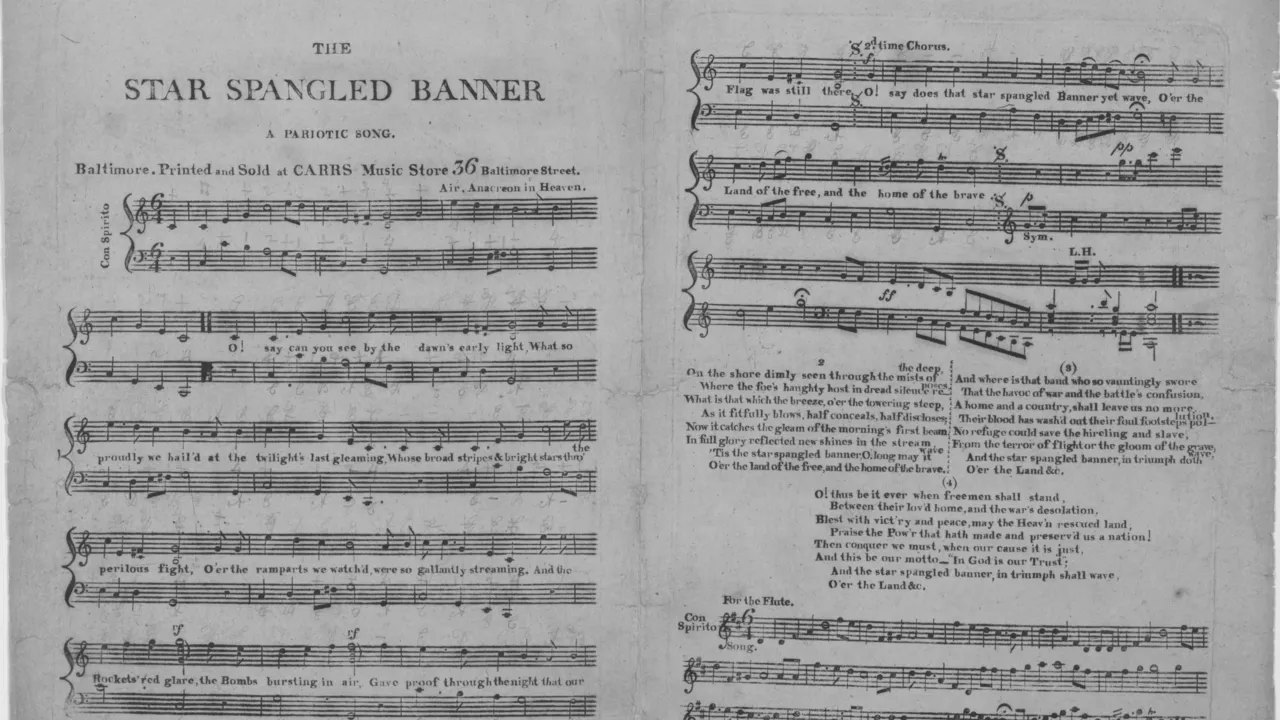
Filled with joy, Francis Scott Key wrote a poem on paper. Today we sing his words as 'The Star- Banner'!
1. Who wrote the words to 'The Star-Spangled Banner' after watching Fort McHenry?
2. How many stars and stripes were on the giant 1814 Fort McHenry flag?
🤯 Mind-Blowing Fact • Grade 2
Each single white cotton star on the original Star-Spangled Banner measures two feet across from point to point!
✨ Word Sparks (Grade 2 Glossary)
Tap 🔊 to hear
seamstress
Skilled maker who cuts and sews cloth items
ramparts
Thick protective walls surrounding a defensive fort
First Lady
Hostess of the White House married to the President
🪝
Why did seamstress Mary Pickersgill sew a flag so huge she had to spread it across a brewery floor?
1
Trouble on the High Seas
During the War of 1812, President James Madison led the young United States against Great Britain after British warships stopped American trading vessels at sea. In August 1814, Dolley Madison bravely rescued a famous painting of George Washington just before British troops entered Washington, D.C.
2
Twenty-Five Hours at Fort McHenry
Weeks later, British ships sailed up the Chesapeake Bay to Baltimore, Maryland, where Major George Armistead wanted a flag big enough for the British to see from miles away! Mary Pickersgill and her helpers stitched a massive wool banner.
3
Sunrise Inspires an Anthem
After twenty-five hours of cannon and rocket fire, lawyer Francis Scott Key spotted that giant flag flying at dawn on September 14, 1814, inspiring 'The Star-Spangled Banner'!
1. What treasured item did First Lady Dolley Madison save from the White House in August 1814?
2. Who led the team in Baltimore that sewed the giant Fort McHenry flag?
🤯 Mind-Blowing Fact • Grade 3
Congress officially made 'The Star-Spangled Banner' the national anthem of the United States in 1931—117 years after Francis Scott Key wrote it!
✨ Word Sparks (Grade 3 Glossary)
Tap 🔊 to hear
impressment
Forcing sailors to serve aboard another nation's warships
frigate
Fast, sturdy three-masted wooden sailing warship
truce
Temporary pause in fighting for peaceful talks
🪝
Why was an American lawyer stuck out on the water near British warships during the Battle of Baltimore?
1
Defending Maritime Rights
Thirty years after winning independence, America fought Great Britain again in the War of 1812 under Virginia-born President James Madison. British naval blockades hurt American shipping, and British captains forced sailors off U.S. merchant ships into the Royal Navy—a practice called .
2
Old Ironsides and Dolley Madison
At sea, the heavy oak USS Constitution earned the nickname 'Old Ironsides' when cannonballs bounced off its hull. On land in August 1814, British forces marched into Washington, D.C., just after First Lady Dolley Madison rescued cabinet papers and George Washington's portrait.
3
Watching From the Patapsco River
Next, the British fleet targeted Baltimore Harbor, guarded by star-shaped Fort McHenry. Georgetown lawyer Francis Scott Key had sailed out under a white flag to negotiate the release of a captured Maryland doctor—so British officers held Key's truce boat back until the battle ended.
4
Four Verses for a Nation
All through the stormy night of September 13–14, 1814, rockets' red glare lit the smaller storm flag until dawn's early light revealed Mary Pickersgill's colossal fifteen-star garrison flag, inspiring America's future national anthem.
1. Which famous U.S. Navy wooden warship earned the nickname 'Old Ironsides' in the War of 1812?
2. Why was Francis Scott Key out on a ship in the river during the bombardment of Fort McHenry?
🤯 Mind-Blowing Fact • Grade 4
Today the fragile, conserved 1814 Fort McHenry flag rests in a special climate-controlled chamber at the Smithsonian's National Museum of American History in Washington, D.C.!
✨ Word Sparks (Grade 4 Glossary)
Tap 🔊 to hear
blockade
Using warships to close off trade with ports
resilience
Strength to endure hardship and bounce right back
sovereignty
A nation's full independence to govern itself
🪝
Why did historians call the War of 1812 America's 'Second War of Independence' even though no borders changed at the peace table?
1
Testing a Young Republic's Sovereignty
During Europe's Napoleonic Wars, Great Britain's Royal Navy blockaded ports and seized thousands of sailors from American merchant ships through impressment, while frontier conflicts simmered near the Great Lakes. In June 1812, President James Madison—the first U.S. president to ask Congress for a formal declaration of war—led the young nation into a grueling test of whether the republic could defend its .
2
Crisis on the Chesapeake in 1814
After Oliver Hazard Perry's naval victory on Lake Erie in 1813 secured the Northwest, seasoned British troops arrived in the Chesapeake Bay in summer 1814. Before British forces burned the unfinished Capitol and White House on August 24, First Lady Dolley Madison coolly directed White House staff, including enslaved teenager Paul Jennings, to save Gilbert Stuart's iconic portrait of George Washington.
3
Baltimore Holds Firm
Turning north toward the vital shipbuilding port of Baltimore, the British fleet unleashed roughly 1,500 mortar shells and Congreve rockets against Fort McHenry starting at dawn on September 13, 1814. Detained eight miles downstream aboard an American truce sloop after negotiating physician Dr. William Beanes's release, lawyer Francis Scott Key watched anxiously until cannon fire fell silent before sunrise on September 14. Major George Armistead lowered the rain-soaked storm flag and hoisted Mary Pickersgill's gleaming 30-by-42-foot flag as fifes played 'Yankee Doodle.'
4
Peace of Ghent and Respect Abroad
Printed first as 'Defence of Fort M'Henry,' Key's poem celebrated national . Following the December 1814 Treaty of Ghent and Andrew Jackson's January 1815 defense of New Orleans, European powers respected U.S. independence permanently, ushering in an 'Era of Good Feelings.'
1. Which treaty signed in December 1814 officially ended the War of 1812 between the United States and Great Britain?
2. Why were TWO flags flown at Fort McHenry between September 13 and September 14, 1814?
🤯 Mind-Blowing Fact • Grade 5
Thirteen-year-old African American indentured apprentice Grace Wisher worked alongside Mary Pickersgill, her mother Rebecca Young, and daughter Caroline on the brewery floor in Baltimore to stitch the 400,000 stitches of the Star-Spangled Banner!
✨ Word Sparks (Grade 5 Glossary)
Tap 🔊 to hear
bunting
Lightweight woven wool fabric used for durable flags
status quo
Returning things to how they stood beforehand
disarmament
Mutual agreement to reduce warships or weapons
🪝
How did a stalemated maritime war forge enduring national symbols, spur domestic manufacturing, and cement permanent peace along the U.S.–Canadian border?
1
Maritime Rights, Frontier Tensions, and Madison's War Message
Caught between warring Great Britain and Napoleonic France during the early 1800s, American merchant shipping suffered repeated British Orders in Council trade restrictions and the forcible impressment of thousands of seamen off U.S.-flagged vessels. Coupled with British support for Shawnee leader Tecumseh's confederacy resisting American expansion in the Old Northwest, these grievances prompted President James Madison on June 1, 1812, to ask Congress for the republic's first constitutional declaration of war.
2
Naval Upsets and Chesapeake Inferno
Though outnumbered more than twenty-to-one by the Royal Navy, heavy forty-four-gun American frigates such as USS Constitution ('Old Ironsides') scored stunning single-ship victories, while Master Commandant Oliver Hazard Perry's September 1813 triumph on Lake Erie secured the Great Lakes frontier. Once Napoleon's 1814 abdication freed veteran British troops, Vice Admiral Alexander Cochrane and Major General Robert Ross raided the Chesapeake—routing militia at Bladensburg and burning Washington's public buildings on August 24, hours after Dolley Madison and White House staffer Paul Jennings saved Gilbert Stuart's portrait of Washington and vital state papers.
3
Twenty-Five Hours Before Fort McHenry
Sailing north to capture Baltimore—America's third-largest city—British forces met determined defenses: Maryland militia halted Ross's land advance at North Point while Major George Armistead's 1,000 defenders held star-shaped Fort McHenry, aided by sunken hulks blocking the harbor channel. Beginning at 6:30 a.m. on September 13, 1814, British bomb ships hurled 200-pound exploding mortar shells and Congreve solid-fuel rockets through torrential rain for twenty-five hours. Watching anxiously eight miles away aboard an American truce vessel under British guard, Georgetown attorney Francis Scott Key and prisoner-exchange agent John Skinner waited through terrifying silence before dawn on September 14—when Armistead replaced the tattered storm flag with Mary Pickersgill's 30-by-42-foot wool banner stitched by her household, including thirteen-year-old African American apprentice Grace Wisher.
4
From Broadside Poem to National Anthem
Jotting opening stanzas on an envelope in Baltimore Harbor and completing four verses at the Indian Queen Hotel, Key saw his poem printed within days as 'Defence of Fort M'Henry' to a well-known English melody by John Stafford Smith; Congress designated 'The Star-Spangled Banner' the official national anthem on March 3, 1931.
5
Treaty of Ghent and Lasting Transformation
Combined with Thomas Macdonough's victory on Lake Champlain, Baltimore's stand convinced British negotiators to sign the status-quo Treaty of Ghent on December 24, 1814—two weeks before news arrived at New Orleans, where Andrew Jackson's diverse coalition won a lopsided victory on January 8, 1815. Though tragic for Indigenous confederacies who lost British backing, the war stimulated New England textile manufacturing, prompted the 1817 Rush-Bagot of the Great Lakes, and confirmed American sovereignty on the world stage.