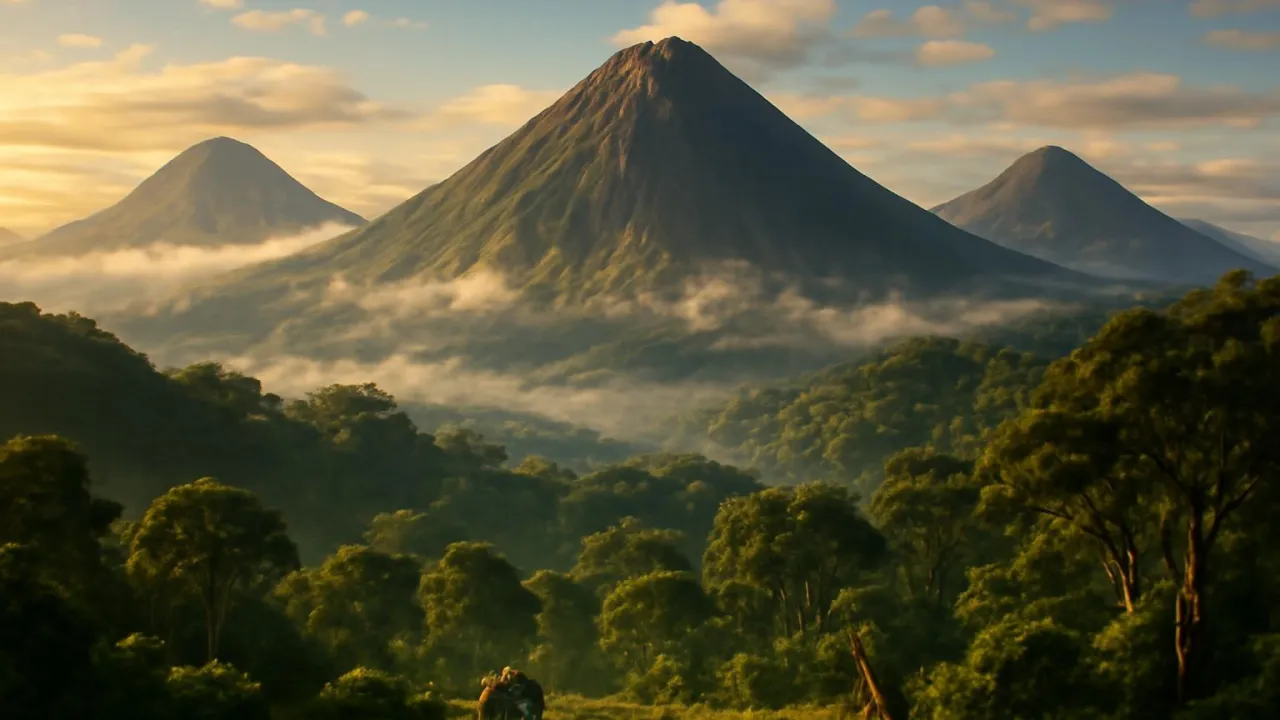
Mount Nyiragongo in Virunga has one of the world’s largest lava lakes.
✨ Word Sparks (Grade 2 Glossary)
Tap 🔊 to hear
volcano
A mountain that erupts hot lava
erupt
To burst out suddenly
mist
Tiny drops of water in the air
🪝
What if you could climb a volcano and look down into the misty forest?
1
Tall and Misty Peaks
The Virunga Mountains have tall with clouds swirling around their tops. When people hike here, they see green forests and hear birds singing. Sometimes, the ground shakes a little from deep inside the Earth.
2
Home to Gorillas
These mountains are famous because mountain gorillas live in the thick forests. Scientists come to study the gorillas and protect them. Visitors can walk quietly to spot these gentle giants.
3
Hot Lava and Smoke
Some in Virunga are still active and can with hot lava. You might see smoke rising from the peaks on some days. The volcanoes help make the soil rich for plants to grow.
2. What makes the soil in Virunga good for plants?
🤯 Mind-Blowing Fact • Grade 3
Some Virunga volcanoes have lava lakes that glow bright red at night.
✨ Word Sparks (Grade 3 Glossary)
Tap 🔊 to hear
magma
Hot melted rock inside Earth
endangered
At risk of disappearing forever
crust
The outer layer of the Earth
🪝
Can you imagine the rumble of a volcano beneath your feet as mist swirls around you?
1
A Chain of Volcanoes
The Virunga Mountains stretch across three African countries, forming a chain of eight volcanoes. Some volcanoes, like Mount Nyiragongo, are still active and can erupt with glowing lava. These volcanic peaks were formed by powerful forces deep inside the Earth. The area is always changing because of eruptions and shifting ground.
2
A Rainforest Wonderland
Dense rainforests cover the lower slopes, filled with the sounds of chattering monkeys and singing birds. The forests are home to rare mountain gorillas, which scientists call a critically species. Conservation teams work hard to protect these gentle animals and their habitat. Tourists can hike with guides to safely see gorillas in the wild.
3
The Science of Volcanoes
A volcano forms when , or hot melted rock, pushes up through cracks in the Earth's . When pressure builds, the volcano can erupt, sending lava and ash into the air. Some Virunga volcanoes, like Nyamuragira, erupt often and help create new land. The volcanic soil is rich in minerals, helping plants grow thick and green.
4
Why Virunga Matters
The Virunga Mountains are a UNESCO World Heritage Site because of their unique wildlife and geology. They provide fresh water for millions of people and animals in the region. Scientists study the mountains to learn about Earth's history and how volcanoes work. Protecting Virunga helps save both rare animals and important natural resources.
1. Why is the soil around Virunga so good for plants?
2. What special animal do people hope to see in Virunga?
🤯 Mind-Blowing Fact • Grade 4
Mount Nyiragongo’s lava lake can fill an Olympic swimming pool in just one hour.
✨ Word Sparks (Grade 4 Glossary)
Tap 🔊 to hear
tectonic plates
Huge pieces of Earth’s crust that move
fertile
Rich with nutrients for plants to grow
biodiversity
Many different living things in one place
🪝
What would it feel like to stand on a mountain where Earth’s crust is still growing and moving?
1
A Volcanic Borderland
The Virunga Mountains form a dramatic border between Rwanda, Uganda, and the Democratic Republic of Congo. This volcanic range includes eight major peaks, some of which are still active and erupt with rivers of molten lava. The mountains were created by slowly pulling apart, allowing magma to rise and solidify into new land. Over millions of years, eruptions have shaped valleys, ridges, and plains.
2
Habitats Full of Life
Thick rainforests cloak the slopes, creating a rich habitat for countless species. Mountain gorillas, golden monkeys, and rare birds all depend on these forests for food and shelter. Conservationists work alongside local communities to protect these animals from threats like poaching and habitat loss. Ecotourism brings visitors from around the world, helping fund efforts to save endangered species.
3
The Science Behind the Eruptions
Virunga’s volcanoes are part of the East African Rift, where the Earth's crust is thin and fractured. When magma rises through these cracks, it can erupt explosively, forming new cones and lava lakes. Mount Nyiragongo’s lava lake is one of the world’s largest and hottest, with temperatures reaching over 1,200°C (2,192°F). The minerals in volcanic ash and lava make the soil extremely , supporting lush plant life.
4
A Global Treasure to Protect
Virunga National Park is Africa’s oldest national park and a UNESCO World Heritage Site. Its unique combination of volcanoes, forests, and wildlife makes it a vital resource for science and conservation. The mountains provide water, climate stability, and homes for millions of people and animals. Protecting Virunga is crucial for and for understanding the powerful forces that shape our world.
1. Why is Virunga important for scientists and conservationists?
2. What causes the Virunga volcanoes to erupt?
🤯 Mind-Blowing Fact • Grade 5
Nyiragongo’s 2002 eruption sent lava racing at 60 km/h, reshaping the city of Goma in just hours.
✨ Word Sparks (Grade 5 Glossary)
Tap 🔊 to hear
rift
A deep crack in Earth’s crust
seismic
Related to shaking or earthquakes
resilience
Ability to recover and stay strong
🪝
What if you could measure the heat of a lava lake and trace the footsteps of mountain gorillas through ancient volcanic forests?
1
Geological Origins and Dynamic Forces
The Virunga Mountains, a striking volcanic chain along the Albertine , were formed by the divergence of the African tectonic plate. Over the past two million years, repeated eruptions and shifting plate boundaries have sculpted eight major volcanoes, including the active giants Nyiragongo and Nyamuragira. These processes are driven by magma upwelling through rift fractures, creating new crust and altering the landscape with each eruption. The region’s geology is still evolving, with earthquakes and volcanic activity continually reshaping its valleys and peaks.
2
Volcanic Engineering: Lava Lakes and Eruptive Power
Mount Nyiragongo is renowned for its persistent lava lake, which holds one of the world’s largest volumes of molten rock. The lava lake’s temperature can exceed 1,200°C (2,192°F), and its fluid basaltic lava flows are among the fastest on Earth, sometimes traveling up to 60 kilometers per hour. Scientists monitor gas emissions, vibrations, and thermal changes to predict eruptions and protect nearby communities. The unique chemistry of Virunga’s volcanoes also enriches the soil, supporting dense forests and diverse life.
3
Ecological Marvel: Biodiversity and Conservation
The lush rainforests on Virunga’s slopes are a global biodiversity hotspot, sheltering critically endangered mountain gorillas, golden monkeys, and over 700 bird species. Conservationists face challenges from habitat loss, poaching, and political instability, but international partnerships and ecotourism provide vital funding for protection efforts. The interconnected ecosystems rely on volcanic soils, high rainfall, and cool mountain climates to sustain their remarkable variety of life. Research in Virunga advances our understanding of species adaptation and ecosystem .
4
Cultural and Human Impact
For centuries, the Virunga Mountains have shaped the cultures and livelihoods of people in Rwanda, Uganda, and the Democratic Republic of Congo. Local communities depend on the fertile volcanic soil for agriculture, while rivers originating in the mountains supply water to millions. The region’s national parks attract scientists, conservationists, and tourists, generating income and fostering cross-border cooperation. However, balancing human needs with wildlife protection remains a complex challenge requiring innovative solutions.
5
Global Significance and Future Challenges
Virunga’s unique blend of geological, ecological, and cultural features led to its designation as a UNESCO World Heritage Site in 1979. The mountains play a crucial role in regulating climate, preserving water resources, and serving as a living laboratory for earth sciences. As climate change and human pressures intensify, safeguarding Virunga’s landscapes and species is more important than ever. Ongoing research, education, and international collaboration are key to ensuring this volcanic wonder endures for future generations.