1. Whom do Americans especially remember on Memorial Day in May?
2. On what date is Veterans Day celebrated every single year?
🤯 Mind-Blowing Fact • Grade 2
Before Memorial Day each May, soldiers place a small American flag precisely one foot in front of more than 260,000 headstones at Arlington National Cemetery in Virginia!
✨ Word Sparks (Grade 2 Glossary)
Tap 🔊 to hear
armistice
An agreement between sides to stop fighting
wreath
A ring of flowers and leaves showing respect
gratitude
Warm feeling of thankfulness for others' help
🪝
Why is Veterans Day always celebrated on the eleventh day of the eleventh month?
1
Why November 11 Matters
Count the elevens: the eleventh hour of the eleventh day of the eleventh month! On November 11, 1918, at 11:00 a.m., a peace agreement called an ended the fighting of World War I. At first called Armistice Day, Congress renamed it Veterans Day in 1954 to thank all U.S. veterans!
2
Why May Remembers the Fallen
Memorial Day began after the Civil War as 'Decoration Day,' when families placed spring flowers and tiny flags on soldiers' graves. Observed on the last Monday in May, it honors men and women who died in military service.
3
Arlington Across the River
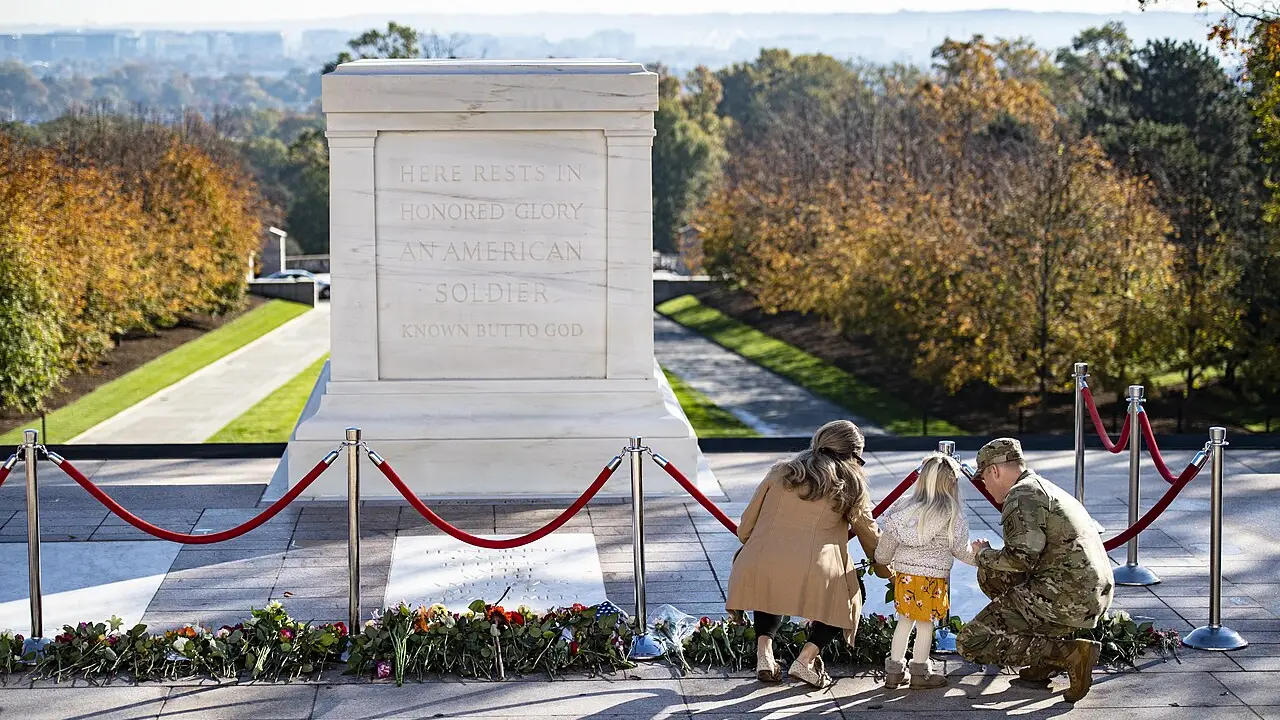
On both holidays, the President lays a at the Tomb of the Unknown Soldier in Arlington National Cemetery in Virginia!
1. What was Veterans Day originally called after World War I ended on November 11, 1918?
2. Where in Virginia is a ceremonial wreath placed at the Tomb of the Unknown Soldier on both holidays?
🤯 Mind-Blowing Fact • Grade 3
Bright red paper poppies worn around Memorial Day were inspired by the 1915 poem 'In Flanders Fields,' describing wild poppies blooming across World War I battlefields!
✨ Word Sparks (Grade 3 Glossary)
Tap 🔊 to hear
observance
Respectful ceremony honoring a special national day
half-staff
Flying a flag halfway up a pole in mourning
peacetime
Years when a country is not at war
🪝
What is an easy trick for remembering how Memorial Day and Veterans Day differ?
1
Memory vs. Thanking All Who Served
Here is a helpful civics memory clue! Memorial Day—held on the last Monday in May—shares its root with 'memory,' honoring service members who died defending the nation. Veterans Day—held every November 11—thanks ALL veterans who have served honorably in the Army, Navy, Marine Corps, Air Force, Space Force, or Coast Guard, in wartime or !
2
Spring Blossoms and Decoration Day
Right after the Civil War ended in 1865, grieving towns from Charleston, South Carolina, and Waterloo, New York, to Petersburg, Virginia, decorated fallen soldiers' graves with spring flowers. In May 1868, General John A. Logan proclaimed Decoration Day, holding the first national at Arlington National Cemetery in Virginia.
3
From Armistice Day to Veterans Day
After World War II and the Korean War, millions more Americans had served in uniform. World War II veteran Raymond Weeks organized the first inclusive 'National Veterans Day' parade in 1947, inspiring President Dwight D. Eisenhower to sign the 1954 law renaming November 11 Veterans Day.
4
Traditions of Respect
On Memorial Day, American flags fly at until noon and rise briskly to the top for the rest of the day, while Americans pause for a National Moment of Remembrance at 3:00 p.m. local time.
1. How is the American flag flown on Memorial Day morning compared to the afternoon?
2. Which six branches make up the United States Armed Forces honored on Veterans Day?
🤯 Mind-Blowing Fact • Grade 4
When federal law briefly moved Veterans Day to the fourth Monday in October between 1971 and 1977, forty-six out of fifty states loved the historic November 11 date so much that they kept celebrating on November 11 until Congress switched it back!
✨ Word Sparks (Grade 4 Glossary)
Tap 🔊 to hear
solemn
Quiet, respectful, and deeply thoughtful in tone
proclaim
To announce officially for the public
tribute
An action or gift showing deep respect
🪝
How did spring flowers in Petersburg, Virginia, and other postwar towns inspire America's Memorial Day—and why did Veterans Day briefly move to October in the 1970s?
1
Roots of Decoration Day in 1865–1868
Walk through Blandford Cemetery in Petersburg, Virginia, or historic grounds in Charleston, South Carolina, and Waterloo, New York, in the spring of 1865 and 1866! Across a healing nation after the Civil War, newly freed African Americans in Charleston, women's memorial societies in Petersburg, and northern townsfolk independently gathered spring blossoms to honor fallen soldiers. Moved by Petersburg's floral , Mrs. Mary Logan told her husband, General John A. Logan, who issued General Order No. 11 establishing May 30, 1868, as Decoration Day—when 5,000 participants decorated 20,000 Union and Confederate graves at Arlington National Cemetery.
2
Why Memorial Day Moved to Monday
For a century, Memorial Day stayed on May 30. Then Congress passed the Uniform Monday Holiday Act of 1968 (taking effect in 1971), moving Memorial Day to the last Monday in May to create a three-day weekend.
3
Why Veterans Day Returned to November 11
That same 1968 law also shifted Veterans Day to the fourth Monday in October starting in 1971! However, veterans' groups and citizens missed the deep historical meaning of 11/11—marking the November 11, 1918 World War I armistice and the November 11, 1921 burial at Arlington's Tomb of the Unknown Soldier. Forty-six states kept celebrating on November 11 anyway, so President Gerald Ford signed a 1975 law returning Veterans Day permanently to November 11 starting in 1978!
4
Thoughtful Civic Etiquette
Understanding both holidays helps students greet neighbors thoughtfully: Memorial Day is a day of remembrance for those who died in service, whereas Veterans Day is a joyful, grateful celebration thanking living and past veterans in our families, schools, and communities.
1. How did Petersburg, Virginia, play a special role in the story of Decoration Day (Memorial Day)?
2. Why did Congress move Veterans Day back to November 11 after trying Monday dates in October during the 1970s?
🤯 Mind-Blowing Fact • Grade 5
Sentinels of the 3rd U.S. Infantry Regiment ('The Old Guard') have guarded the Tomb of the Unknown Soldier in Arlington, Virginia, every single minute of every day and night—even through blizzards and hurricanes—since July 2, 1937!
✨ Word Sparks (Grade 5 Glossary)
Tap 🔊 to hear
sentinel
A soldier standing ceremonial guard with precision
mobilization
Organizing citizens and resources for national defense
attributive
A noun describing another noun without an apostrophe
🪝
How did two distinct moments—Civil War healing in 1865–1868 and the eleventh hour of November 11, 1918—give America complementary civic traditions of remembrance and gratitude?
1
Grassroots Origins of Memorial Day
Trace Memorial Day back to the spring of 1865 and 1866, when communities shattered by over 600,000 Civil War deaths sought healing through shared remembrance! On May 1, 1865, thousands of formerly enslaved Charlestonians gathered at Washington Race Course in South Carolina to give dignified burials and floral tributes to fallen Union prisoners. By 1866, towns North and South—from Waterloo, New York (recognized by Congress in 1966) and Boalsburg, Pennsylvania, to Columbus, Mississippi, and Petersburg, Virginia's Blandford Cemetery on June 9, 1866—held annual decoration ceremonies.
2
Arlington National Cemetery and National Law
Inspired by local observances, Commander-in-Chief John A. Logan of the Grand Army of the Republic issued General Order No. 11 on May 5, 1868, designating May 30 for strewing flowers on comrades' graves. Former Ohio congressman—and future President—James A. Garfield delivered the inaugural keynote before 5,000 attendees at Arlington National Cemetery in Virginia. Broadened after World War I to honor Americans who died in every conflict, Memorial Day shifted under the Uniform Monday Holiday Act (effective 1971) to the last Monday in May, anchored at 3:00 p.m. by the National Moment of Remembrance enacted in 2000.
3
The Eleventh Hour and the Tomb of the Unknown Soldier
Half a century after Logan's order, guns fell silent across Europe's Western Front at 11:00 a.m. on November 11, 1918. Proclaimed Armistice Day by President Woodrow Wilson in November 1919 and made a legal federal holiday in 1938, November 11 gained deeper resonance in 1921 when an unidentified American soldier from World War I was laid to rest on the plaza of Arlington's Memorial Amphitheater—guarded twenty-four hours a day, 365 days a year since 1937 by of the 3rd U.S. Infantry Regiment ('The Old Guard').
4
1954 Transformation Into Veterans Day
Following the of sixteen million Americans in World War II and nearly six million during the Korean War, Birmingham veteran Raymond Weeks petitioned Washington to expand November 11 to thank all who served. Congressman Ed Rees sponsored legislation signed by President Dwight D. Eisenhower on June 1, 1954, replacing 'Armistice' with 'Veterans'—spelled deliberately as an noun without an apostrophe because the day belongs to veterans themselves.
5
International Kinship and Civic Stewardship
While Commonwealth nations such as Canada, the United Kingdom, and Australia observe November 11 as Remembrance Day honoring fallen troops—similar to America's Memorial Day—the United States pairs May's solemn tribute to those who gave their lives with November's living expression of gratitude to the roughly sixteen million veterans living in American communities today.