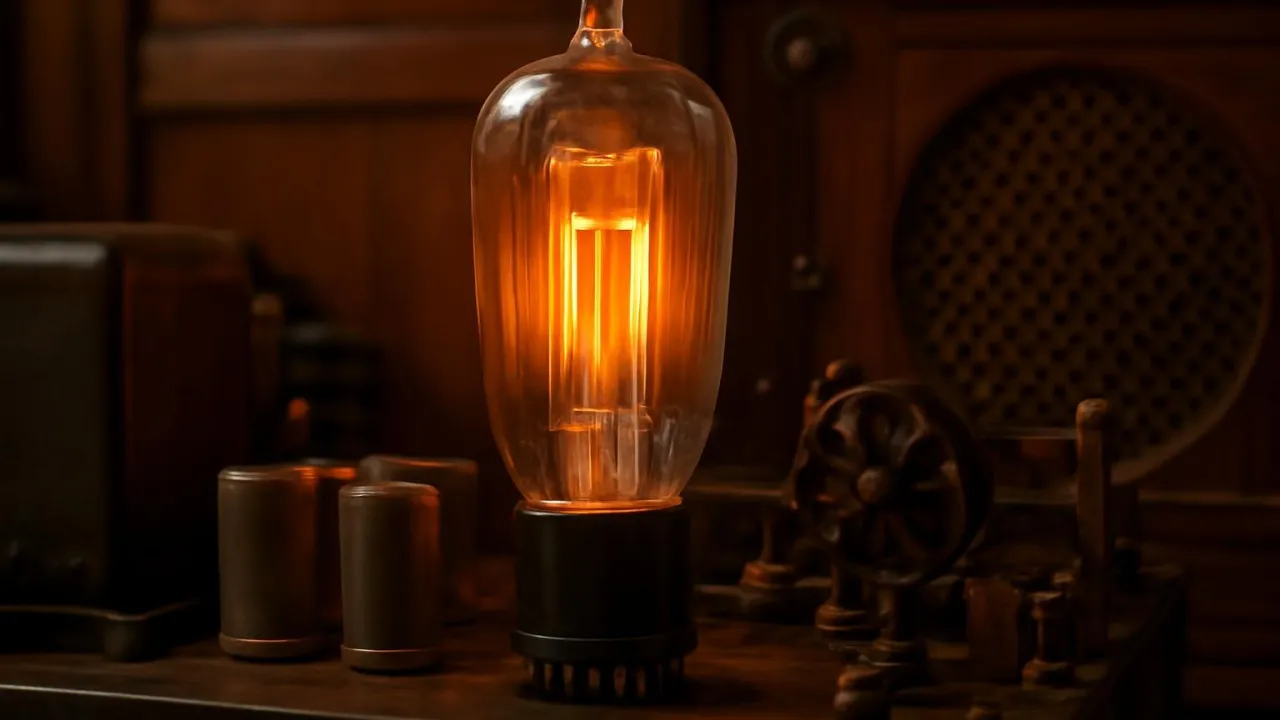
Some old radios had over ten vacuum tubes glowing inside at once!
✨ Word Sparks (Grade 2 Glossary)
Tap 🔊 to hear
filament
A thin wire that heats up
signal
A message sent by electricity
television
A screen that shows moving pictures
🪝
Have you ever seen a glass tube glow in a radio?
1
A Magic Glass Light
Vacuum tubes look like tiny glowing light bulbs, but they do much more. People used to see them inside radios and . They made a gentle buzzing and shining orange glow. These tubes helped bring music and voices to homes.
2
How They Work
Inside the glass tube, there is no air, only a vacuum. Electricity moves through special parts called and plates. The vacuum lets electricity move easily and safely. This helps the tube make sounds louder or turn on and off.
3
Changing the World
Vacuum tubes let people listen to faraway radio shows. They made and the first computers possible. Before tiny chips, these tubes powered many amazing inventions.
The first electronic computer, ENIAC, used over 17,000 vacuum tubes!
✨ Word Sparks (Grade 3 Glossary)
Tap 🔊 to hear
amplify
To make something louder or bigger
electron
A tiny part of electricity
transistor
A tiny part that replaced tubes
🪝
What if you could see electricity glowing inside a glass tube?
1
The Glowing Heart of Early Electronics
Vacuum tubes were the bright, buzzing parts inside old radios and televisions. When powered on, their filaments glowed orange and made a gentle hum. These glass tubes looked mysterious, like tiny science lamps. People watched them light up as their favorite shows played.
2
How Vacuum Tubes Work
A vacuum tube contains a filament, like a light bulb, and metal plates. The filament heats up and releases , which flow through a vacuum. The vacuum means there is no air, so electrons can travel freely. This lets the tube signals or act as a switch.
3
A Breakthrough in Communication
Invented by John Ambrose Fleming in 1904, vacuum tubes made long-distance radio possible. They amplified weak signals so people could hear music and voices from far away. Later, tubes helped create the very first computers. These machines used thousands of tubes to do math.
4
Why We Remember Vacuum Tubes
Vacuum tubes were replaced by tiny , but they changed the world forever. They started the age of electronics, making radios, TVs, and computers possible. Today, some guitar amps and radios still use them for their warm, unique sound. Their orange glow is a symbol of invention.
Vacuum tubes allowed the first live radio broadcast across the Atlantic Ocean in 1906!
✨ Word Sparks (Grade 4 Glossary)
Tap 🔊 to hear
cathode
The part that releases electrons
anode
The part that collects electrons
amplifier
A device that makes sounds louder
🪝
Can you imagine a world where glowing glass tubes powered every radio and computer?
1
The Bright Beginning of Modern Electronics
Step into an old radio workshop, and you’d see rows of glass tubes shining orange. These are vacuum tubes, the first electronic and switches. When electricity passes through the heated filament, it releases electrons that move through a vacuum. This process allows the tube to boost weak signals or open and close circuits.
2
Inside the Glass: How It Works
A vacuum tube usually contains a , , and sometimes a control grid. The cathode heats up, releasing electrons that travel to the anode. The vacuum inside the tube prevents air molecules from interfering with the electron flow. By adding a control grid, engineers could regulate the current, making the tube act as an or a switch.
3
A Revolution in Communication and Computing
Invented by John Ambrose Fleming in 1904, vacuum tubes quickly changed the world. They made long-distance radio broadcasts possible by amplifying faint signals across continents. Later, vacuum tubes powered the first televisions and the earliest computers, such as ENIAC, which used over 17,000 tubes to perform calculations.
4
From Glowing Tubes to Microchips
Vacuum tubes were large, fragile, and produced a lot of heat, but they sparked the electronic age. In the 1950s, transistors replaced tubes, making devices smaller, cooler, and more reliable. Still, vacuum tubes remain important in music and some radios, valued for their warm, unique sound and historical legacy.
1. What does the control grid in a vacuum tube do?
2. Why did transistors replace vacuum tubes?
🤯 Mind-Blowing Fact • Grade 5
The ENIAC computer’s vacuum tubes weighed over 30 tons and filled an entire room!
✨ Word Sparks (Grade 5 Glossary)
Tap 🔊 to hear
thermionic emission
Electrons released from a hot surface
resonance
A rich, full sound made by vibration
transistor
A tiny part that controls electricity
🪝
What if every computer and radio you used needed thousands of glowing glass tubes to work?
1
The Dawn of Electronic Amplification
Imagine walking into a radio laboratory in the early 1900s, where glass tubes glowed like tiny lanterns. Vacuum tubes, invented by John Ambrose Fleming in 1904, became the first electronic devices capable of amplifying weak electrical signals and switching currents on and off. These devices used a heated cathode to emit electrons, which then traveled through a vacuum toward an anode, creating a controlled flow of electricity.
2
Engineering the Vacuum: How Tubes Operate
A typical vacuum tube consists of several key components: a cathode, anode (or plate), and often a control grid. When the cathode is heated, it releases electrons into the vacuum, a process called . The control grid, placed between the cathode and anode, can regulate the flow of electrons by varying its voltage, allowing the tube to amplify signals or act as a precise electronic switch. The vacuum inside the tube prevents air molecules from colliding with the electrons, ensuring efficient operation.
3
Transforming Communication and Computation
Vacuum tubes revolutionized communication by enabling long-distance radio, the first television broadcasts, and even radar during World War II. In the realm of computation, the ENIAC computer, completed in 1945, used over 17,000 vacuum tubes and could perform thousands of calculations per second. However, these tubes generated significant heat, required frequent replacement, and consumed large amounts of power, which limited their practicality for everyday devices.
4
The Legacy and Evolution of Electronic Tubes
The invention of the in 1947 by John Bardeen, Walter Brattain, and William Shockley marked the beginning of the end for vacuum tubes in most applications. Transistors were far smaller, more energy-efficient, and more durable, allowing modern electronics to shrink dramatically. Despite this, vacuum tubes are still prized in certain high-end audio amplifiers and radio transmitters, where their unique and warm sound are highly valued by musicians and engineers.
5
A World Changed by Glowing Glass
Vacuum tubes symbolize the birth of the electronic age, bridging the gap between mechanical inventions and the digital world. Their ability to amplify, switch, and shape electrical signals made possible the rapid spread of information, entertainment, and scientific discovery in the twentieth century. Today, their orange glow and iconic glass shape remind us of a time when invention meant seeing electricity itself come alive.