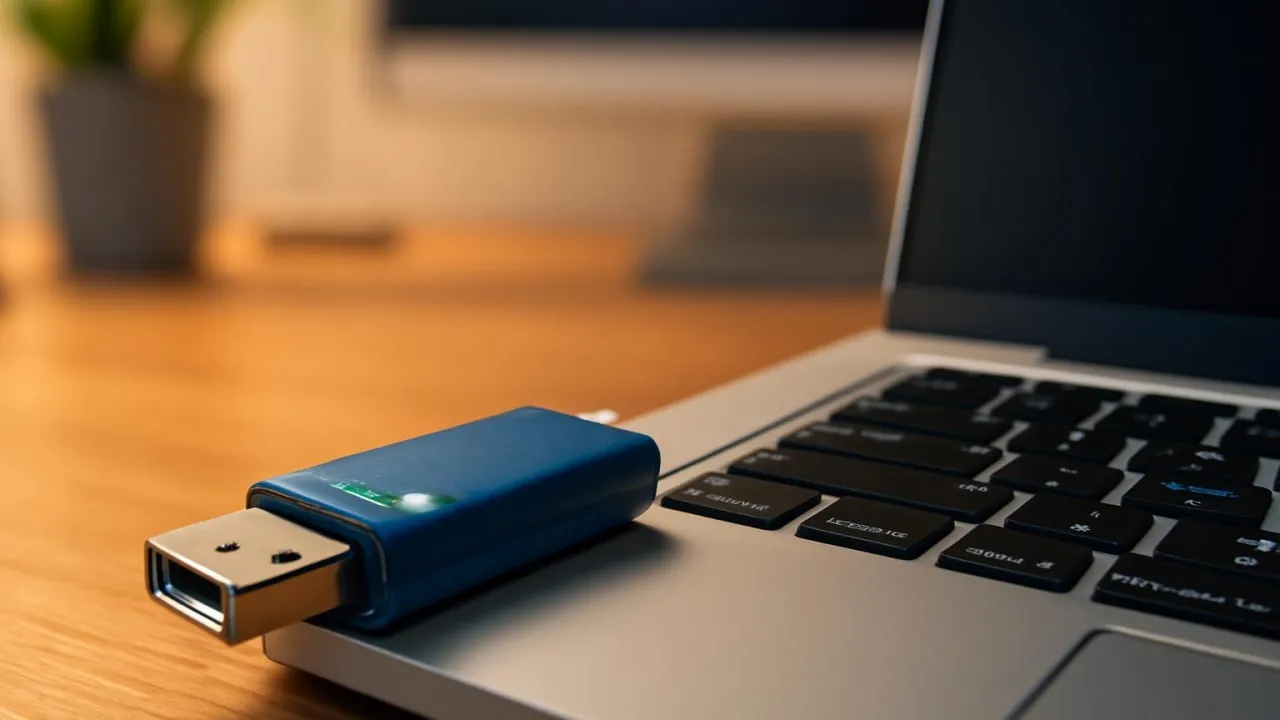
1. What sound might you hear when plugging in a USB drive?
2. Why do people use USB flash drives?
🤯 Mind-Blowing Fact • Grade 2
Some USB flash drives are shaped like animals or cartoon characters!
✨ Word Sparks (Grade 2 Glossary)
Tap 🔊 to hear
memory
Where computers store information
port
A place to plug in devices
copy
To make another file the same
🪝
How can a tiny stick help you save schoolwork and photos?
1
A Pocket-Sized Helper
USB flash drives are small and light, but they store a lot. You can carry thousands of pictures or songs in your pocket. They are easy to bring to school or a friend’s house. Many people use them to keep their projects safe.
2
How Does It Work?
You plug the USB drive into a computer’s , and it connects quickly. The computer shows the files stored inside, and you can or move them. You can add new files or delete old ones. It is simple and fast for everyone.
3
Easy Sharing Everywhere
USB flash drives make sharing files simple between computers. You can give your friend a of a photo or homework. Teachers use them to share lessons or projects. They help people work together and learn new things.
Some USB flash drives are so tiny, they can fit on a keychain with your house keys!
✨ Word Sparks (Grade 3 Glossary)
Tap 🔊 to hear
solid-state
No moving parts inside
non-volatile
Keeps data even when off
transfer
To move something from place to place
🪝
What if your homework, photos, and favorite songs could travel with you everywhere?
1
A Pocket-Sized Wonder
Click! That’s the sound you might hear as a USB flash drive slides into a computer’s port. Suddenly, a tiny device smaller than your finger holds a whole world of digital files. Invented by Dov Moran and his team in Israel in 2000, this gadget changed how we carry information. People everywhere began using flash drives instead of floppy disks or CDs.
2
The Science of Flash Memory
Inside a flash drive, there are memory chips that store data using electric charges. No moving parts means it’s tough and lasts a long time, even if dropped. This type of memory is called , because it keeps your files safe even when unplugged. That’s why flash drives are so handy for saving and moving homework, photos, and music.
3
Plug In and Transfer
To use a flash drive, you simply plug it into a USB port and wait for the computer to recognize it. Files can be copied, moved, or deleted with a few easy clicks. This makes sharing school projects, pictures, or songs between computers simple and fast. Teachers, students, and families all rely on flash drives for quick file .
4
Everywhere Around the World
You’ll find USB flash drives in classrooms, offices, and homes across the globe. Some are shaped like animals or toys, while others are waterproof or super tiny. Their invention made digital life portable and easy for everyone. Today, flash drives help people keep important information safe and close by.
1. What happens when you plug a flash drive into a computer?
2. Why is a flash drive called 'solid-state'?
🤯 Mind-Blowing Fact • Grade 4
Some modern USB flash drives can store more than one million books!
✨ Word Sparks (Grade 4 Glossary)
Tap 🔊 to hear
electronic cell
Tiny part that stores data
durable
Strong and hard to break
digital
Using numbers and computers
🪝
Imagine if every book, photo, and song you love could travel with you—how would you do it?
1
The Birth of a Digital Pocket
In the year 2000, Dov Moran and his team at M-Systems in Israel invented the USB flash drive, revolutionizing how we store and move information. Before this, people relied on floppy disks or CDs, which were slow and easily damaged. The flash drive’s small size and tough design made it a favorite almost instantly. Today, you can find USB drives in classrooms, offices, and homes all around the world.
2
Inside the Flash Drive
A USB flash drive uses solid-state flash memory, which means it stores data using tiny instead of moving parts. When plugged into a USB port, the computer sends electric signals to read or write files. This non-volatile memory keeps your data safe, even when the drive is unplugged or dropped. The lack of moving parts makes flash drives and reliable for everyday use.
3
Changing How We Share
The invention of the USB flash drive made sharing and transferring files incredibly fast and easy. You can copy homework, photos, or music from one computer and move them to another in seconds. Teachers use them to share lessons, and families use them to save precious memories. Some flash drives are even waterproof or disguised as toys, making them both practical and fun.
4
A Global Impact
USB flash drives have changed the way people all over the world handle information. They’ve helped businesses, schools, and families keep important files safe and portable. As technology evolves, flash drives continue to get faster and hold more data. Their invention marked a major step in the digital age, making information more mobile than ever before.
1. Why are USB flash drives more reliable than floppy disks?
2. How did USB drives change file sharing?
🤯 Mind-Blowing Fact • Grade 5
The largest USB flash drives today can store up to 2 terabytes—enough to save over 500,000 photos!
✨ Word Sparks (Grade 5 Glossary)
Tap 🔊 to hear
semiconductor
Material that controls electric signals in chips
encrypted
Protected with a secret code
terabyte
One trillion bytes of digital data
🪝
What if you could carry the world’s knowledge on a device smaller than your thumb?
1
A Revolution in Data Portability
The invention of the USB flash drive in 2000 by Dov Moran and his team at M-Systems in Israel marked a turning point in digital storage history. Prior to this breakthrough, people relied on floppy disks and optical CDs, both of which were limited in capacity, speed, and durability. The flash drive’s compact design, combined with its ability to store vast amounts of data, quickly made it a global favorite for students, professionals, and families alike. Its plug-and-play nature eliminated the need for complex installation or external power sources, making digital information truly portable for the first time.
2
Engineering the Flash Drive
At the heart of every USB flash drive is solid-state flash memory, a technology that stores data using millions of microscopic electronic cells. Each cell can be electrically programmed and erased, allowing for rapid data writing and retrieval without any moving parts. When inserted into a USB port, the drive establishes a direct electrical connection with the computer, enabling high-speed data transfer through serial communication protocols. This non-volatile memory retains information even when the device is removed or loses power, ensuring the safety and longevity of stored files.
3
From Prototype to Everyday Essential
The earliest USB flash drives could hold only 8 megabytes—barely enough for a handful of photos by today’s standards. However, advances in engineering have led to drives capable of storing of data, equivalent to millions of books or thousands of high-definition videos. Manufacturers have also developed drives with waterproof, shockproof, and features, making them suitable for harsh environments and secure data transport. The USB interface itself has evolved from USB 1.1 to USB 3.2 and beyond, dramatically increasing transfer speeds and reliability.
4
Impact on Society and Technology
USB flash drives have transformed the way people share, back up, and transport digital information worldwide. In schools, they enable students to carry projects and presentations with ease, while businesses rely on them for secure file transfers and data recovery. The simplicity of their design has made them accessible across cultures and age groups, bridging the digital divide in many regions. As cloud storage grows, flash drives remain vital for offline access, privacy, and quick data exchange, demonstrating their enduring value in a connected world.
5
The Future of Flash Storage
Looking ahead, the principles behind USB flash drives continue to inspire new forms of portable memory, including ultra-fast solid-state drives and wireless data transfer devices. Innovations in materials science and microchip design promise even greater storage capacities and durability. While cloud technology is expanding, the need for physical, secure, and instantly accessible data storage keeps USB flash drives relevant. Their invention is a testament to human ingenuity, showing how a small device can have a huge impact on how we learn, create, and connect.