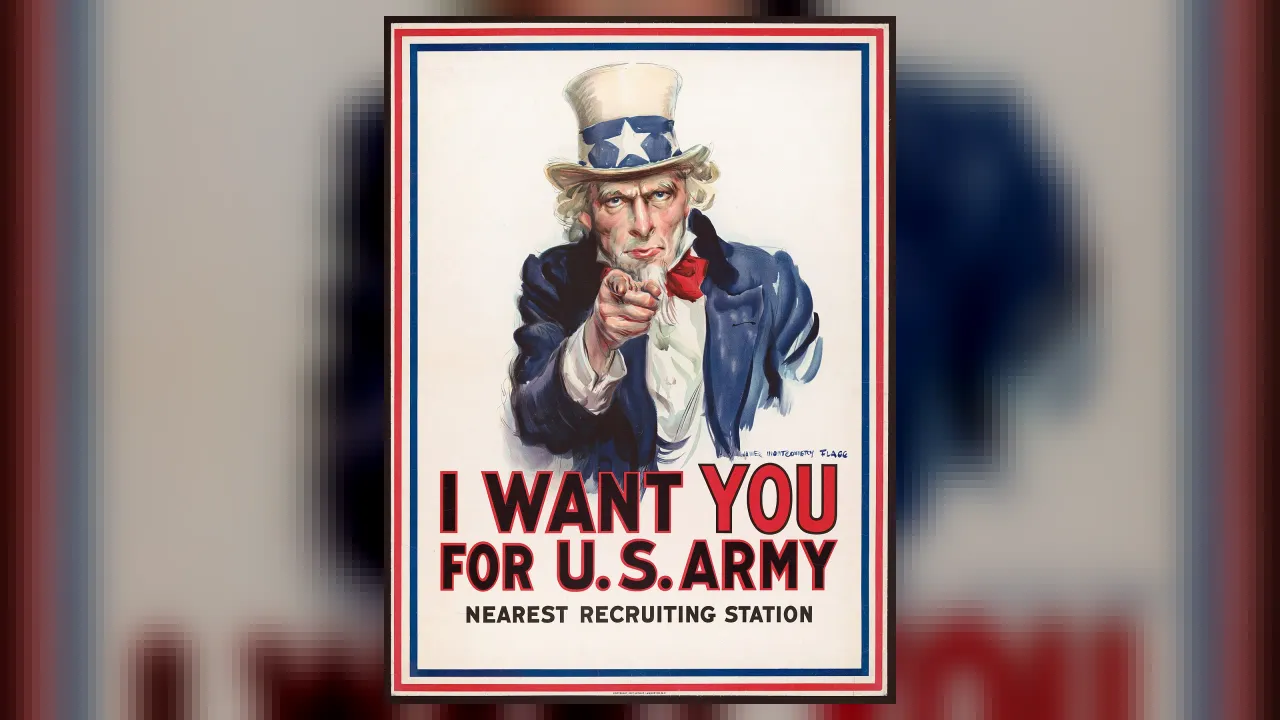
1. Which real person inspired the nickname 'Uncle Sam'?
2. What did the stamped letters 'U.S.' on the wooden barrels really mean?
🤯 Mind-Blowing Fact • Grade 2
In 1961, the U.S. Congress passed an official resolution honoring 'Uncle Sam' Wilson of Troy, New York, as the namesake of America's national symbol!
✨ Word Sparks (Grade 2 Glossary)
Tap 🔊 to hear
resolution
An official statement voted on by Congress
namesake
A person after whom something is named
bunting
Festive red, white, and blue cloth decorations
🪝
How did two stamped letters on wooden food barrels turn into a tall gentleman in a star-spangled top hat?
1
Barrels for the Army in 1812
Step onto a busy Hudson River dock in Troy, New York, during the War of 1812! Local businessman Samuel Wilson—known around town for his fairness and kindness as 'Uncle Sam'—inspected wooden barrels of preserved meat shipped to U.S. Army troops.
2
A Joke That Caught On
Each barrel had to be stamped 'U.S.' to show it belonged to the United States government. When someone asked what the initials meant, dockworkers grinned and said they stood for 'Uncle Sam'—and soldiers spread the nickname across America!
3
America's Family of Symbols
Later, artists gave Uncle Sam a white beard, blue coat, and starry hat. Together with the Stars and Stripes, the Statue of Liberty, and the bald eagle, patriotic symbols help Americans celebrate shared history!
1. During which war did soldiers start calling United States supplies 'Uncle Sam's'?
2. What colors are Uncle Sam's famous top hat, coat, and striped trousers?
🤯 Mind-Blowing Fact • Grade 3
As a teenager during the American Revolution, the real Samuel Wilson actually served in the Continental Army caring for cattle and mending fences near Boston!
✨ Word Sparks (Grade 3 Glossary)
Tap 🔊 to hear
personification
Representing a country or idea as a person
provisions
Food and supplies packed for a journey
anthem
An uplifting song celebrating a whole nation
🪝
Before Uncle Sam became famous, who were Brother Jonathan and Columbia?
1
Early Characters for a Young Country
Open an early American newspaper from the late 1700s and you might meet two older patriotic figures! Poets and artists often drew 'Columbia'—a graceful figure draped in classical robes—to represent the spirit of America, alongside a witty New England farmer nicknamed 'Brother Jonathan.'
2
Samuel Wilson and the War of 1812
During the War of 1812, contractor Elbert Anderson hired Troy, New York inspector Samuel Wilson to supply barrels of stamped 'E.A.—U.S.' Soldiers from upstate New York who knew 'Uncle Sam' Wilson joked that Uncle Sam was feeding the whole army, and newspapers printed the nickname by September 1813.
3
Artists Shape His Look
In the 1860s and 1870s, cartoonist Thomas Nast drew Uncle Sam as tall and lanky—a bit like Abraham Lincoln—with a white goatee and starry vest. Then in 1917, illustrator James Montgomery Flagg painted the famous pointing Uncle Sam poster, using his own face in a mirror to save hiring a model!
4
Why Patriotic Symbols Matter
From Lady Liberty's welcoming torch in New York Harbor to Francis Scott Key's 'Star-Spangled Banner,' national symbols unite millions of diverse citizens through instantly recognizable images.
1. Which two artists created the classic look of Uncle Sam with his white goatee and starry top hat?
2. Which graceful female figure represented America in poems, songs, and statues before Uncle Sam?
🤯 Mind-Blowing Fact • Grade 4
Notice a clever spelling secret hidden right inside America's initials: 'U.S.' stands for both 'United States' and 'Uncle Sam'—and without periods it spells 'US,' all of us citizens together!
✨ Word Sparks (Grade 4 Glossary)
Tap 🔊 to hear
abbreviation
Shortened form of words using capital letters
distinction
A clear meaningful difference between two things
conservation
Protecting forests, soil, and natural resources wisely
🪝
Why does America have two different human symbols—Uncle Sam AND Lady Liberty—and what is the difference between them?
1
Two Symbols, Two Different Roles
Compare a lively Fourth of July parade poster of Uncle Sam with the serene bronze Statue of Liberty standing in New York Harbor! Historians point out a neat : Uncle Sam usually personifies the active United States government—collecting taxes, organizing civic drives, or calling citizens to pitch in—whereas Columbia and Lady Liberty personify America's highest ideals of freedom, opportunity, and justice.
2
Tracing the 1812 Trail in Troy
Born in Massachusetts in 1766, Samuel Wilson served as a young Revolutionary War helper before starting a thriving brickmaking and meatpacking business with his brother Ebenezer in Troy, New York. Stamping 'U.S.' onto oak casks in 1812–1813 turned the for United States into a warm household nickname, first documented in a Troy newspaper on September 7, 1813, and honored by a 1961 Act of Congress.
3
A Gallery of American Civic Symbols
In elementary civics, Uncle Sam stands alongside an entire family of national emblems: the fifty-star, thirteen-stripe American flag; the Great Seal's bald eagle; the Liberty Bell; the Statue of Liberty (gifted by France in 1886); and our national anthem, 'The Star-Spangled Banner,' written by Francis Scott Key during the War of 1812.
4
Visual Shorthand for Civic Teamwork
Over two centuries, Uncle Sam has promoted victory gardens, savings bonds, tree-planting , and voter registration—reminding citizens that in a republic, 'U.S.' also spells 'Us'!
1. How do historians explain the difference in meaning between Uncle Sam and Lady Liberty?
2. Which other famous American patriotic symbol also grew out of the War of 1812 alongside Uncle Sam?
🤯 Mind-Blowing Fact • Grade 5
African American poet Phillis Wheatley wrote one of the earliest surviving poems depicting 'Columbia' as the golden-haired spirit of America in October 1775—sending it directly to General George Washington!
✨ Word Sparks (Grade 5 Glossary)
Tap 🔊 to hear
vernacular
Everyday spoken language and humor of ordinary people
allegory
Artistic figure standing for an abstract big idea
pluralistic
Bringing many diverse backgrounds together in harmony
🪝
How did folkloric wordplay, nineteenth-century political cartooning, and public iconography weave Uncle Sam and fellow emblems into a shared national visual language?
1
From Classical Allegory to Vernacular Folklore
Examine early American engravings from the 1770s through the 1810s and you can watch a young republic searching for its visual identity! Neoclassical artists favored 'Columbia'—derived from Columbus and immortalized in Phillis Wheatley's 1775 poetry and Washington's federal 'District of Columbia'—alongside the Roman cap of liberty. Meanwhile, everyday citizens gravitated toward earthy characters like 'Brother Jonathan,' until the War of 1812 birthed an enduring figure out of two stenciled initials: U.S.
2
Primary Evidence from 1813 and Troy, New York
On September 7, 1813, the Troy Post printed an explanation noting that 'Uncle Sam' had become army slang because government wagons and casks were stamped 'U.S.' Local oral and archival tradition traced the joke to Troy meatpacker Samuel Wilson (1766–1854), who inspected beef and pork barrels for military contractor Elbert Anderson. Recognizing this civic folklore, the 87th Congress adopted a concurrent resolution on September 15, 1961, saluting 'Uncle Sam' Wilson of Troy as progenitor of America's national symbol.
3
Visual Evolution Under Nast and Flagg
Before the Civil War, Uncle Sam and Brother Jonathan looked nearly identical in woodcuts. Beginning in the late 1860s in Harper's Weekly, German-born illustrator Thomas Nast—who had grown up admiring Abraham Lincoln's tall stature and beard—standardized Uncle Sam's goatee, swallowtail coat, and striped trousers. In 1916–1917, magazine artist James Montgomery Flagg adapted a British poster layout by Alfred Leete, painting himself in a mirror to create the unmistakable pointing Uncle Sam printed more than four million times.
4
Constellation of National Civic Symbols
Uncle Sam belongs to a complementary vocabulary of nonpartisan American emblems: the Stars and Stripes (established June 14, 1777), the Great Seal (1782), Francis Scott Key's 'Star-Spangled Banner' (1814; designated national anthem in 1931), Frédéric Auguste Bartholdi's Statue of Liberty Enlightening the World (1886), and Katharine Lee Bates's 'America the Beautiful' (1895).
5
Shared Identity in a Pluralistic Republic
In a vast constitutional democracy uniting fifty states and hundreds of cultural heritages, shared civic symbols provide common touchstones—inviting citizens both to celebrate national achievements and to engage actively in community life.