2. What famous ancient building in Rome was built out of travertine?
🤯 Mind-Blowing Fact • Grade 2
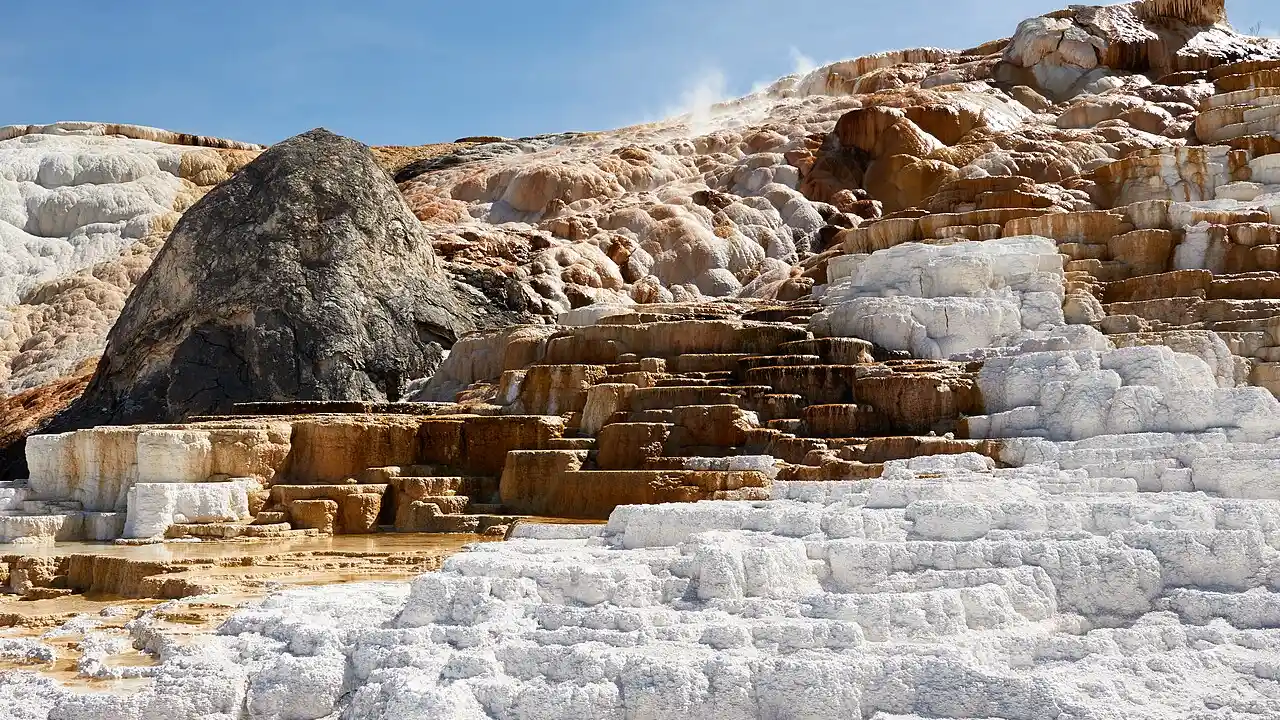
At Turkey's famous Pamukkale—whose name means 'Cotton Castle'—glowing turquoise pools sit inside snow-white travertine terraces!
✨ Word Sparks (Grade 2 Glossary)
Tap 🔊 to hear
crystallize
To turn from dissolved minerals into solid crystals
carbon dioxide
Invisible gas that makes soda and spring water fizz
patio
An outdoor stone courtyard next to a home
🪝
How can a rock grow so fast that you can spot new stone layers in a single summer?
1
Like Opening a Warm Soda
Most rocks take millions of years to form, yet travertine breaks the speed limit! Underground water packed with gas dissolves limestone as it heats up. When that warm spring water bubbles out at the surface, gas escapes—just like opening a warm soda—and solid calcite right away.
2
Yellowstone's Growing Staircases
At Mammoth Hot Springs in Yellowstone National Park, steaming water builds snowy-white and peach travertine terraces that can grow more than a foot thicker in just one year!
3
Cool Under Bare Feet
Because pale travertine reflects sunlight and holds tiny air pockets, tiles made of travertine stay pleasantly cool under bare feet on sunny days.
1. Why does travertine form right where underground spring water reaches the open air?
2. Where in the United States can you watch steaming travertine terraces growing today?
🤯 Mind-Blowing Fact • Grade 3
Virginia's breathtaking 80-foot Falling Spring Falls in Alleghany County plunges right over a giant cliff of porous travertine built by its own warm mineral spring water!
✨ Word Sparks (Grade 3 Glossary)
Tap 🔊 to hear
precipitate
To separate out of water as solid mineral
tufa
Extra-spongy freshwater limestone formed around cool springs
rimstone dam
Curved mineral ridge holding back a terraced pool
🪝
Why are travertine waterfalls bright turquoise blue and lined with lacy stone dams?
1
Freshwater Cousin of Marine Limestone
Both marine limestone and travertine share the exact same chemical formula—calcium carbonate (CaCO3)—and both fizz briskly in weak acid! The big difference is where they form: ordinary limestone builds up on ocean floors, whereas travertine on land from freshwater springs, rivers, and caves.
2
Waterfalls That Build Their Own Dams
Travertine does not always require volcanic heat! Whenever cool spring water splashes and tumbles over rocks—as at Havasu Falls in Arizona or Falling Spring Falls in Virginia's Alleghany County—churning agitation shakes out carbon dioxide gas. Calcite coats moss and sticks along pool rims, building curved natural and spongy rock called .
3
Heat-Loving Microbes Add Color
Pure travertine is snowy white, yet hot-spring terraces glow canary yellow, apricot orange, and emerald green where heat-loving bacteria and algae live in the warm water—and iron oxides stain older bands warm tan and rust.
4
Named After Tivoli in Italy
The word travertine comes from Tiburtinus, the ancient Roman name for quarries at Tivoli near Rome!
1. How is travertine different from ordinary ocean limestone even though both are made of calcium carbonate?
2. How can a tumbling waterfall like Virginia's Falling Spring Falls build travertine without boiling-hot geysers?
🤯 Mind-Blowing Fact • Grade 4
Los Angeles's gleaming Getty Center museum is wrapped in 1.2 million square feet of cleft-cut Italian travertine studded with fossilized leaves and feathers!
✨ Word Sparks (Grade 4 Glossary)
Tap 🔊 to hear
degassing
Escape of dissolved gas bubbles from liquid
thermophilic
Heat-loving organisms thriving in hot-spring waters
aragonite
Needle-shaped calcium carbonate crystal common in hot springs
🪝
How do microscopic bacteria help engineer giant travertine staircases at hot springs?
1
Underground Dissolution, Surface Degassing
Follow a raindrop sinking deep into fractures near Yellowstone or Italy's Apennine Mountains. Heated by magma miles below and charged with volcanic carbon dioxide gas, the hot groundwater turns acidic enough to dissolve thick buried beds of ancient marine limestone. Once that pressurized water bursts out at a surface spring, atmospheric pressure is hundreds of times lower: CO2 fizzes rapidly into the air, water pH rises, and calcium carbonate crystallizes up to five millimeters per day!
2
Thermophilic Biofilms Shape the Steps
Geobiologists discovered that travertine terraces are partnerships between chemistry and microscopic life! Mats of —heat-loving—cyanobacteria and microbes coat the wet pool lips. Their sticky filaments trap tiny and calcite needles like Velcro while photosynthesis consumes dissolved carbon dioxide, accelerating growth right where water spills fastest over terrace rims.
3
Vein-Cut Versus Fleuri-Cut Stone
Scoring 3 to 4 on the Mohs scale, quarried travertine displays Swiss-cheese cavities where gas bubbles and decayed plant stems once sat. Stonecutters saw blocks parallel to bedding for cloud-like swirls or perpendicular to bedding ('vein-cut') to showcase crisp creamy stripes—adorning landmarks like Los Angeles's Getty Center.
4
Fossilized Time Capsules
Because travertine entombs leaves, insects, and even prehistoric hominid footprints before they decay, scientists prize spring travertines as high-resolution archives of past climates.
1. Why do travertine rimstone dams grow fastest right along the lip where water spills over the edge?
2. What creates the small, irregular holes (vugs) scattered inside slabs of travertine?
🤯 Mind-Blowing Fact • Grade 5
By dating banded travertine veins that sealed ancient fault cracks using uranium-thorium isotopes, seismologists can pinpoint the exact centuries when prehistoric earthquakes ruptured the crust!
✨ Word Sparks (Grade 5 Glossary)
Tap 🔊 to hear
thermogene
Travertine deposited by deep, geothermally heated spring waters
polymorph
Mineral sharing identical chemistry with a different crystal lattice
fenestral porosity
Window-like small cavities preserved between carbonate rock layers
🪝
How can layers of banded travertine record earthquake faults, monsoon rainfall, and ice ages like pages in a calendar?
1
Thermogene Versus Meteogene Travertine Systems
Carbonate sedimentologists divide terrestrial freshwater CaCO3 precipitates into two geochemical families. travertines—such as Tivoli in Italy, Pamukkale in Turkey, and Mammoth Hot Springs—are driven by deep geothermal fluids rich in magmatic or metamorphic CO2, precipitating dense, finely laminated aragonite and calcite at millimeter-to-centimeter annual rates. Meteogene travertines (often called calcareous tufa), like Croatia's Plitvice Lakes and Virginia's karst waterfall aprons, form from cooler soil-CO2-charged groundwater degassing over turbulent cascades and bryophyte cushions.
2
Aragonite-to-Calcite Polymorphism
At spring orifices hotter than roughly 40 degrees Celsius with elevated magnesium-to-calcium ratios, orthorhombic aragonite needles crystallize first in delicate shrubby and radial fans. Downstream as water cools—or during shallow burial diagenesis—metastable aragonite recrystallizes into stable trigonal calcite spar while preserving sub-millimeter seasonal banding.
3
Tectonic Fault Valves and Uranium-Thorium Dating
Because hydrothermal travertine fissures open and seal during earthquakes along extensional faults, geologists use high-precision uranium-thorium radiometric dating on banded vein travertine to determine exact recurrence intervals of prehistoric seismic events!
4
Stable Isotope Paleoclimate Thermometers
Oxygen-18 and carbon-13 stable isotope ratios locked inside sub-millimeter seasonal bands of cave and spring travertines act as natural weather archives. By analyzing consecutive calcite laminae with mass spectrometers, paleoclimatologists track ancient groundwater temperatures, summer monsoon rainfall intensity, and ecological shifts between woodland trees and prairie grasses across hundreds of millennia.
5
Architectural Endurance and Acid Sensitivity
With compressive strengths rivaling dense marine limestone yet lower structural weight thanks to fenestral vugs that hold mortar tightly, quarried travertine has endured two thousand years in Rome's Colosseum, St. Peter's Basilica colonnade, and modern museum facades—while heritage conservationists carefully monitor urban acid deposition to prevent surface dissolution on historic carvings.