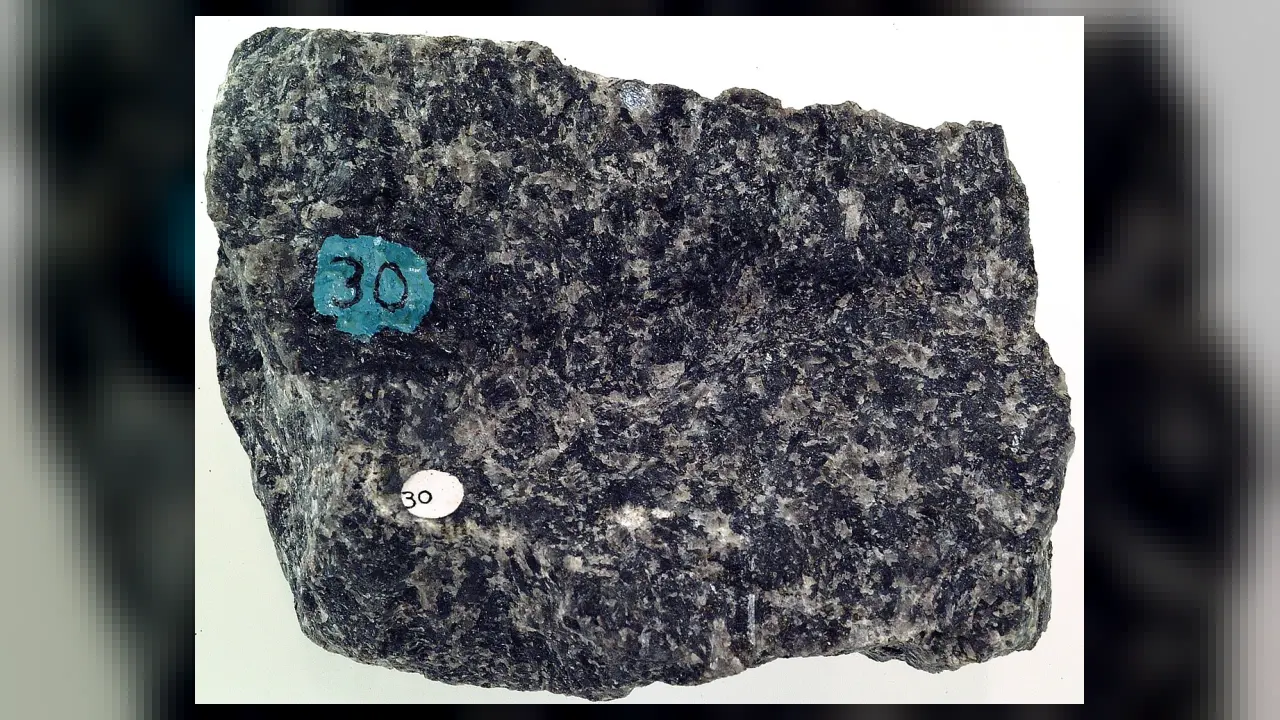
1. Why did the crystals inside gabbro grow big enough to see?
2. Where on Earth can you find huge layers of gabbro?
🤯 Mind-Blowing Fact • Grade 2
Even though builders call polished gabbro 'black granite,' true gabbro contains almost zero quartz!
✨ Word Sparks (Grade 2 Glossary)
Tap 🔊 to hear
interlocking
Fitting tightly together like puzzle pieces
polish
To rub a stone until it shines smoothly
olivine
An olive-green mineral found in dark rocks
🪝
Why do stone shops sell shiny black countertops as 'black granite' when they are really gabbro?
1
Basalt's Big-Crystal Twin
Imagine dark, iron-rich magma rising under the sea. The part that erupts into cold ocean water freezes fast into smooth black basalt. The magma left miles underground cools over thousands of years, growing chunky crystals of gabbro!
2
Tough, Heavy, and Glossy
Because gabbro holds lots of iron, calcium, and magnesium minerals, a fist-sized piece feels noticeably heavier than pale granite. Sometimes tiny flecks of green peek out between the dark gray and black grains.
3
Secret Identity on Countertops
When stoneworkers gabbro, it shines like a dark starry night. Builders often nickname it 'black granite' and use it for tough kitchen counters, floor tiles, and monuments.
1. Which fast-cooling volcanic rock has the exact same recipe as slow-cooling gabbro?
2. Why does a piece of gabbro feel heavier than the same-sized piece of pale granite?
🤯 Mind-Blowing Fact • Grade 3
Nearly two-thirds of Earth's solid surface is underlain by a layer of gabbro several miles thick beneath the oceans!
✨ Word Sparks (Grade 3 Glossary)
Tap 🔊 to hear
intrusive
Igneous rock crystallized slowly beneath Earth's surface
mid-ocean ridge
Underwater mountain chain where new crust forms
pyroxene
Dark iron-magnesium silicate mineral common in gabbro
🪝
How do underwater mountain chains manufacture billions of tons of gabbro without anyone seeing it?
1
Hidden Factory Under Mid-Ocean Ridges
Dive miles beneath the Atlantic or Pacific Ocean to a , where tectonic plates slowly pull apart. Below that underwater rift sits a giant magma chamber. While runny lava leaks out the top to form pillow basalt, the deeper chamber cools gradually into a thick foundation of coarse-grained gabbro.
2
Plutonic Rock With Visible Crystals
Geologists call igneous rocks that cool deep underground or plutonic rocks. Because surrounding rock insulates the chamber like a thermos, crystals of dark gray calcium plagioclase feldspar and glossy black grow several millimeters wide, locking tightly together.
3
Why Continents Float Higher Than Oceans
Continental crust is built mostly of lighter felsic granite, while oceanic crust is built of dense mafic basalt and gabbro. Because heavy gabbro rides lower on Earth's mantle, our planet has deep ocean basins that hold the seas!
4
Gabbro on Dry Land
Ancient tectonic collisions sometimes shove slices of ocean crust onto continents—and magma chambers also intrude land—exposing dark gabbro hills in places like Virginia's Piedmont.
1. How does dense gabbro help explain why Earth has deep ocean basins?
2. Which two main minerals lock together to give gabbro its dark, coarse-grained look?
🤯 Mind-Blowing Fact • Grade 4
South Africa's massive Bushveld layered gabbro complex holds more than seventy percent of the entire world's known platinum supply!
✨ Word Sparks (Grade 4 Glossary)
Tap 🔊 to hear
phaneritic
Coarse-grained texture where crystals show without magnification
ophiolite
Slice of ancient ocean crust uplifted onto land
pluton
Large body of magma crystallized deep underground
🪝
What happens when a slice of deep oceanic gabbro gets shoved onto dry land during a continental collision?
1
Comparing the Big Four Igneous Rocks
Earth scientists organize common igneous rocks on a neat two-by-two grid of chemistry and cooling depth. Felsic magma makes coarse granite underground and fine rhyolite on top; mafic magma makes fine basalt on top and coarse gabbro underground. Containing 45 to 52 percent silica, gabbro is packed with iron, magnesium, and calcium, giving it a hefty density near 2.9 to 3.1 grams per cubic centimeter.
2
Layer Three of Oceanic Crust and Ophiolites
Seismic waves show that oceanic crust follows a predictable cake-like stack: marine sediment on top, pillow basalt and sheeted dikes in the middle, and a two-to-three-mile-thick base of gabbro resting above mantle peridotite. Rarely, tectonic collisions thrust an intact slab of ocean crust—called an —up onto land, letting geologists walk right through ancient seafloor magma chambers in Oman, Cyprus, California, and Newfoundland!
3
Piedmont Gabbro and Rich Mineral Soils
In Virginia's Piedmont province, dark gabbro and diabase bodies intruded during ancient mountain-building and rifting eras. When warm rain chemically weathers gabbro's iron- and calcium-rich minerals, it breaks down into distinctive rusty-orange clay soils rich in plant nutrients.
4
World-Class Ore Treasures
As giant layered gabbro magma chambers cool, heavy metallic crystals sink to the floor, concentrating valuable deposits of platinum, chromium, nickel, titanium, and copper.
1. What is an ophiolite, and why do geologists travel across the world to study one?
2. How do valuable metals like platinum and chromium become concentrated inside giant gabbro chambers?
🤯 Mind-Blowing Fact • Grade 5
Precision aerospace factories measure jet parts on ultra-flat tables carved from polished gabbro because it expands less with heat and never rusts like steel!
✨ Word Sparks (Grade 5 Glossary)
Tap 🔊 to hear
Bowen's Reaction Series
Order in which minerals crystallize as magma cools
cumulate
Igneous rock layer formed by crystals settling downward
hydrolysis
Chemical weathering reaction between water and silicate minerals
🪝
Why does gabbro sit near the very top of Bowen's Reaction Series—and why does that matter both on Earth and on the Moon?
1
High-Temperature Crystallization on Bowen's Reaction Series
Examine a polished slab of gabbro where chatoyant labradorite feldspar flashes iridescent blue between dark augite crystals. Gabbro crystallizes from mafic tholeiitic or alkalic magmas at intense temperatures between 1,000 and 1,200 degrees Celsius—right at the top of . Early-forming olivine, calcic plagioclase, and clinopyroxene or orthopyroxene interlock in a coarse equigranular or ophitic texture, typically containing less than five percent quartz.
2
Layered Mafic Intrusions and Crystal Cumulates
When vast volumes of mantle-derived magma pond inside continental crust—as in Greenland's Skaergaard Intrusion, Montana's Stillwater Complex, or South Africa's Bushveld Complex—slow cooling over hundreds of thousands of years drives rhythmic convection and gravitational crystal settling. Dense chromite, magnetite, and platinum-group sulfide grains accumulate on the chamber floor like igneous sedimentary beds, called , creating strategic mineral horizons.
3
Goldich Dissolution Stability: Strong in Dry Air, Vulnerable to Acid Rain
Paradoxically, gabbro is extraordinarily strong and non-porous in polished precision surface plates—prized in engineering metrology labs because it resists warping better than steel—yet in warm, humid outdoor climates it chemically weathers faster than granite. Because calcic plagioclase and pyroxene crystallized at high temperatures far from surface conditions, carbonic acid in rainwater hydrolyzes them into smectite clays and iron oxides faster than quartz.
4
Oceanic Layer 3 and Seafloor Spreading
At fast- and slow-spreading mid-ocean ridges alike, seismic refraction identifies a four-to-five-kilometer-thick gabbroic Layer 3 whose cooling releases vast geothermal heat into deep-sea hydrothermal vents.
5
Lunar Highlands and Basaltic Worlds
Apollo samples revealed ancient lunar highland norites, troctolites, and gabbros over four billion years old—crystallized within the Moon's primordial magma ocean—proving plutonic mafic rocks build crusts across rocky worlds.