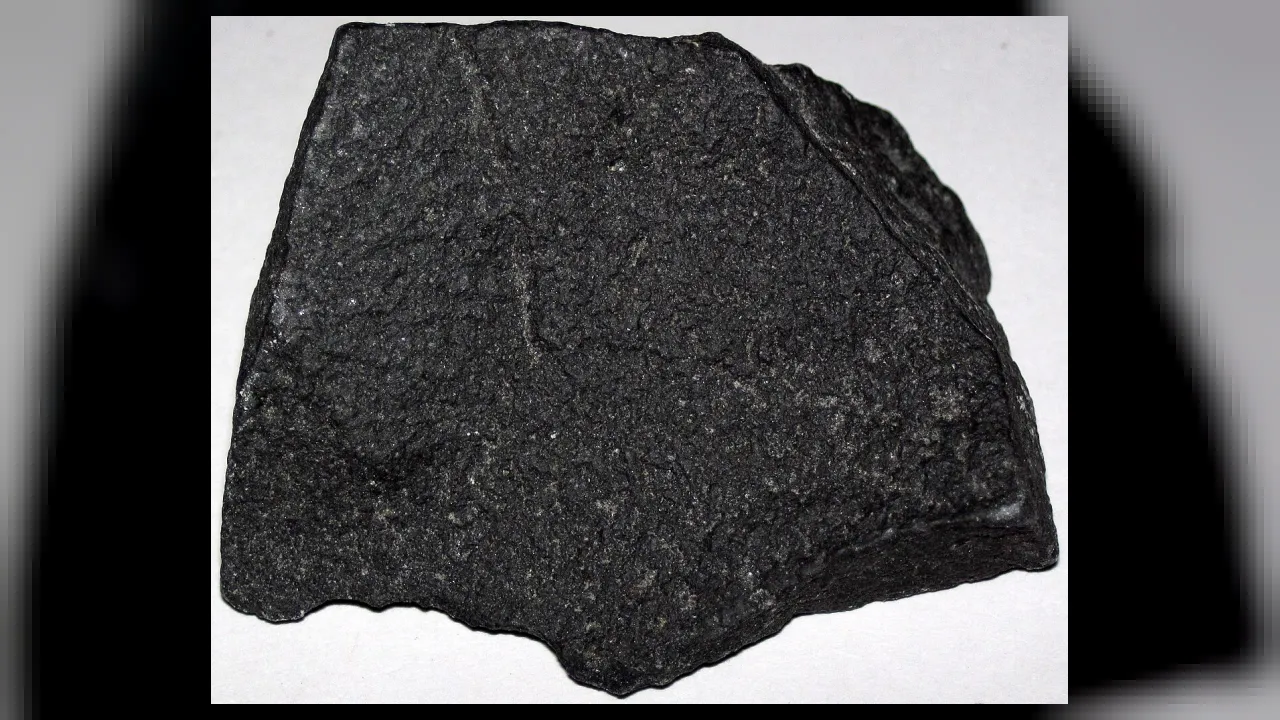
2. Where can you see giant plains of basalt just by looking up at night?
🤯 Mind-Blowing Fact • Grade 2
Black sand beaches in Hawaii and Iceland are made of tiny grains of dark basalt shattered when hot lava hit cold ocean waves!
✨ Word Sparks (Grade 2 Glossary)
Tap 🔊 to hear
basin
Huge bowl-shaped low area holding an ocean
column
Tall upright stone pillar or post
microscopic
So tiny you need a microscope
🪝
Why does lava underwater puff up like stone pillows, while lava on land can crack into neat six-sided posts?
1
Earth's Most Common Volcanic Rock
If you drained all the seawater off our planet, you would discover a giant dark blanket of basalt paving every ocean ! Because basalt lava is super hot and runny like warm syrup, it flows smoothly across miles before hardening.
2
Underwater Pillows!
When glowing basalt lava squeezes out of cracks along the icy-cold ocean floor, its outer skin chills instantly into rounded blobs stacked like stone sofa cushions—called pillow basalt!
3
Nature's Six-Sided Columns
Up on dry land, thick pools of cooling basalt shrink evenly and crack into astonishing six-sided stone pillars that look almost hand-carved by friendly giants!
1. What happens when hot basalt lava erupts directly into cold deep ocean water?
2. What gives Hawaii's famous black-sand beaches their dark color?
🤯 Mind-Blowing Fact • Grade 3
Olympus Mons on Mars—a towering shield volcano nearly three times taller than Mount Everest—is built almost entirely of hardened basalt lava flows!
✨ Word Sparks (Grade 3 Glossary)
Tap 🔊 to hear
olivine
Green mineral crystal common inside dark basalt
shield volcano
Wide, gently sloped volcano of runny lava
ballast
Crushed stone holding railroad tracks steady
🪝
How are granite and basalt complete opposites inside the igneous rock family?
1
Meet Granite's Opposite Twin
Hold pale, coarse granite in your left hand and dark, fine-grained basalt in your right! Both are igneous rocks born from melted stone, yet they tell opposite stories: granite cooled slowly miles underground inside continents, while extrusive basalt erupted out as lava and chilled rapidly.
2
Heavy With Iron and Magnesium
Why does a fist-sized piece of basalt feel so dark and heavy? Its magma holds less silica than granite and much more iron and magnesium! Those elements form dark minerals like pyroxene and olive-green , giving weathered basalt cliff edges a rusty brown outer coat.
3
Building Giant Shield Volcanoes
Because runny basalt lava spreads out in broad, thin sheets instead of piling into steep cones, flow after flow builds wide '' like Hawaii's Mauna Loa—Earth's largest active volcano rising miles from the Pacific seafloor!
4
Everyday Crushed Stone
Construction engineers crush tough, dense basalt into durable highway asphalt gravel, sturdy railroad track , and fireproof rock-wool building insulation!
1. Why are basalt's mineral crystals microscopic while granite's crystals are large?
2. Why does basalt lava build wide, gently sloped shield volcanoes like Mauna Loa?
🤯 Mind-Blowing Fact • Grade 4
Compton Peak in Virginia's Shenandoah National Park preserves stunning six-sided volcanic columns erupted 570 million years ago before multi-celled animals even walked on land!
✨ Word Sparks (Grade 4 Glossary)
Tap 🔊 to hear
hexagonal
Shaped with six straight sides and angles
fissure
Long crack in Earth erupting runny lava
pahoehoe
Smooth, rope-like surface of fluid basalt lava
🪝
Where can you touch 570-million-year-old hexagonal basalt columns right on a Virginia mountaintop?
1
Ancient Lava Columns Atop Shenandoah
Hike up Compton Peak or stroll the Limberlost Trail inside Virginia's Shenandoah National Park and you will stand before towering six-sided stone pillars! Roughly 570 million years ago, as an ancient supercontinent stretched and tore apart, giant ground flooded Virginia with glowing basalt lava. Later Appalachian mountain-building squeezed that basalt into greenish metamorphic Catoctin greenstone—yet the crisp geometric cooling columns still stand proudly along the ridge!
2
The Physics of Hexagonal Jointing
Why does cooling basalt split into neat hexagons instead of squares or circles? Just as sun-baked mud flats shrink and pull apart at 120-degree Y-shaped angles to release tension evenly, a thick, ponded lake of basalt lava contracts slightly as it cools, sending vertical fractures marching straight up and down into five-, six-, and seven-sided columns.
3
Two Famous Hawaiian Lava Textures
Hawaiian observers gave world geology two universal words for basalt lava surfaces: hotter, gas-rich lava cools with smooth, billowy, rope-like wrinkles called '' (pronounced pah-HOY-hoy), while cooler, slower flows break into sharp, clinkery rubble called 'aa' (pronounced AH-ah).
4
Earth's Mid-Ocean Ridge Conveyor
Every single year along the underwater Mid-Atlantic Ridge, rising mantle rock melts into fresh pillow basalt that widens the Atlantic Ocean floor—pushing Virginia and Europe about one inch farther apart!
1. What natural process creates six-sided columns at Giant's Causeway and Virginia's Compton Peak?
2. Where on Earth is brand-new basalt crust forming every single day?
🤯 Mind-Blowing Fact • Grade 5
Tiny magnetic iron minerals frozen inside mid-ocean basalt act like giant underwater tape recorders—preserving dozens of times Earth's North and South magnetic poles flipped over millions of years!
✨ Word Sparks (Grade 5 Glossary)
Tap 🔊 to hear
aphanitic
Igneous texture with crystals too tiny to see
magnetite
Naturally magnetic iron mineral in basalt
plume
Rising column of extra-hot rock from mantle
🪝
Why is basalt the most widespread volcanic rock across Mercury, Venus, Earth, the Moon, and Mars—and how is it helping capture carbon today?
1
Universal Crust of Rocky Worlds
Whether Soviet Venera landers analyze Venus's scorching plains, NASA rovers drill ancient craters on Mars, or Apollo astronauts bag regolith inside the Moon's Sea of Tranquility, one igneous rock dominates every inner rocky world in our solar system: basalt! Whenever a planet's upper silicate mantle—composed of magnesium-iron peridotite—undergoes decompression partial melting, the resulting liquid naturally forms low-viscosity mafic magma containing 45 to 52 percent silica (SiO₂) that erupts past 1,150°C.
2
Aphanitic Mineralogy and Magnetic Tape Recorders
Viewed in thin section under a polarizing microscope, basalt's (fine-grained) matrix reveals interlocking microscopic laths of calcium-rich plagioclase feldspar, dark augite pyroxene, green olivine, and tiny crystals of iron-titanium . Crucially, as fresh seafloor lava cools below its Curie temperature (~580°C), those magnetite grains lock permanently into alignment with Earth's magnetic field! Mapping symmetric normal and reversed magnetic stripes across mid-ocean basalt provided smoking-gun proof of plate tectonics in the 1960s.
3
Continental Flood Basalts and Ancient Rifting
During rare geologic episodes, colossal deep-mantle unleash continental 'flood basalts'—such as the Columbia River Basalt Group across Washington and Oregon or India's Deccan Traps—stacking kilometer-thick lava plateaus across entire regions. Closer to home, across Virginia's Culpeper and Danville Mesozoic basins, dark basalt flows and coarse intrusive diabase sills record the fiery rifting of supercontinent Pangaea 200 million years ago.
4
Turning Greenhouse Gas Into Solid Stone
Today, geochemists in Iceland's CarbFix project and the Pacific Northwest are harnessing basalt's reactive calcium, magnesium, and iron minerals for climate stewardship! When carbonated water carrying dissolved CO₂ is pumped into deep, porous vesicular basalt layers, chemical reactions rapidly release metal ions that bind the carbon into solid white calcite crystals—permanently turning gas into underground stone within two years.
5
Spinning Basalt Into Aerospace Fibers
Materials engineers even melt crushed quarried basalt at 1,450°C and extrude it through microscopic platinum bushings into golden-brown continuous basalt fiber—stronger than standard fiberglass, immune to salt-spray rust, and woven into coastal bridge rebar, wind-turbine blades, and spacecraft heat shields!