💎 EARTH SCIENCE
🪨 Planetary Lithospheric Recycling System
VA Science SOL 1.6, 2.6, 3.7, 4.4, 4.7, 5.8 (Weather, Rocks, Oceans & Earth Systems)
The Rock Cycle
Planet Earth's Nonstop Stone Recycling Machine
Grade 5 • Advanced • 319 words
🌍 Earth Science TypeEarth System Science & Dynamic Geology
🌋 Where It FormsFrom erupting mountain peaks and river valleys down into Earth's upper mantle
💎 Key PropertiesDriven by internal Earth heat, plate tectonics, solar weather, water, and gravity
⚡ Planet Earth SparkContinuously recycling igneous, sedimentary, and metamorphic rocks over millions of years
🤯 Mind-Blowing Fact • Grade 1
The pebble in your sneaker tread today might have been part of a volcano, an ocean floor, and a giant mountain range millions of years ago!
✨ Word Sparks (Grade 1 Glossary)
Tap 🔊 to hear
recycle
Turn old material into something brand-new
cycle
Repeating pattern with no single end
pebble
A small stone worn smooth by water
🪝
Does a hard stone stay the exact same forever, or does Earth recycle rocks?
1
Rocks on the Move!
Pick up a smooth gray by a creek! It feels quiet and still. Yet over millions of years, Earth every rock!
2
Three Changing Families
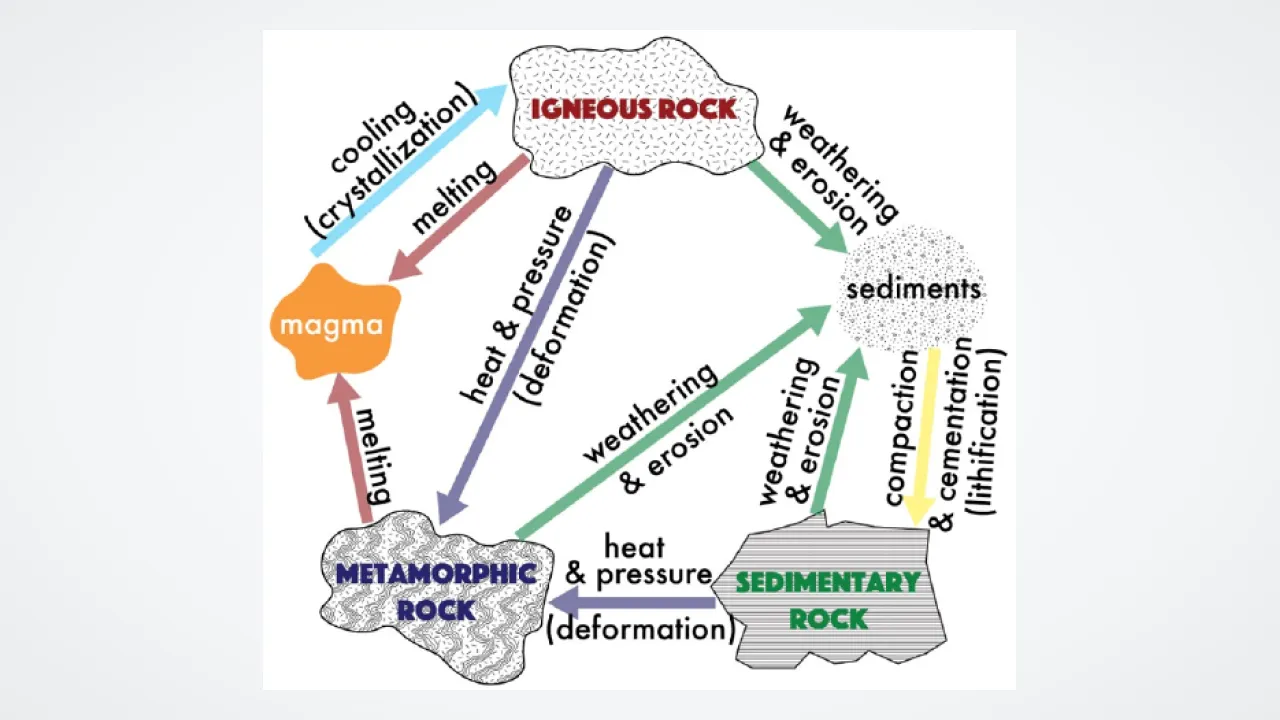
Rain and wind wear mountains into sand that presses into layered sedimentary rock. Deep heat and squeeze turn stone into metamorphic rock. Melting and cooling make igneous fire rock!
3
A Circle With No End
Round and round those changes go! Scientists call Earth's giant stone recycler the rock .
1. How fast does the rock cycle usually change one rock into another?
2. Which three rock families are connected by the rock cycle?
🤯 Mind-Blowing Fact • Grade 2
Because Earth constantly recycles its crust through the rock cycle, very few rocks from Earth's earliest days survive unchanged—unlike the quiet Moon!
✨ Word Sparks (Grade 2 Glossary)
Tap 🔊 to hear
weathering
Breaking big rocks into tiny pieces outdoors
crust
Earth's rocky outer shell we walk on
shortcut
A direct path between two places
🪝
Does the rock cycle only move in one neat circle, or can rocks take shortcuts?
1
Choose Your Own Adventure!
Unlike a clock hand spinning only one way, Earth's rock cycle is a web full of and loops! Any rock—igneous, sedimentary, or metamorphic—can transform into any other kind if conditions change.
2
Surface Weather vs. Deep Heat
Up on Earth's surface, sun, wind, ice, and rushing rivers break boulders into loose sediment that cements into sedimentary layers. Down below, Earth's inner heat and moving bake stones into metamorphic rock or melt them into magma!
3
Even Melting Yourself Over!
An igneous granite boulder can even sink back down, melt again into glowing magma, and cool into a brand-new igneous rock—nothing is ever wasted on our dynamic planet Earth!
1. Why is the rock cycle more like a web of paths than a one-way race track?
2. Why does the Moon still have so many ancient, unchanged surface rocks compared to Earth?
🤯 Mind-Blowing Fact • Grade 3
Scottish scientist James Hutton first described Earth's endless rock cycle in the 1780s after spotting tilted ancient layers capped by younger sandstone at Siccar Point!
✨ Word Sparks (Grade 3 Glossary)
Tap 🔊 to hear
uplift
Pushing deep underground rock upward into mountains
internal
Located deep on the inside
conserve
Keep total amount unchanged without losing pieces
🪝
What two giant energy engines keep Earth's rock cycle running day and night?
1
Two Giant Engines Working Together
Stand where a bubbly mountain stream tumbles over granite ledges and you are watching two giant energy engines tug in opposite directions! Deep underground, Earth's heat pushes magma upward and lifts tall mountain ranges; overhead, the Sun's energy powers wind, rain, and glaciers that carve mountains back down.
2
Following One Quartz Grain's Journey
Watch one tough glassy quartz crystal travel the rock cycle! Born inside cooling underground granite (igneous), it gets uncovered by rain erosion, washes down a river to a sunny beach, and cements tightly into sandstone (sedimentary).
3
Down Into the Mountain Roots
Millions of years later, colliding continents bury that sandstone miles deep! Intense heat and pressure fuse its sand grains into sparkling quartzite (metamorphic)—and if pushed deeper still, it melts completely into magma to start fresh!
4
Earth's Matter Is Conserved
Atoms of silicon, oxygen, iron, and calcium never vanish into thin air; the rock cycle simply rearranges those building blocks into endless new minerals and textures!
1. Which two energy sources drive Earth's rock cycle?
2. How can a deep underground metamorphic rock eventually become sedimentary sand?
🤯 Mind-Blowing Fact • Grade 4
Along Richmond's Fall Line on the James River, soft Coastal Plain sediments meet hard Piedmont granite and gneiss—creating natural rapids that determined where early Virginia cities grew!
✨ Word Sparks (Grade 4 Glossary)
Tap 🔊 to hear
tectonics
Motion of giant plates forming Earth's crust
divergent
Moving apart in opposite directions
convergent
Pushing together toward a collision zone
🪝
How can you drive across all five chapters of the rock cycle on a single road trip across Virginia?
1
A Cross-State Time Machine
Buckle up for an east-to-west geology trip across Virginia's five physiographic provinces—a classroom favorite for Virginia SOL Earth science! Starting at Virginia Beach on the Coastal Plain, Atlantic waves sort loose quartz sand and shell fragments destined for future sedimentary rock. Drive west across the Fall Line in Richmond or Fredericksburg, and rushing river rapids foam over tough Piedmont metamorphic schists and igneous Petersburg granite!
2
Blue Ridge Fire to Valley Limestone
Climb westward onto Skyline Drive in the Blue Ridge province and you stand atop billion-year-old intrusive granite alongside ancient basalt lava metamorphosed into greenstone. Drop down into the Valley and Ridge and Appalachian Plateau provinces, and folded Paleozoic limestones, cavern halls, ridge-forming sandstones, and southwest coal seams reveal vanished tropical seas and ancient fern swamps!
3
Plate Tectonics Turns the Wheel
What stitched all five provinces together over hundreds of millions of years? Plate ! mid-ocean ridges birth fresh basalt crust; continental collisions fold sedimentary beds into metamorphic mountain cores; and deep subduction zones drag wet rock down to melt into rising volcanic arcs.
4
Connected to Water and Carbon Cycles
Earth's rock cycle even partners with our atmosphere and oceans: rainwater slowly weathers silicate mountain rocks and carries dissolved calcium ions downstream to the sea, where corals and clams build brand-new limestone reefs!
1. How do plate tectonics keep the rock cycle moving?
2. What creates the rushing rapids at Virginia's Fall Line in cities like Richmond and Fredericksburg?
🤯 Mind-Blowing Fact • Grade 5
Because dense ocean-floor basalt continually recycles down subduction trenches, almost zero open-ocean crust on Earth is older than 200 million years—while continental rocks preserve 4-billion-year-old history!
✨ Word Sparks (Grade 5 Glossary)
Tap 🔊 to hear
unconformity
Gap in rock layers showing vanished time
craton
Ancient, stable core of a continent
hydrothermal
Involving mineral-rich water heated underground
🪝
How does the rock cycle link radioactive mantle heat, oceanic crust conveyor belts, and Earth's long-term climate thermostat?
1
Hutton's Unconformity and Deep Time
In June 1788, Scottish geologist James Hutton rowed along dramatic North Sea cliffs to Siccar Point and beheld vertical beds of gray Silurian metamorphic slate planed flat by ancient erosion and capped by gently sloping red Devonian sandstone. Calculating how many geologic chapters were required to deposit deep ocean mud, fold it upright inside colliding mountains, erode those peaks flat, and bury them anew convinced Hutton that planet Earth operates as a dynamic, self-renewing rock machine across billions of years of 'deep time.'
2
The Oceanic Crust Conveyor Belt
Modern plate-tectonic geophysics reveals striking differences in how oceanic and continental crust cycle. Along a 65,000-kilometer global seam of mid-ocean ridges, decompression melting continuously extrudes dense basalt seafloor that spreads outward, collects deep-sea ooze, and plunges back into the mantle down subduction trenches within 200 million years. Buoyant, lower-density continental granite, by contrast, resists subduction—preserving folded, metamorphosed continental up to four billion years old!
3
Thermodynamics of Five Transition Pathways
Every pathway on a rock-cycle diagram reflects minerals adjusting toward chemical equilibrium with their surroundings: magmatic crystallization locks molten ions into silicate lattices; surface weathering and erosion break high-temperature minerals down into stable clays and quartz; diagenetic lithification compacts and cements loose detritus; solid-state metamorphism recrystallizes rocks under kilobar mountain pressures; and deep crustal melting resets stone back into incandescent magma.
4
Earth's Carbonate-Silicate Climate Thermostat
Crucially, the rock cycle stabilizes Earth's long-term habitability! Slightly acidic rainwater containing dissolved atmospheric CO₂ chemically weathers calcium-silicate mountain rocks, washing calcium and bicarbonate ions down rivers into oceans where marine organisms lock that carbon into limestone reefs. Tens of millions of years later, subducted limestone vents measured CO₂ back through volcanic arcs—maintaining a planetary thermostat that has kept Earth's oceans liquid for over four billion years!
5
Concentrating Essential Mineral Resources
Every mineral resource society depends upon is sorted and concentrated by rock-cycle processes: veins precipitating copper, silver, and gold around cooling igneous plutons; ancient evaporite seas crystallizing halite and potash; and high-pressure regional metamorphism forging Virginia's industrial kyanite, slate, and soapstone.