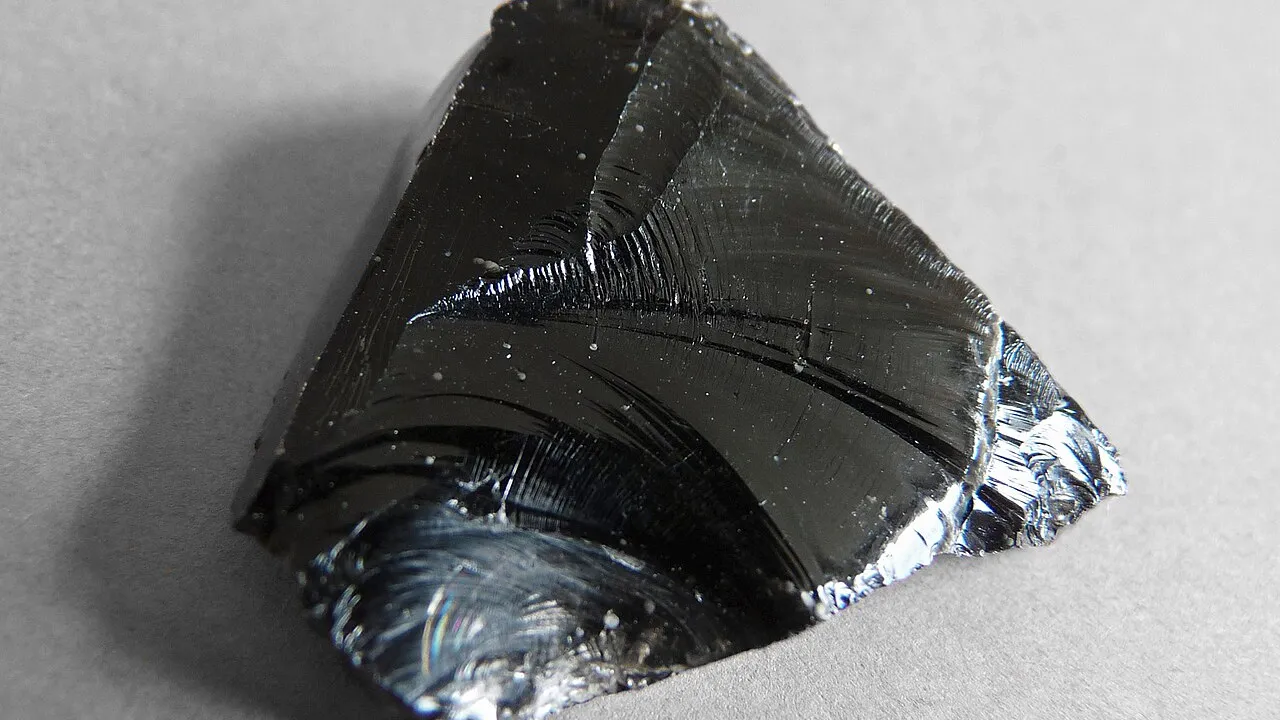
2. What did ancient people make from sharp pieces of obsidian?
🤯 Mind-Blowing Fact • Grade 2
Yellowstone National Park has an entire mountainside made of black volcanic glass called Obsidian Cliff!
✨ Word Sparks (Grade 2 Glossary)
Tap 🔊 to hear
volcanic glass
Natural glass formed when lava cools rapidly
ripple
A small curved wave pattern on a surface
mineral
A natural solid building block of rocks
🪝
Why does obsidian look like a dark mirror instead of a grainy rock?
1
Born in a Volcano's Chill
Imagine thick, glowing lava oozing out of a volcano into chilly air or cold water. Instead of cooling slowly underground, the lava freezes right away. That sudden chill turns the melted rock into smooth, jet-black .
2
Colors Hidden in the Glass
Most obsidian is glossy black, yet tiny bits of iron can turn it reddish-brown or golden. Sometimes white clusters form inside over time, creating a pretty pattern called snowflake obsidian.
3
Curved Ripples and Ancient Blades
When obsidian cracks, it breaks in smooth, shell-shaped . Because those thin edges are extra sharp, Native American craftspeople traded obsidian across hundreds of miles to shape spear points and scrapers.
1. What creates the white spots inside snowflake obsidian?
2. How does obsidian break when struck?
🤯 Mind-Blowing Fact • Grade 3
Under a powerful microscope, a steel scalpel looks jagged like a saw, while an obsidian blade stays mirror-smooth!
✨ Word Sparks (Grade 3 Glossary)
Tap 🔊 to hear
silica
A common Earth compound that makes thick glass
mineraloid
A natural glass-like solid lacking crystal structure
conchoidal fracture
Smooth, curved breakage shaped like a seashell
🪝
Can something born from a volcano be a rock without having any mineral crystals at all?
1
Thick Silica-Rich Lava
Picture a slow, sticky lava flow creeping down the flank of a volcano. Unlike runny Hawaiian lava, this magma is packed with , the exact same chemical ingredient found in quartz sand and window glass. Because silica makes lava thick and syrupy, atoms struggle to move around inside it.
2
Frozen Before Crystals Can Form
Along the outer crust of a lava dome or where lava meets a lake, temperatures plunge rapidly. Atoms lock into place in a jumbled, disorderly arrangement before they can line up into neat mineral crystals. Geologists call this crystal-free volcanic glass a .
3
Shell-Shaped Conchoidal Fracture
Strike a piece of obsidian carefully, and shock waves travel evenly through the uniform glass. The stone splits with a curved, clam-shell pattern known as . Its freshly flaked rim can be many times thinner than paper.
4
From Stone Age Trade to Modern Surgery
Prehistoric cultures prized obsidian for mirrors, jewelry, and hunting blades. Even today, specialized eye and delicate tissue surgeons sometimes use obsidian scalpel blades because their glass edges cut more cleanly than steel.
1. Why does high silica content help obsidian turn into glass?
2. Why do geologists classify obsidian as a mineraloid rather than a true mineral?
🤯 Mind-Blowing Fact • Grade 4
Archaeologists found obsidian tools in 2,000-year-old Ohio Valley mounds that traveled more than 1,500 miles from Yellowstone in Wyoming!
✨ Word Sparks (Grade 4 Glossary)
Tap 🔊 to hear
felsic
Rich in silica and light-colored feldspar elements
amorphous
Having atoms arranged randomly with no crystals
devitrification
Slow change of natural glass into tiny crystals
🪝
Why does the exact same melted rock become coarse pink granite deep underground, yet jet-black glass at Earth's surface?
1
One Magma, Two Completely Different Fates
Hold a chunk of speckled granite in one hand and glossy black obsidian in the other, and they look like total opposites. Remarkably, both come from magma containing roughly seventy percent silica! In Earth's rock cycle, cooling rate controls texture. Trapped miles underground, felsic magma cools over thousands of years, growing visible quartz and feldspar crystals. Extruded onto the surface, its outer edges quench almost instantly into volcanic glass.
2
Microscopic Iron and Rainbow Sheen
Pure silica glass is clear, so why is obsidian dark? Even tiny amounts—often less than two percent—of finely dispersed iron and magnesium oxides tint the glass deep black or mahogany brown. When microscopic gas bubbles or magnetite nanoparticles align along flow layers, light reflects off thin internal layers to create shimmering gold sheen or iridescent rainbow obsidian.
3
Why Obsidian Disappears From Ancient Rocks
On the Mohs hardness scale, obsidian measures 5 to 5.5, slightly softer than quartz. Over millions of years, volcanic glass is chemically unstable at Earth's surface. Absorbing trace water causes it to slowly crystallize in a process called , forming radiating white cristobalite clusters before eventually turning into fine-grained rock. Consequently, nearly all obsidian on Earth is geologically young, mostly fewer than twenty million years old.
4
Tracing Prehistoric Trade Networks
Every volcanic flow has a unique chemical fingerprint of trace elements. Archaeologists analyze obsidian spear points found in ancient North American sites—even thousands of miles east of western volcanoes—and match them directly back to Obsidian Cliff in Wyoming or Valles Caldera in New Mexico.
1. If obsidian and granite have almost the same silica-rich chemistry, what makes them look so different?
2. Why do geologists rarely find obsidian that is hundreds of millions of years old?
🤯 Mind-Blowing Fact • Grade 5
An obsidian flake's cutting edge can narrow to just 3 nanometers—only about thirty atoms wide!
✨ Word Sparks (Grade 5 Glossary)
Tap 🔊 to hear
viscosity
A fluid's thickness and resistance to flowing
isotropic
Having identical physical properties in every direction
hydration rim
Thin water-soaked outer layer used to date obsidian
🪝
How does extreme magma viscosity turn a volcanic eruption into blades just three nanometers thick?
1
Polymerized Silica Chains and Extreme Viscosity
Step onto Oregon's Big Obsidian Flow at Newberry Volcano, where a rugged sea of sparkling black blocks stretches across a square mile of crater floor. Thirteen hundred years ago, rhyolitic magma containing more than 70 percent silicon dioxide erupted at roughly 800 to 900 degrees Celsius. At such high silica concentrations, silicon-oxygen tetrahedra link into tangled chains before the lava even exits the vent. That high —millions of times thicker than runny basalt—prevents ions from diffusing into ordered crystal lattices as the flow margin chills.
2
Crossing the Glass Transition
Instead of crystallizing at a sharp freezing point, rapidly cooled rhyolitic melt passes through a glass transition, locking disordered atomic chains into a rigid supercooled solid. Because obsidian lacks cleavage planes between mineral grains, mechanical stress propagates smoothly along curved shock fronts. Skilled flintknappers exploit this structure to strike off blades whose cutting edges taper to roughly 3 nanometers—nearly ten times thinner than honed surgical steel.
3
Optical Physics of Mahogany, Sheen, and Snowflake Varieties
Variations in oxidation state and microscopic inclusions produce striking optical effects. Oxidized hematite wisps swirl with dark magnetite to create reddish-streaked mahogany obsidian. Thin-film interference across sub-micron layers of aligned nanoparticles generates purple, green, and gold flashes in fire and rainbow obsidian. Meanwhile, partial devitrification nucleates spherical, radiating clusters of white cristobalite—a high-temperature silica polymorph—yielding classic snowflake obsidian.
4
Obsidian Hydration Dating and Geochemical Sourcing
The instant a human chips a fresh obsidian tool, atmospheric water begins diffusing into the newly exposed surface at a measurable, temperature-dependent rate, forming a microscopic . By measuring this rim's thickness in microns under polarized light and combining X-ray fluorescence trace-element ratios of rubidium, strontium, and zirconium, geoarchaeologists pinpoint both when an artifact was flaked and the exact volcanic dome where it originated.
5
Where to Find Obsidian on Earth
Because water infiltration and recrystallization destroy volcanic glass over geologic eons, obsidian outcrops cluster in Cenozoic volcanic belts—including the Cascade Range, Yellowstone Caldera, Mexico, Iceland, Japan, and Italy's Aeolian Islands—preserving snapshots of Earth's youngest silicic eruptions.