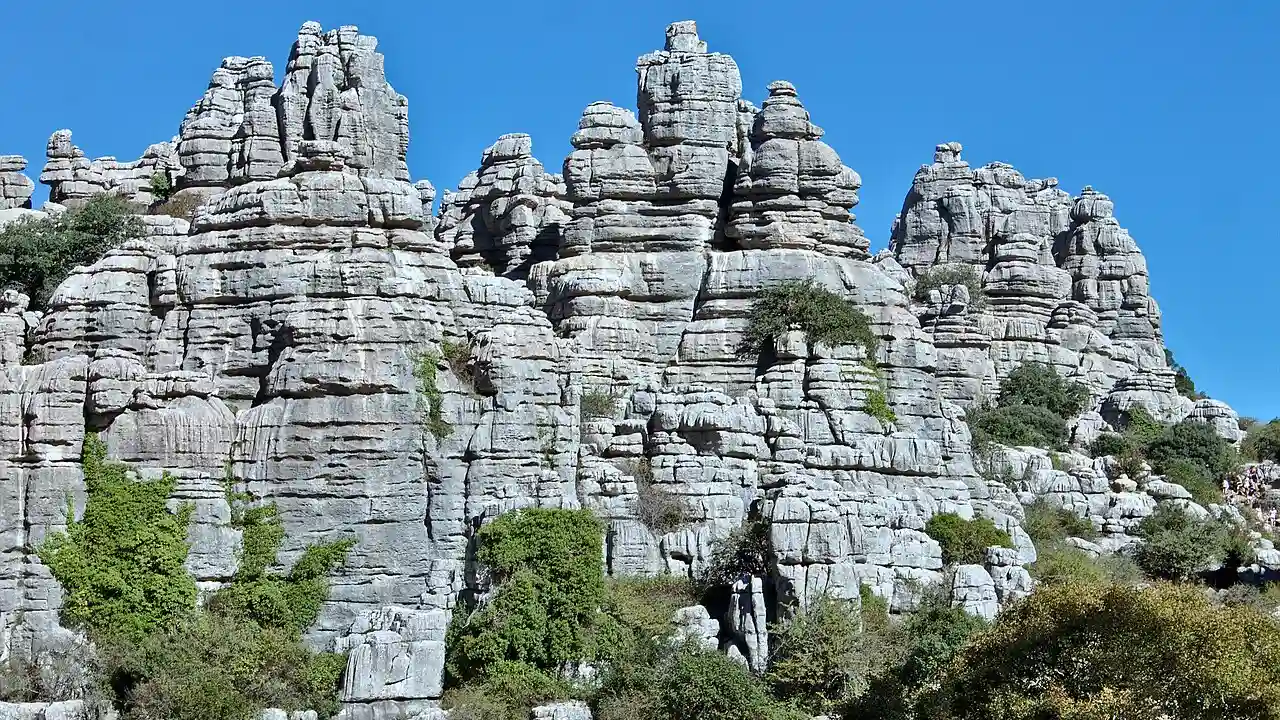
2. What happens when you put a drop of vinegar or lemon juice on limestone?
🤯 Mind-Blowing Fact • Grade 2
Virginia's famous Natural Bridge—standing 215 feet tall—is the leftover roof of an ancient collapsed limestone cavern!
✨ Word Sparks (Grade 2 Glossary)
Tap 🔊 to hear
calcite
The main mineral inside seashells and limestone
sedimentary
Rock formed from layers pressed and cemented together
cavern
A huge underground cave room in rock
🪝
Why can you find ocean shells locked inside mountain rocks hundreds of miles from the beach?
1
A Blanket of Sea Life
Imagine swimming over a sunny tropical reef millions of years ago! Clams, snails, corals, and sea lilies built hard shells from minerals in the seawater. When they died, their broken shells drifted down like white snow and hardened into limestone.
2
The Acid Fizz Test
Limestone is made of a mineral called . Geologists carry a small dropper bottle of weak acid to test mystery rocks. One drop on calcite releases tiny carbon dioxide bubbles that fizz right before your eyes!
3
Virginia's Underground Wonderlands
Long after ancient seas dried up, Earth pushed those limestone layers into valleys and hills. Slightly acidic rainwater seeped through cracks, carving famous caves like Luray in Virginia.
1. Which main mineral makes up seashells and limestone?
2. How did Luray Caverns and Natural Bridge form in Virginia?
🤯 Mind-Blowing Fact • Grade 3
In Virginia's Luray Caverns, a musical instrument called the Great Stalacpipe Organ taps real limestone stalactites to play echoing songs across 3.5 acres of cave!
✨ Word Sparks (Grade 3 Glossary)
Tap 🔊 to hear
calcium carbonate
Chemical compound forming calcite, shells, and limestone
karst
Landscape of caves and sinkholes in dissolved rock
stalactite
Icicle-shaped mineral formation hanging from cave ceilings
🪝
How does ordinary rainwater turn solid gray limestone into dripping cave icicles made of stone?
1
Built From Calcium Carbonate
Run your fingers across a fossil-packed slab of gray or cream limestone, and you may feel ribbed brachiopod shells, crinoid stems, and lacy corals. Marine organisms extract dissolved calcium and carbonate ions from warm, sunlit seawater to build shells of . Over millions of years, burial and mineral cement turn that lime mud and shell hash into solid sedimentary rock.
2
Karst Landscapes and Sinkholes
As rain falls through the sky and perks through soil, it absorbs carbon dioxide, becoming very weak carbonic acid. Trickling along joints in limestone bedrock, this water dissolves calcite molecule by molecule. Regions shaped by dissolving limestone—featuring caves, disappearing streams, and sinkholes—are called topography.
3
Stalactites and Stalagmites
Inside an air-filled cave chamber, mineral-rich water drips from the ceiling, releasing carbon dioxide gas and leaving tiny rings of calcite behind. Icicle-like hang tight to the ceiling, while stalagmites mound upward from the cave floor.
4
Everyday Ingredient in Cement
People quarry limestone to carve classic buildings, neutralize acidic farm soils, and bake into Portland cement for sidewalks, bridges, and skyscrapers.
1. What do geologists call a landscape with caves, springs, and sinkholes carved into dissolving limestone?
2. What makes ordinary rainwater slightly acidic before it seeps into limestone cracks?
🤯 Mind-Blowing Fact • Grade 4
Both the Empire State Building in New York and the Pentagon in Virginia are clad in fossil-bearing Indiana oolitic limestone!
✨ Word Sparks (Grade 4 Glossary)
Tap 🔊 to hear
lithify
To compact and cement loose sediment into rock
ooid
Tiny pearl-like sphere of layered calcium carbonate
coquina
Limestone made almost entirely of broken shell fragments
🪝
Why is Virginia's Shenandoah Valley famous for both fertile farms above ground and spectacular caverns below?
1
When an Ancient Sea Covered the Appalachians
Drive down Virginia's Valley and Ridge province through the Shenandoah Valley, and you are traveling across the floor of an ancient tropical sea! Around 450 to 500 million years ago during the Paleozoic Era, warm shallow waters covered much of eastern North America. Billions of marine shells, calcareous algae, and lime muds accumulated thousands of feet thick, lithifying into vast beds of limestone that were later folded and uplifted.
2
Why Valleys Form Between Sandstone Ridges
Scoring just 3 on the Mohs hardness scale, calcite-rich limestone weathers chemically much faster in humid climates than tough quartz sandstone. Over millions of years, weakly acidic groundwater dissolved the limestone beds downward into broad, fertile agricultural valleys, leaving harder sandstone layers towering on either side as long mountain ridges.
3
Varieties: Coquina, Oolitic, and Lithographic Limestone
Not all limestone looks alike! Florida's is a porous mass of loosely cemented clam shells. Indiana's oolitic limestone—used on the Empire State Building and the Pentagon—consists of tiny, wave-rolled spheres of calcite called that carve smoothly in every direction.
4
Protecting Karst Groundwater
Because water races rapidly through open karst cave conduits without natural sand filtration, Virginia communities carefully protect sinkholes and springs to keep well water clean.
1. Why does limestone underlie the low floor of Virginia's Shenandoah Valley while sandstone forms the high ridges beside it?
2. Why is groundwater in limestone karst regions extra sensitive to surface pollution?
🤯 Mind-Blowing Fact • Grade 5
More than eighty percent of all the carbon on Planet Earth is locked away safely inside limestone and related carbonate rocks!
✨ Word Sparks (Grade 5 Glossary)
Tap 🔊 to hear
speleothem
Any mineral cave formation like stalactites or flowstone
calcination
Heating limestone strongly to make reactive quicklime
carbon reservoir
Major natural storage place holding Earth's carbon
🪝
How does humble gray limestone act as Earth's largest long-term vault for carbon dioxide?
1
Planetary Carbon Lockbox
Examine a cliff of bedded marine limestone, and you are looking at Earth's single largest reservoir of carbon—far surpassing all living forests, soils, and coal beds combined! Whenever silicate rocks weather on land, rivers carry dissolved calcium and bicarbonate ions to the ocean. Coral polyps, mollusks, foraminifera, and precipitating lime muds combine those ions into calcium carbonate (CaCO3), locking atmospheric carbon away in stone for hundreds of millions of years and keeping Earth from overheating like Venus.
2
Inverse Solubility of Calcite in Warm Seas
Unlike table salt or sugar, which dissolve more easily as water warms, calcium carbonate exhibits retrograde solubility: it precipitates most readily in warm, sunlit, agitated shallow water! Wave action and photosynthesis by marine algae strip dissolved carbon dioxide from tropical shoals—such as the modern Bahama Banks—raising seawater pH and triggering milky clouds of microscopic aragonite needles and concentric ooids.
3
Reversible Karst Geochemistry
Once uplifted onto continents, limestone enters a reversible chemical dance: CaCO3 + H2O + CO2 <-> Ca2+ + 2HCO3-. Soil-enriched carbonic acid dissolves bedrock downward along joints to excavate multiphase cave labyrinths; when cave drips degas carbon dioxide into cavern air, the equation runs backward, precipitating crystalline .
4
Calcination Into Quicklime and Cement
In industrial kilns heated above 900 degrees Celsius, limestone undergoes , driving off carbon dioxide to yield reactive quicklime (CaO)—essential for Portland cement clinker, steelmaking flux, and flue-gas scrubbers.
5
Metamorphic Destiny
Subducted or buried beneath colliding mountain belts, fossiliferous limestone recrystallizes under intense heat and pressure into interlocking crystalline marble, beginning another turn of the rock cycle.