1. How do sedimentary rocks form over millions of years?
2. Which group of rocks holds almost all of Earth's dinosaur and shell fossils?
🤯 Mind-Blowing Fact • Grade 2
Finding fossil seashells inside limestone high near the top of Mount Everest proved that the world's tallest mountain peak once sat beneath an ancient ocean!
✨ Word Sparks (Grade 2 Glossary)
Tap 🔊 to hear
compaction
Pressing sediment tightly under heavy upper weight
sandstone
Gritty sedimentary rock made of cemented sand
limestone
Sedimentary rock often formed from sea shells
🪝
Why do canyon cliffs look like giant striped birthday cakes of red, tan, and gray?
1
Nature's Recycling Crew
Every mountain on Earth slowly crumbles under wind, rain, and freezing ice! Rivers carry those worn-down grains of gravel, sand, and clay out to calm water, dropping them in flat blankets.
2
Squeeze and Glue!
Turning loose beach sand into solid takes two patient steps. First, heavy upper layers squeeze water and air spaces out—called . Next, dissolved minerals in groundwater act like natural cement, gluing every grain tight!
3
Reading Stripes From Bottom to Top
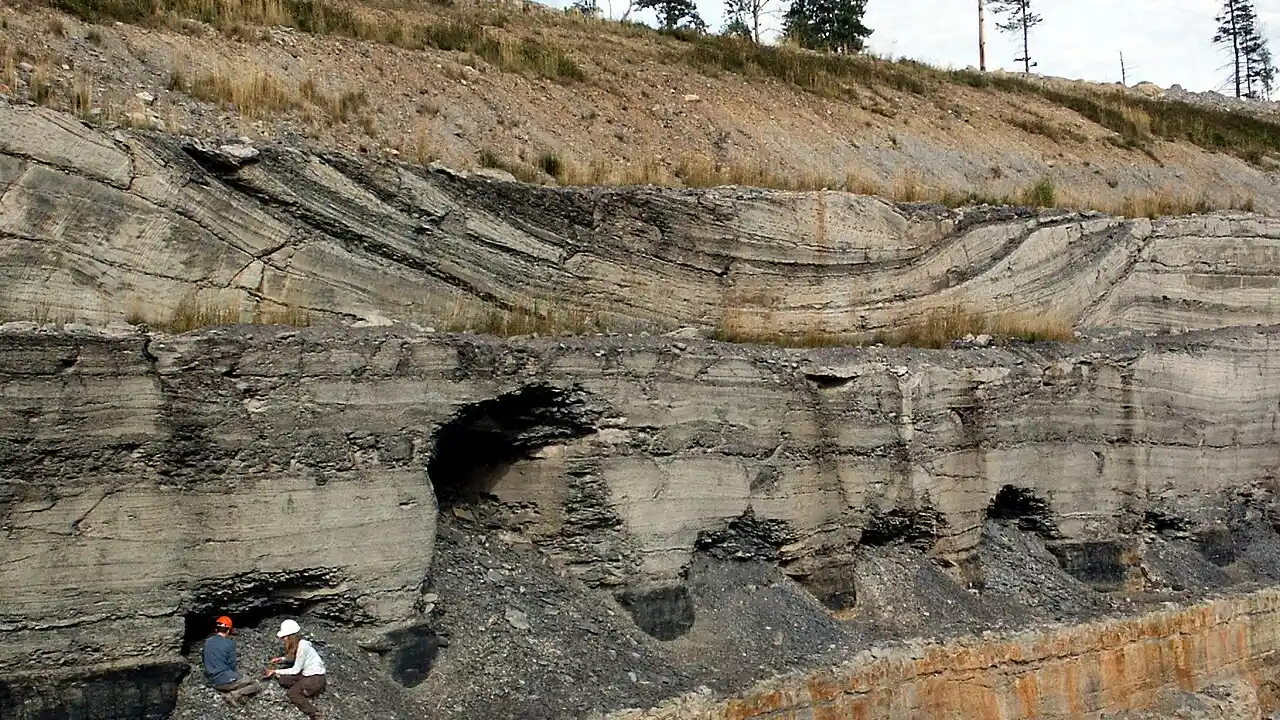
In undisturbed cliffs like the Grand Canyon, the oldest rock layers sit right on the bottom and the youngest layers rest up on top—just like clothes tossed into a laundry basket all week!
1. In a stack of undisturbed sedimentary rock layers, where is the oldest layer?
2. What did fossilized sea creatures near the top of Mount Everest prove?
🤯 Mind-Blowing Fact • Grade 3
Rippled waves frozen into solid sandstone slabs preserve the exact direction wind or shallow water flowed hundreds of millions of years ago!
✨ Word Sparks (Grade 3 Glossary)
Tap 🔊 to hear
deposition
Dropping carried sediment in a new place
cementation
Dissolved minerals gluing sediment grains into rock
conglomerate
Sedimentary rock made of cemented rounded pebbles
🪝
Can rock form from evaporating salty water or ancient swampy plants as well as river sand?
1
Four Patient Steps to Stone
Follow a single tough quartz grain chipped off a Blue Ridge cliff! First, weathering breaks it loose from mountain rock; second, rushing erosion carries it down the James River; third, gentle drops it onto a calm sandy delta; and fourth, slow compaction plus mineral lock it into solid sandstone.
2
Clastic Rocks: Built From Broken Pieces
Geologists sort fragment-built sedimentary rocks by grain size. Smooth river pebbles cemented together form lumpy , medium sand grains build gritty sandstone, and microscopic mud and clay particles press into flat, easily split shale.
3
Chemical and Organic Rocks
Not all sedimentary rocks come from tumbled pebbles! When shallow desert lakes evaporate in hot sunshine, dissolved minerals crystallize into rock salt and white gypsum. Meanwhile, coral and clam shells build gray limestone, and compressed ancient swamp ferns turn into black coal.
4
A Blanket Across the Continents
Although sedimentary layers form a relatively thin blanket compared to deep granite crust underneath, they cover roughly three-quarters of Earth's land surface!
1. Which sedimentary rock is made of rounded pebbles cemented together?
2. How does chemical rock salt form in dry basins?
🤯 Mind-Blowing Fact • Grade 4
At Yorktown and Chippokes State Park in Virginia, Chesapeake Bay waves wash millions-of-years-old Miocene shark teeth and giant Chesapecten scallop fossils straight out of soft sedimentary cliffs!
✨ Word Sparks (Grade 4 Glossary)
Tap 🔊 to hear
strata
Stacked horizontal beds of sedimentary rock
porous
Having tiny open spaces holding water
aquifer
Underground rock layer storing fresh groundwater
🪝
How do Virginia caves, Grand Canyon cliffs, and Mars rover discoveries all tie back to sedimentary rocks?
1
Reading Earth's Diary Page by Page
Think of horizontal sedimentary —stacked rock beds—as illustrated pages in planet Earth's biography! Polygon mud cracks preserved inside red shale reveal a sun-baked drought 250 million years ago; sweeping cross-bedded sandstone cliffs in Utah trace ancient windblown desert dunes; and shell-packed coquina and Yorktown cliffs along Virginia's Coastal Plain preserve fossil whale bones, shark teeth, and giant Chesapecten scallops from eras when warm Atlantic waves lapped miles inland.
2
Limestone and Secret Underground Caverns
Across Virginia's Valley and Ridge province, thick gray beds of limestone and dolostone accumulated on warm, sunlit Paleozoic seafloors. Because falling rainwater absorbs atmospheric carbon dioxide to form very weak carbonic acid, seeping groundwater slowly dissolves fractures inside calcium-carbonate limestone—carving spectacular underground rooms like Luray Caverns filled with dripping stalactites and rising stalagmites!
3
Storing Fresh Drinking Water Underground
Unlike tightly interlocking crystals in granite, rounded sand grains inside sandstone often keep microscopic pore spaces between corners. Those connected pores turn buried sandstone formations into vast natural underground sponges called , storing clean groundwater that supplies town wells and farm springs.
4
Ancient River Deltas on Mars!
When NASA's Curiosity and Perseverance rovers rolled across Martian craters and photographed finely laminated mudstones alongside rounded-pebble conglomerates, planetary geologists cheered—proving beyond doubt that liquid rivers and calm lakes once flowed across ancient Mars!
1. How did caverns like Virginia's Luray Caverns form inside sedimentary limestone?
2. Why did finding mudstone and rounded-pebble conglomerate on Mars excite NASA scientists?
🤯 Mind-Blowing Fact • Grade 5
Rust-striped sedimentary rocks called Banded Iron Formations settled out of ancient oceans over 2.4 billion years ago when tiny microbes first released oxygen that rusted dissolved sea iron!
✨ Word Sparks (Grade 5 Glossary)
Tap 🔊 to hear
lithification
Process turning loose sediment into solid rock
superposition
Rule that lower rock layers formed earlier
breccia
Sedimentary rock of sharp, angled cemented fragments
🪝
How do stratigraphers decode grain roundness, chemical cements, and index fossils to reconstruct vanished oceans and climates?
1
Lithification: From Loose Detritus to Solid Bedrock
Scoop up a fistful of wet coastal sand and waves wash it apart effortlessly; yet bury that same sand layer two kilometers beneath accumulating river-delta muds at temperatures of 50°C to 150°C, and loose sediment undergoes diagenesis and . Crushing overburden weight squeezes open pore volume in half while mineral-rich groundwater precipitates microscopic quartz, white calcite, or rust-red hematite cements around grain contacts—locking shifting dunes and mudflats into enduring stone.
2
Grain Sorting and Transport Forensics
Under a hand lens, clastic grains read like forensic travel logs. Sharp, angular rock fragments cemented into prove debris tumbled barely yards down a fault cliff or landslide before burial. By contrast, well-sorted, frosted, sphere-like quartz grains in pure quartz sandstone reveal thousands of kilometers of relentless river and surf abrasion that pulverized softer feldspars and micas completely into clay.
3
Steno's Laws and Global Biostratigraphy
In 1669, pioneering naturalist Nicolas Steno formulated the Laws of and Original Horizontality: water-borne sediments settle in flat horizontal sheets under gravity, stacking chronologically from oldest at the base to youngest at the top. Pairing Steno's geometry with 'index fossils'—widespread, rapidly evolving marine creatures like Paleozoic trilobites or Mesozoic ammonites—lets stratigraphers match rock layers across Virginia's Appalachians, British cliffs, and North Africa.
4
Carbonate Platforms, Chert, and Banded Iron
Biogenic and chemical sedimentary rocks archive dramatic shifts in Earth's ocean and air chemistry. Warm tropical shelves teem with corals and shelly plankton that build vast calcium-carbonate (CaCO₃) limestone platforms; deep abyssal plains accumulate glassy radiolarian skeletons into flint-hard chert; and rust-striped Banded Iron Formations over 2.4 billion years old record the Great Oxidation Event when photosynthetic cyanobacteria first filled Earth's seas and sky with free oxygen!
5
Thin Continental Veneer, Immense Everyday Value
Although sedimentary strata account for only about 5 percent of Earth's outer 16 kilometers of crust by volume, they blanket roughly 75 percent of exposed continental land—providing Virginia's southwestern bituminous coal seams, Shenandoah limestone for Portland cement and farm soil conditioning, gypsum for wallboard, clean sandstone aquifers, and humanity's primary window into prehistoric life.