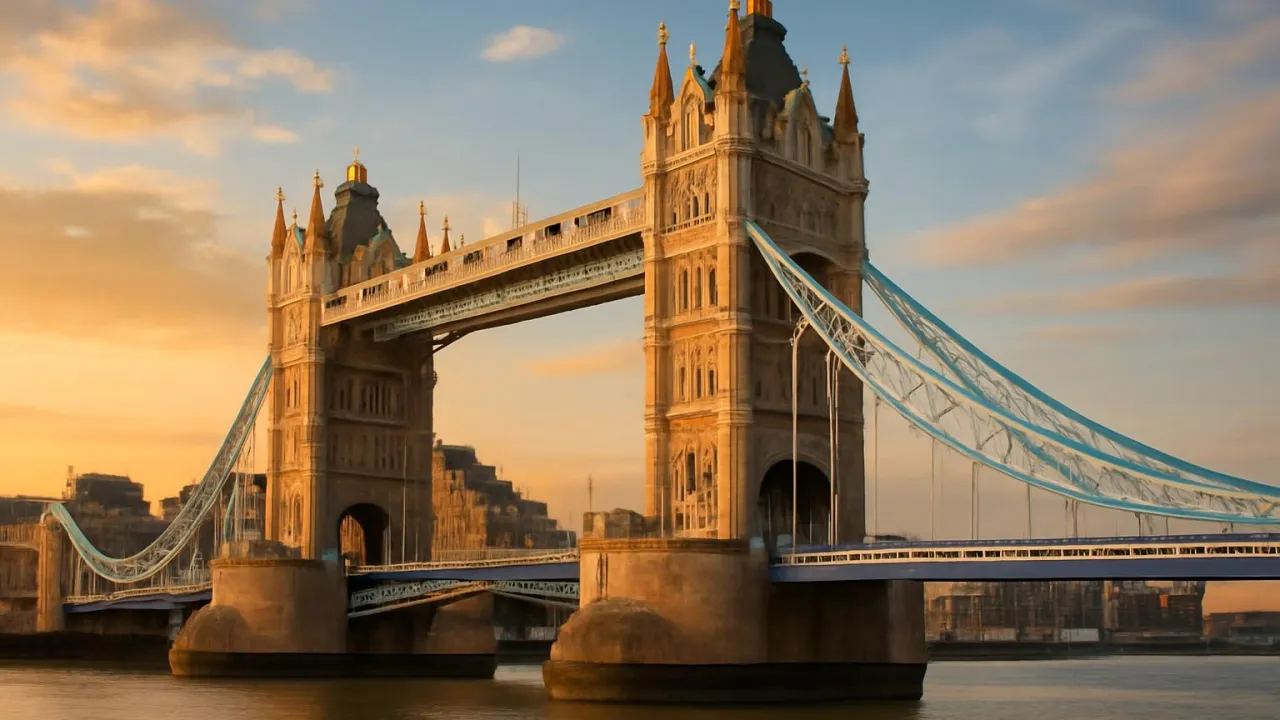
Tower Bridge’s bascules can lift in just five minutes!
✨ Word Sparks (Grade 2 Glossary)
Tap 🔊 to hear
bascule
A moving bridge part that lifts
walkway
A path to walk on
machine
A tool that helps do work
🪝
Can you imagine a bridge that splits in two?
1
The Bridge That Opens
Tower Bridge stretches across the River Thames in London. It has two tall towers and a road in between. The middle part can split and rise up for ships.
2
How It Works
Special called lift the bridge’s arms. When a tall ship needs to pass, the arms slowly open. People wait and watch as boats glide through.
3
A Busy Place
Many people and cars cross Tower Bridge every day. Visitors love to walk on the high between the towers. The bridge is famous for its blue and white colors.
Tower Bridge’s bascules each weigh over 1,000 tons—about as much as 150 elephants!
✨ Word Sparks (Grade 3 Glossary)
Tap 🔊 to hear
bascule
A bridge part that lifts up
monument
A famous building or statue
suspension
Hanging or held up by cables
🪝
What would you see if you stood on a bridge that moves?
1
A Bridge Over the Thames
Tower Bridge stands proudly above the River Thames in London, England. Its two towers are connected by high walkways and a road below. The bridge is famous for its blue and white paint and its unique design. People come from all over the world to see it.
2
The Bascule Mystery
Tower Bridge is a bridge, which means it can lift its middle section. The bascules are giant levers that pivot upward, powered by old steam engines and now by electricity. When a tall ship approaches, the bascules rise, creating a gap for the boat to pass through. This engineering marvel keeps river traffic and city traffic moving.
3
Walking Above the River
Visitors can walk across the lower road or climb up to the glass walkways. From up high, you can see the city, the river, and boats floating below. The glass floor lets you look straight down at the road and water. It feels like floating above London!
4
A Bridge for Everyone
Tower Bridge is not just for cars and people—it’s a working . It connects busy parts of London and lets ships reach the city’s heart. The bridge’s design combines strong steel with beautiful stone towers. Its and chains make it both useful and iconic.
Tower Bridge’s walkways were once closed because few people used them, but now they’re a top attraction with glass floors!
✨ Word Sparks (Grade 4 Glossary)
Tap 🔊 to hear
hydraulic
Uses liquid pressure to move things
counterweight
A heavy weight that helps lift
Victorian
From the time Queen Victoria ruled
🪝
Imagine hearing giant gears rumble as a bridge splits open above the river—how does it work?
1
London’s Lifting Landmark
Tower Bridge rises above the Thames as one of London’s most recognizable structures. Built during the era, its two massive stone towers are linked by high-level walkways and a central roadway. The bridge’s blue and white colors stand out against the city’s skyline, drawing millions of visitors each year. It was designed to allow both road traffic and large river ships to pass.
2
The Bascule Engineering Marvel
The bridge’s most fascinating feature is its bascule mechanism, which uses enormous and gears. Originally powered by steam, these bascules now use systems driven by electricity. When a tall ship approaches, the bascules pivot upward, creating a clear passage for river traffic. Each bascule weighs over 1,000 tons and can be raised in just five minutes.
3
Walking in the Sky
Visitors can explore the high-level glass walkways, suspended between the two towers. These walkways provide breathtaking views of London, the winding Thames, and the busy street below. The glass floors let you watch the bridge and boats from above, offering a thrilling perspective. Inside the towers, exhibitions explain the bridge’s history and mechanics.
4
A Bridge That Connects and Inspires
Tower Bridge is much more than a crossing—it’s a symbol of engineering progress and London’s history. Its unique combination of bascule and suspension design made it a marvel of its time. The bridge connects important parts of the city and allows ships to reach central London. Today, it remains a beloved monument, inspiring engineers, artists, and travelers from around the world.
1. Why does Tower Bridge need both bascules and suspension chains?
2. What makes the walkways special today?
🤯 Mind-Blowing Fact • Grade 5
Tower Bridge’s original steam-powered hydraulic system could lift its 1,100-ton bascules using only water pressure and gravity!
✨ Word Sparks (Grade 5 Glossary)
Tap 🔊 to hear
accumulator
A tank that stores energy for machines
girders
Strong beams that hold up bridges
infrastructure
The structures that help a city work
🪝
What if you could design a bridge that lifts hundreds of tons with perfect balance—how would you do it?
1
A Victorian Marvel on the Thames
Picture the deep clang of iron gears and the hiss of hydraulics as Tower Bridge’s bascules rise above the Thames. Completed in 1894 after eight years of construction, Tower Bridge was engineered to solve a unique problem: how to allow tall-masted ships into London’s Pool of London while maintaining a vital road link. Its iconic twin towers, clad in Cornish granite and Portland stone, anchor the bridge’s steel skeleton and instantly signal Victorian ingenuity to all who visit.
2
The Science of the Bascule Mechanism
Tower Bridge’s bascule system is a triumph of mechanical engineering, using two massive pivoting leaves, each weighing over 1,100 tons. Originally, steam-powered hydraulic engines pumped water into , storing energy to lift the bascules with remarkable efficiency. Today, the bascules operate using oil-driven hydraulic systems powered by electricity, but the physics remain the same: enormous counterweights balance each bascule, allowing smooth, rapid lifting with minimal energy loss.
3
Suspension Chains and Structural Strength
Beyond its bascules, Tower Bridge employs suspension chains and steel to support the central roadway and walkways. The suspension system distributes the weight of vehicles and pedestrians, while the stone towers absorb and transfer the load into deep foundations beneath the riverbed. This combination of bascule and suspension engineering allows the bridge to handle both heavy river traffic and thousands of daily crossings.
4
Cultural Impact and Historical Evolution
Tower Bridge has become a symbol not just of London, but of the power of innovative engineering. Its opening ceremonies, attended by the Prince of Wales, marked a turning point in urban . Over time, the bridge’s technology has evolved from coal-fired steam engines to eco-friendly electric hydraulics, reflecting broader changes in energy and design. Today, the bridge is both a vital transport link and a museum, showcasing Victorian machinery and the science behind its operation.
5
Modern Experience and Ongoing Legacy
Visitors now marvel at the panoramic views from the glass-floored walkways, which were added in 2014 to enhance the educational experience. The bridge opens for river traffic about 800 times each year, coordinated by a computerized booking system that preserves the city’s heritage while serving modern needs. Tower Bridge’s blend of artistry, physics, and history continues to inspire engineers, architects, and curious minds worldwide, making it a living landmark that bridges the past and future.