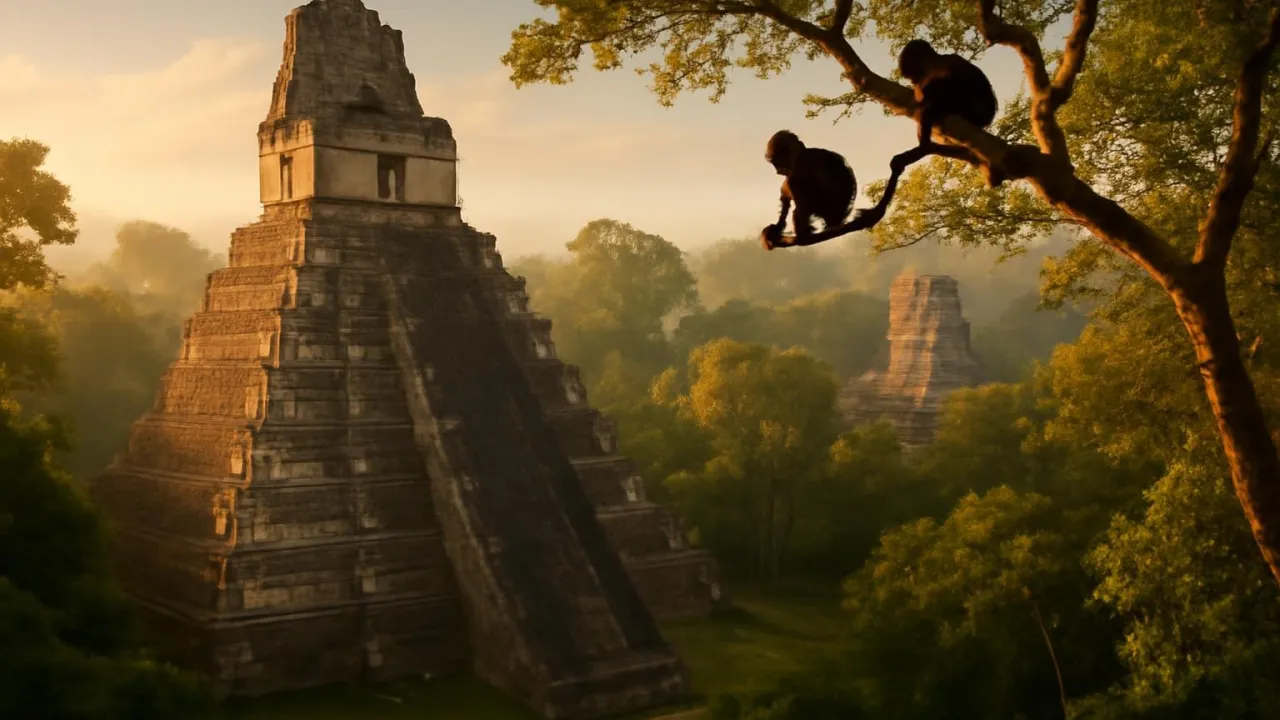
Tikal Mayan Temples
Jungle Pyramids Echoing with Ancient Secrets
Tikalโs tallest temple is as high as a 20-story building!
Can you hear the jungle birds sing above tall stone steps?
1 Stone Steps in the Trees
Tikal rise high in green trees. The are wide and steep. Birds fly over the tall tops.
2 Climbing Up High
People visit and climb the big . You can see far above the trees. The wind feels cool and soft.
3 Sounds of the Jungle
Monkeys call and leaves rustle all around. The stones feel warm from the sun. It is a wild, old place.
1. What do you hear at Tikal?
2. What do people do at Tikal?
Tikalโs biggest temple is taller than a blue whale is long!
What would it feel like to stand on a giant jungle pyramid?
1 Tall Temples in the Trees
Tikalโs temples rise high above the , with stone steps leading up. Birds and monkeys fill the air with sounds. The ancient built these amazing places long ago.
2 Climbing to the Top
Visitors can climb the steep steps to reach the top. From there, you can see green trees stretching far away. The breeze feels cool and fresh on your face.
3 A Place of Mystery
People wonder how the made these giant stone buildings. The stones fit together tightly, even after hundreds of years. Tikal is a place full of history and adventure.
1. Who built the Tikal temples?
2. What do you see from the top?
Temple IV at Tikal was the tallest building in the Americas for over 1,000 years.
Imagine hearing howler monkeys echo as you climb ancient stone stepsโwhat secrets might these temples hold?
1 Temples Above the Jungle
Tikalโs temples tower over the rainforest, their stone steps reaching skyward. The Maya built these pyramids using blocks, stacking them in layers. As you climb, you hear birds and monkeys echoing through the trees. The view from the top stretches far above the green canopy.
2 Built by Ancient Engineers
The Maya were skilled engineers who shaped each stone to fit tightly together. They used simple tools and teamwork to lift heavy blocks and create steep stairways. These temples have lasted for centuries because of their strong design. The largest, Temple IV, stands about 230 feet tall.
3 A City Full of Wonders
Tikal was once a busy city with thousands of people. The temples were used for ceremonies, music, and watching the stars. Some rooms have special designs that let voices echo loudly. The city is now a UNESCO World Heritage Site, protected for all to explore.
4 Nature and History Together
Today, Tikal is home to colorful birds, jaguars, and ancient ruins. Rain and wind cause , but the temples still stand strong. Visitors walk jungle trails to see the stone monuments and learn about Maya history. The mix of wild nature and old buildings makes Tikal truly unique.
1. Why do Tikalโs stones fit so well?
2. What makes Tikal special today?
Some Tikal temples were built to align perfectly with the sunrise on special Maya calendar days.
What if you could explore a city where stone pyramids rise above the jungle and echo with ancient voices?
1 Sky-High Temples in the Rainforest
Deep in the Guatemalan rainforest, Tikalโs stone temples soar above the treetops, some reaching 230 feet into the sky. The Maya built these pyramids between 200 and 900 CE, using millions of limestone blocks shaped by hand. From the top, explorers see endless green stretching to the horizon, while howler monkeys and toucans fill the air with sound. The templesโ steps are steep and narrow, designed to impress and challenge those who climb them.
2 Maya Engineering and Design
Maya engineers developed clever building techniques, using ramps, levers, and teamwork to move heavy stones. They arranged blocks in layers, creating strong arches and platforms that have resisted erosion for centuries. Some temples have chambers with special acoustic , allowing voices or music to echo during ceremonies. The precise alignment of buildings also helped the Maya track the sun, moon, and stars for their calendar.
3 A Center of Culture and Power
Tikal was a powerful Maya city, home to tens of thousands of people at its peak. The temples were centers for rituals, music, and astronomy, where rulers and priests performed ceremonies to honor their gods. Carved stone monuments, called , tell stories of battles, kings, and celebrations. Today, Tikal is a UNESCO World Heritage Site, attracting visitors from around the world to learn about Maya civilization.
4 Natureโs Role in Tikalโs Story
The rainforest both hides and protects Tikalโs ruins, sheltering colorful birds, jaguars, and ancient trees. Rain and wind slowly cause erosion, but the templesโ solid design helps them endure. Scientists and work to preserve the site, studying how the Maya lived and built in harmony with nature. Exploring Tikal means discovering both wild beauty and the mysteries of an ancient world.
1. How did the Maya move heavy stones?
2. Why do scientists visit Tikal today?
Tikalโs Temple IV remained the tallest building in the Americas until the late 19th century, outlasting even early skyscrapers.
What secrets might you uncover if you trekked through dense rainforest to stand atop a 1,300-year-old Maya pyramid?
1 A Lost City Above the Canopy
Imagine climbing steep stone steps as morning mist rises from the rainforest, revealing Tikalโs pyramids soaring above the treetops. Built by the Classic Maya between 200 and 900 CE, Tikalโs more than 3,000 structures include towering temples, plazas, and palaces. Temple IV, the tallest, stands at 230 feet (70 meters), making it the highest pre-Columbian structure in the Americas. From its summit, you can see the endless green sea of the Petรฉn rainforest and hear the distant calls of howler monkeys and toucans. The cityโs location was chosen for its strategic height, access to water, and fertile land.
2 Maya Engineering: Precision and Ingenuity
The Maya engineered Tikalโs temples using locally quarried limestone, shaping each block with stone tools and fitting them together with remarkable precision. Workers used ramps, wooden levers, and human labor to raise massive stones, sometimes weighing several tons. The stepped pyramid design distributes weight evenly, allowing these structures to withstand centuries of earthquakes and erosion. Some temples include and vaulted chambers, demonstrating advanced architectural knowledge. Acoustic resonance was intentionally used in certain rooms, amplifying voices and ceremonial sounds across plazas.
3 Astronomy and Urban Design
Tikalโs city layout reflects the Mayaโs deep understanding of astronomy and mathematics. Major temples and plazas are aligned with the sunโs position during solstices and equinoxes, turning the city into a giant calendar. Observatories and allowed priests to track celestial events, helping them plan agriculture and ceremonies. The Maya developed a complex writing system, recorded on stelae and altars, to document rulers, battles, and important dates. These records help archaeologists decode the cityโs history and its role in Maya civilization.
4 Cultural Legacy and Modern Discovery
At its peak, Tikal was a powerful city-state with a population possibly exceeding 60,000. Its rulers controlled trade, politics, and religious life across a vast region of Mesoamerica. After its decline in the late 9th century, the city was gradually reclaimed by the rainforest, remaining hidden until explorers and archaeologists began major excavations in the 19th and 20th centuries. Today, Tikal is a UNESCO World Heritage Site, drawing scientists and travelers eager to study its architecture, art, and environmental adaptations. Ongoing research continues to reveal new temples, tombs, and artifacts beneath the jungle floor.
5 Nature, Preservation, and the Future
The rainforest ecosystem both protects and threatens Tikalโs ancient monuments, sheltering rare wildlife while also causing gradual decay through erosion and plant growth. Preservation efforts involve archaeologists, , and local communities working together to stabilize structures and manage tourism. Tikalโs story inspires new generations to appreciate the achievements of the Maya and the importance of protecting world heritage sites. By studying Tikal, we gain insight into how ancient societies thrived in harmony with nature and how their knowledge still echoes through the jungle today.
1. How did Tikalโs temple design help them survive earthquakes and erosion?
2. Why is Tikal important for scientists and historians today?