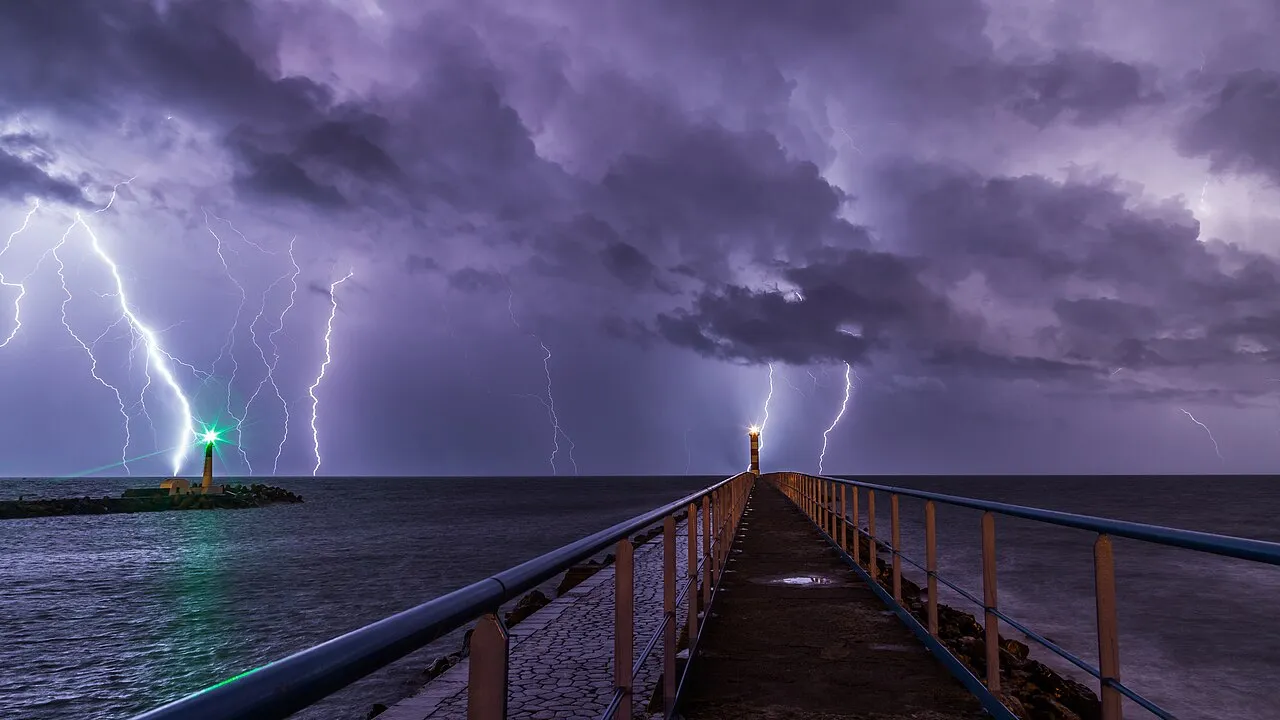
2. Why do your eyes see lightning before your ears hear thunder?
🤯 Mind-Blowing Fact • Grade 2
Close lightning makes a sharp 'CRACK!' like a snapping twig, while faraway lightning stretches into a low, rolling rumble!
✨ Word Sparks (Grade 2 Glossary)
Tap 🔊 to hear
expand
puff outward quickly to take more space
sound wave
vibrations traveling through air to our ears
rumble
a deep, rolling, long booming sound
🪝
How can counting 'one-one-thousand, two-one-thousand' tell you how far away lightning struck?
1
Hotter Than the Sun
Safe inside your house during a summer storm, watch a bright flash streak outside and listen closely! In a split second, that lightning bolt heated a thin tunnel of air past 50,000 degrees Fahrenheit.
2
From Shockwave to Sound
Air heated that fast blasts outward like a popped balloon, creating a fierce push called a shockwave. After a few yards, that shockwave slows down into the booming we hear as thunder.
3
Count Five Seconds Per Mile
Light arrives instantly, while thunder travels one mile every five seconds! Count ten seconds between the flash and the boom, and the lightning struck two miles away.
1. If you count 15 seconds between seeing a lightning flash and hearing thunder, how far away was the strike?
2. What smart safety rhyme helps everyone remember what to do when they hear thunder?
🤯 Mind-Blowing Fact • Grade 3
There is no special silent lightning called 'heat lightning'—it is simply ordinary thunderstorm lightning flashing too far away for its thunder to reach you!
✨ Word Sparks (Grade 3 Glossary)
Tap 🔊 to hear
supersonic
traveling faster than the speed of sound
channel
the narrow path carved through air by lightning
refract
bend upward through cooler upper air layers
🪝
Why does one quick flash of lightning turn into a long, ten-second rolling rumble of thunder?
1
Exploding a Pencil-Thin Channel
Crack-kaboom! Although a lightning bolt looks wide against dark clouds, its glowing electric core is actually only about as thick as your thumb! In millionths of a second, electricity superheats that narrow air to 30,000 degrees Celsius.
2
Supersonic Shockwave Birth
Trapped air has no time to drift aside gently. Pressure inside the bolt jumps more than ten times normal air pressure, blasting outward faster than the speed of sound as a shockwave before relaxing into ordinary sound waves.
3
Why Thunder Rolls and Rumbles
A single lightning bolt can zigzag for five miles through the sky! Sound from the bottom part closest to you reaches your ears first, while sound from miles higher up arrives several seconds later—stretching one flash into a long roll!
4
Why 'Heat Lightning' Is Silent
Distant flashes on summer nights are just regular thunderstorms more than 10 to 15 miles away, whose thunder bends upward into cooler sky air before reaching your ears!
1. What is the main reason one split-second lightning flash creates a rumble lasting many seconds?
2. Why can people rarely hear thunder from lightning more than 15 miles away?
🤯 Mind-Blowing Fact • Grade 4
Falling snow acts like giant acoustic foam studio panels, muffling winter 'thundersnow' so people just two miles away often hear nothing at all!
✨ Word Sparks (Grade 4 Glossary)
Tap 🔊 to hear
plasma
superheated electrified gas inside a lightning bolt
frequency
how fast sound waves vibrate, setting pitch
acoustic
relating to sound waves and hearing
🪝
Why does winter 'thundersnow' sound muffled right down the street while summer thunder booms across a whole county?
1
Plasma Heating and Pressure Spikes
Watch a jagged summer lightning stroke leap between cloud and ground over a Virginia valley. Within microseconds, 30,000 amperes of electric current rip electrons off nitrogen and oxygen molecules, turning a two-centimeter-wide air path into glowing near 30,000 degrees Celsius! Air pressure inside that channel rockets to 10 to 100 atmospheres, driving a cylindrical shockwave outward at supersonic speed for the first several meters before decaying into booming thunder.
2
Miles vs. Kilometers: Flash-to-Bang Math
Light races at 300,000 kilometers per second, reaching your eyes almost instantaneously, whereas sound travels through warm 20-degree-Celsius air at roughly 343 meters per second. That handy speed gap gives storm spotters two easy rules: divide flash-to-bang seconds by three to get distance in kilometers, or divide by five to get distance in miles!
3
Sharp Cracks vs. Low Bass Rumbles
Why does a strike across the street snap with a sharp high-pitched CRACK while a storm eight kilometers away mutters in deep bass? Air molecules absorb crisp high- sound waves rapidly over short distances, leaving only long, deep low-frequency bass waves to roll across valleys and echo off hills.
4
Snowflakes as Nature's Acoustic Muffler
During rare winter thundersnow, billions of fluffy six-sided snow crystals hanging in the air trap and scatter sound waves like studio foam—muffling thunder so only neighbors within two or three kilometers hear the boom!
1. If you count 9 seconds between a lightning flash and its thunder clap, roughly how many kilometers away was the bolt?
2. Why does distant thunder sound low and rumbling instead of sharp and cracking?
🤯 Mind-Blowing Fact • Grade 5
Scientists use arrays of ground microphones to listen to thunder arrivals and reconstruct exact 3D pictures of lightning branches hidden deep inside storm clouds!
✨ Word Sparks (Grade 5 Glossary)
Tap 🔊 to hear
return stroke
blinding main surge of current in lightning
attenuation
gradual weakening of waves traveling through air
infrasound
sound vibrations pitched below human hearing
🪝
How can scientists reconstruct a hidden 3D map of a lightning bolt inside a cloud using only an array of microphones?
1
Joule Heating and Cylindrical Blast Waves
When a cloud-to-ground stepped leader connects with an upward , peak currents averaging 30 kiloamperes—and occasionally topping 200 kiloamperes in positive strokes—surge through a tortuous channel barely 2 to 5 centimeters wide. Intense Joule heating raises channel plasma toward 30,000 kelvins in less than 10 microseconds, faster than surrounding air can move. Pressure spikes past 10 megapascals, launching a supersonic Mach-10 cylindrical blast wave that expands several meters before relaxing into nonlinear and then linear acoustic thunder near 343 meters per second.
2
Tortuosity Shapes Claps and Rolls
High-speed photography and acoustic physics reveal why thunder rarely sounds smooth: a lightning channel kinks and zigzags every few dozen meters! Segments oriented perpendicular to a listener beam intense, focused 'thunderclaps' broadly sideways, whereas segments aimed toward or away from the listener smear sound arrivals over time as rolling rumbles.
3
Atmospheric Attenuation and Thermal Refraction
Because sound speed increases with the square root of absolute air temperature, normal daytime lapse rates (warm surface air beneath frigid cloud air) bend acoustic rays upward away from the ground via refraction, creating an acoustic shadow zone beyond roughly 20 to 25 kilometers. Conversely, a nighttime temperature inversion bends thunder rays back downward, carrying storm booms surprisingly far!
4
Acoustic Tomography of Hidden Lightning
By arranging sensitive microphones across a field and timing microsecond arrival differences, atmospheric physicists perform thunder acoustic ray tracing—rebuilding crisp three-dimensional maps of lightning branches hidden completely inside opaque clouds!
5
Infrasound From Upper-Atmospheric Sprites
Below human hearing (< 20 hertz), thunder generates ultra-low-frequency pulses that global microbarometer networks detect hundreds of kilometers away—even recording ghostly sighs from mesospheric lightning sprites!