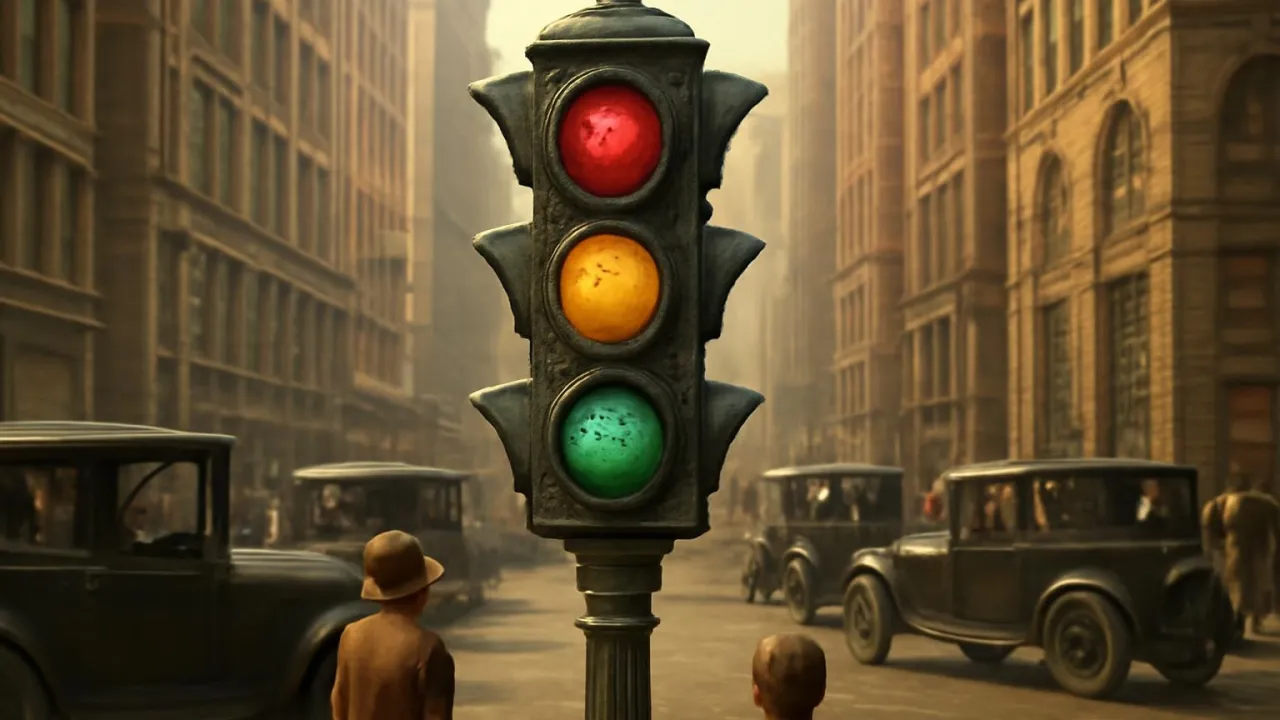
Garrett Morgan’s traffic signal made roads safer in many countries!
✨ Word Sparks (Grade 2 Glossary)
Tap 🔊 to hear
invent
To make something new
caution
To be careful and watch
order
The way things happen
🪝
Have you ever watched traffic lights change colors at a busy street?
1
A Colorful Way to Stay Safe
Red, yellow, and green lights help cars and people. The lights change in a special . Drivers know when to stop or go. This keeps everyone safe in the city.
2
How the Lights Work Together
Red tells cars to wait and stop. Green means cars can move ahead safely. Yellow warns drivers to slow down. Each color has an important job to do.
3
Inventing a Smart Solution
Garrett Morgan invented a new traffic signal in 1920. His idea used three lights instead of two. Now, traffic signals help people all around the world. They make busy roads safer for everyone.
Some modern traffic lights use sensors to detect cars and change colors automatically!
✨ Word Sparks (Grade 3 Glossary)
Tap 🔊 to hear
sensor
A tool that detects movement or light
intersection
Where two or more roads cross
vibration
A quick shake or movement
🪝
Imagine if all the traffic lights in your city turned off at once—what would happen?
1
Lights That Guide the Way
Cities are full of red, yellow, and green lights blinking in order. These traffic signals tell cars and people when to stop, slow down, or go. Without them, streets would be confusing and unsafe. The colors are easy to see, even from far away.
2
The Science Behind the Signal
Traffic signals use electricity to light up colored bulbs. Each bulb is placed in a special order: red on top, yellow in the middle, green on the bottom. The lights change using a timer or a . This system helps control traffic flow and prevents accidents.
3
A Brilliant Invention
Garrett Morgan invented a three-color traffic signal in 1920. Before his idea, most signals had only two colors. His invention added a yellow light, which gives drivers time to slow down. Today, this design is used all over the world.
4
Helping People Everywhere
Traffic lights are found in cities, towns, and busy . They help cars, buses, bikes, and people move safely. The signals use -resistant bulbs so they work in all weather. Their bright colors and clear order make travel safer for everyone.
1. Why is the yellow light important in traffic signals?
2. What powers most traffic signals today?
🤯 Mind-Blowing Fact • Grade 4
Garrett Morgan’s traffic signal patent was later sold to General Electric for $40,000!
✨ Word Sparks (Grade 4 Glossary)
Tap 🔊 to hear
patent
A special right to your invention
sequence
The order things happen in
reaction time
How fast you respond to something
🪝
What if every driver decided when to stop or go, with no traffic signals at busy crossroads?
1
A World of Moving Colors
The familiar red, yellow, and green lights have become a universal language for drivers and pedestrians. Traffic signals organize the movement of cars, bikes, and people at intersections, reducing confusion and accidents. Their bright colors are chosen for visibility in all types of weather and light. The order of the lights—red on top, yellow in the middle, green on the bottom—remains the same almost everywhere.
2
Engineering Safety Into Every Cycle
Traffic signals work by using electric circuits and timers to change the lights in a set . Some modern systems use sensors to detect vehicles, adjusting the timing for busy or empty roads. The yellow light, also called the caution signal, creates a buffer between stop and go, using the principle of . This scientific design helps prevent sudden stops and collisions.
3
The Inventor Who Changed the Streets
In 1920, Garrett Morgan patented a three-color traffic signal, improving on earlier two-color models. His design introduced the yellow caution light, which allowed drivers time to react safely. Morgan’s invention was inspired by witnessing dangerous crashes at busy intersections. Today, his idea has shaped how cities and towns manage traffic worldwide.
4
A Lasting Impact on Our World
Three-color traffic signals are now found on every continent, helping billions of people travel safely each day. Their engineering reduces traffic jams, lowers accident rates, and keeps pedestrians protected. The invention has also inspired new technologies, like smart signals that adjust to real-time traffic. This simple system continues to save lives and keep cities moving smoothly.
Modern adaptive traffic signals can reduce city travel times by up to 25 percent!
✨ Word Sparks (Grade 5 Glossary)
Tap 🔊 to hear
adaptive
Able to change based on new information
incandescent
A type of light bulb that glows
automation
Machines doing work without people
🪝
How did a simple set of colored lights revolutionize the safety and speed of modern cities?
1
The Science of Traffic Control
Imagine the chaos if every intersection relied on drivers’ guesses instead of signals. The three-color traffic signal uses the physics of light and human perception to organize traffic flow. Red, yellow, and green are chosen because they are easily distinguishable, even for people with some color blindness. The sequence—red (stop), yellow (caution), green (go)—is engineered based on reaction time and visibility. This system reduces accidents and keeps vehicles and pedestrians moving efficiently.
2
Mechanical and Electrical Innovations
Early traffic signals were manually operated, but Garrett Morgan’s 1920 invention introduced an automated, electrically powered system. The lights use colored lenses with or LED bulbs, controlled by timers or microprocessors. Sensors embedded in the road can detect waiting vehicles, adjusting the signal cycle for real-time conditions. The yellow light’s duration is calculated to give drivers enough time to safely stop, using formulas based on average speed and distance.
3
A Historical Leap in Urban Safety
Before Morgan’s three-color signal, cities relied on police officers or two-color lights, which often led to confusion and accidents. Morgan’s patent for a three-position signal, including a yellow caution phase, was a breakthrough in traffic engineering. His design was first installed in Cleveland, Ohio, and quickly spread to other cities. The invention’s success led to widespread adoption and the eventual sale of Morgan’s patent to General Electric for $40,000—a huge sum at the time.
4
Global Impact and Modern Evolution
Today, three-color traffic signals are standard in nearly every country, managing millions of intersections. They have reduced collision rates, improved emergency response times, and made urban growth possible. Modern advancements include traffic control systems, which use cameras and artificial intelligence to optimize light cycles. Solar-powered signals and energy-efficient LEDs make the system even more sustainable for the future.
5
A Lasting Legacy of Innovation
Garrett Morgan’s invention has become a symbol of urban safety and smart engineering. The simple, color-coded system is taught to children worldwide and remains essential to city planning. Its principles have inspired further inventions in , signaling, and transportation safety. The three-color traffic signal stands as a reminder that even small changes—like adding a yellow light—can have an enormous, lasting impact on society.