🇺🇸 U.S. HISTORY
🏛️ Federal Relief & Conservation Milestone • 1933–1942
VA History & Social Science SOL K.1, 1.2, 2.4, VS.1–VS.10, USI & USII
The New Deal & Civilian Conservation Corps
Planting Three Billion Trees and Rebuilding America's Parks
Grade 1 • Early Reader • 68 words
⏳ Era / StatehoodLaunched March 1933 under President Franklin D. Roosevelt
🗺️ Region / CapitalOver 4,500 CCC Camps Nationwide (Including Shenandoah & Virginia State Parks)
📜 Key MilestoneEmployed 3 million young men to plant 3 billion trees and build 800+ parks
⚡ Historical SparkBuilt Virginia's entire original six-park state park system on a single day in June 1936 along with Shenandoah's Skyline Drive overlooks
🤯 Mind-Blowing Fact • Grade 1
Workers in the Civilian Conservation Corps planted more than three billion trees—earning the fun nickname 'Roosevelt's Tree Army'!
✨ Word Sparks (Grade 1 Glossary)
Tap 🔊 to hear
conservation
Protecting forests water wildlife and natural land
seedling
Very young tree grown from a seed
shelter
Roofed structure keeping hikers dry and safe
🪝
Who planted three billion green trees and built cozy stone cabins in our favorite parks?
1
A Plan Called the New Deal
Dig, plant, pat! Young workers press tiny pine into bare dirt. In 1933, President Franklin Roosevelt started the New Deal to create helpful jobs.
2
Roosevelt's Tree Army
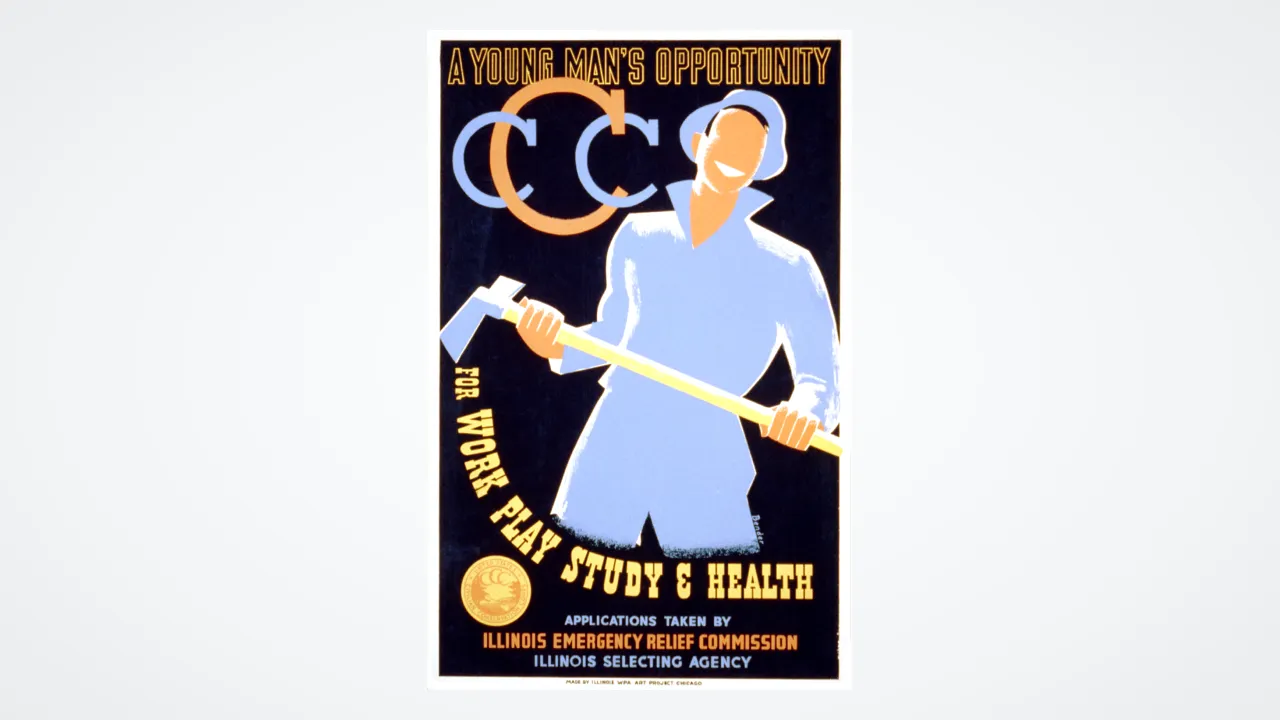
One famous team was the Civilian Corps, or CCC. Young men lived in forest camps, planted trees, and stopped soil from washing away.
3
Trails We Hike Today
Workers built stone bridges, picnic , and hiking trails. Families still camp and hike in these pretty parks every summer!
1. Why were Civilian Conservation Corps workers nicknamed 'Roosevelt's Tree Army'?
2. Which structures built by CCC workers can families still enjoy in parks today?
🤯 Mind-Blowing Fact • Grade 2
More than forty thousand young workers who had missed school learned how to read and write during evening classes at CCC camps!
✨ Word Sparks (Grade 2 Glossary)
Tap 🔊 to hear
erosion
Wearing away of soil by wind or water
public works
Bridges schools and parks built for everyone
corps
Organized team of people working together
🪝
How did earning thirty dollars a month in a forest camp help millions of families back home?
1
Relief, Recovery, and Jobs
Hear the ring of axes and hammers echoing across misty mountain ridges in 1933! During the Great Depression, President Franklin D. Roosevelt launched New Deal programs to put unemployed Americans back to work building schools, bridges, dams, and parks.
2
Life in a CCC Camp
Three million young men aged eighteen to twenty-five joined the Civilian Conservation . They received warm meals, boots, and classes, and out of their thirty-dollar monthly pay, twenty-five dollars went straight home to feed their families!
3
Saving Forests and Soil
CCC crews fought wildfires, stocked rivers with fish, built eight hundred state parks, and planted three billion trees. Their hard work healed eroded land and gave young workers lifelong skills.
1. How much of each CCC worker's thirty-dollar monthly paycheck was sent home to help their family?
2. What happened during evening classes at many CCC camps?
🤯 Mind-Blowing Fact • Grade 3
On June 15, 1936, Virginia became the first state in America to open an entire system of six state parks on a single day—all built by CCC crews!
✨ Word Sparks (Grade 3 Glossary)
Tap 🔊 to hear
hydroelectric
Electricity generated by fast-flowing dam water
stonemason
Craftsperson who shapes stone for sturdy walls
rustic
Built naturally with rough logs and stone
🪝
Did you know Virginia opened six brand-new state parks on the very same day thanks to the CCC?
1
The First Hundred Days of Action
Picture thousands of eager young volunteers stepping off trains in the Blue Ridge Mountains in spring 1933! Within weeks of taking office, President Franklin D. Roosevelt and Congress launched the New Deal—a series of programs focused on relief for the jobless, economic recovery, and banking reform.
2
Conservation Meets Craftsmanship
The Civilian Conservation Corps quickly became one of the most popular New Deal agencies. Guided by foresters and skilled , enrollees terraced gullies to stop soil erosion, strung rural fire-lookout telephone lines, and crafted log lodges.
3
Virginia's Skyline Drive and State Parks
Over one hundred CCC camps operated across Virginia! Crews shaped scenic stone walls along Skyline Drive in Shenandoah National Park and built Douthat, Fairy Stone, Hungry Mother, Seashore (now First Landing), Staunton River, and Westmoreland State Parks—all opening together on June 15, 1936.
4
Other New Deal Builders
Alongside the CCC, the Works Progress Administration built post offices, libraries, and murals, while the Tennessee Valley Authority brought power and flood control to rural Appalachia.
1. Which famous scenic mountain road in Virginia features stone overlooks built by CCC crews?
2. What did the Tennessee Valley Authority (TVA) bring to rural Appalachian families during the New Deal?
🤯 Mind-Blowing Fact • Grade 4
Camp Roosevelt in Virginia's George Washington National Forest near Luray was the very first Civilian Conservation Corps camp established anywhere in the United States, opening on April 17, 1933!
✨ Word Sparks (Grade 4 Glossary)
Tap 🔊 to hear
reforestation
Replanting trees across logged or damaged land
infrastructure
Essential roads bridges schools and power lines
pension
Regular income paid to retired older workers
🪝
How did the New Deal's 'Three Rs' transform both American conservation and everyday infrastructure?
1
Relief, Recovery, and Reform
Imagine waking up to a bugle call in Camp Fechner high atop Virginia's Blue Ridge Mountains, lacing heavy leather work boots, and heading out to lay hand-cut granite boulders along Skyline Drive! Taking office in March 1933 amid twenty-five percent unemployment, President Franklin D. Roosevelt worked with Congress to enact the New Deal, guided by three goals: immediate Relief for struggling families, Recovery for industry and agriculture, and Reform to prevent future financial panics.
2
Inside the Civilian Conservation Corps
Established on March 31, 1933, the CCC united four federal departments: Labor recruited unemployed young men (plus WWI veterans and Native American Tribal members), the Army ran 4,500 camps, and Agriculture and Interior directed conservation fieldwork. Sending twenty-five of their thirty monthly dollars home injected millions of dollars directly into hometown grocery stores across America.
3
Transforming the Landscape
Between 1933 and 1942, three million CCC enrollees planted more than half of all trees ever set in U.S. history—over three billion seedlings! They constructed 125,000 miles of forest roads, 3,470 fire lookout towers, Red Rocks Amphitheatre in Colorado, and facilities at Shenandoah National Park and Blue Ridge Parkway.
4
WPA, TVA, and Social Security
Broader New Deal programs left lasting civic cornerstones: the Works Progress Administration (WPA) built thousands of schools, airports, and bridges; the Rural Electrification Administration wired ninety percent of farms; and the Social Security Act of 1935 created retirement and unemployment insurance.
1. Where did the very first Civilian Conservation Corps camp in the entire United States open in April 1933?
2. What were the 'Three Rs' that guided New Deal legislation?
🤯 Mind-Blowing Fact • Grade 5
African American CCC companies at Colonial National Historical Park in Yorktown, Virginia conducted careful archaeological excavations uncovering Revolutionary War artifacts and earthworks still studied today!
✨ Word Sparks (Grade 5 Glossary)
Tap 🔊 to hear
watershed
Land area draining rainwater into shared rivers
stewardship
Responsible care and protection of natural resources
archaeological
Studying past human life through buried artifacts
🪝
How did an emergency nine-year conservation corps launch modern environmental stewardship and redefine federal civic responsibility?
1
Reimagining Federal Action in 1933
During the 'First Hundred Days' of spring 1933, Congress passed fifteen landmark bills reshaping the relationship between citizens and the federal government. Rather than relying solely on local charities overwhelmed by mass unemployment, the New Deal combined financial regulation (FDIC and SEC), social insurance (the 1935 Social Security Act), and large-scale public works—led by the Works Progress Administration (WPA), Public Works Administration (PWA), and Civilian Conservation Corps (CCC).
2
Interagency Genius of the CCC
Signed into law on March 31, 1933, the CCC mobilized rapid cooperation: within seventeen days, the first two hundred enrollees pitched tents at Camp Roosevelt in Virginia's George Washington National Forest. Over nine years, three million unmarried men aged 17–28, roughly 250,000 World War I veterans, and 80,000 Native Americans working on reservation lands through the Indian Division conserved degraded and timberlands.
3
Ecological Rescue and Park Architecture
Decades of clear-cut logging and drought had stripped millions of acres of topsoil. CCC soil-conservation crews built millions of check dams, contoured farmland across the Great Plains Shelterbelt, and planted more than three billion trees. Simultaneously, master craftspeople taught enrollees 'National Park Service Rustic' architecture, leaving hand-hewn stone amphitheaters, lodges, and trails from Grand Canyon and Acadia to Virginia's Shenandoah National Park and Pocahontas State Park.
4
Inclusion Challenges and Educational Triumphs
Although the 1933 law prohibited discrimination, many local administrators segregated CCC companies after 1935; nevertheless, nearly 200,000 African American enrollees served with distinction—including companies that restored historic battlefields at Yorktown and Petersburg, Virginia. Evening camp classrooms awarded high school diplomas and taught literacy to over 57,000 enrollees.
5
From Conservation Camps to Modern Service Corps
When Congress ended CCC funding in June 1942 as enrollees entered World War II service, its disciplined graduates strengthened engineering units worldwide. Today, AmeriCorps and state conservation corps carry forward the CCC's enduring vision of uniting youth employment with of America's natural heritage.