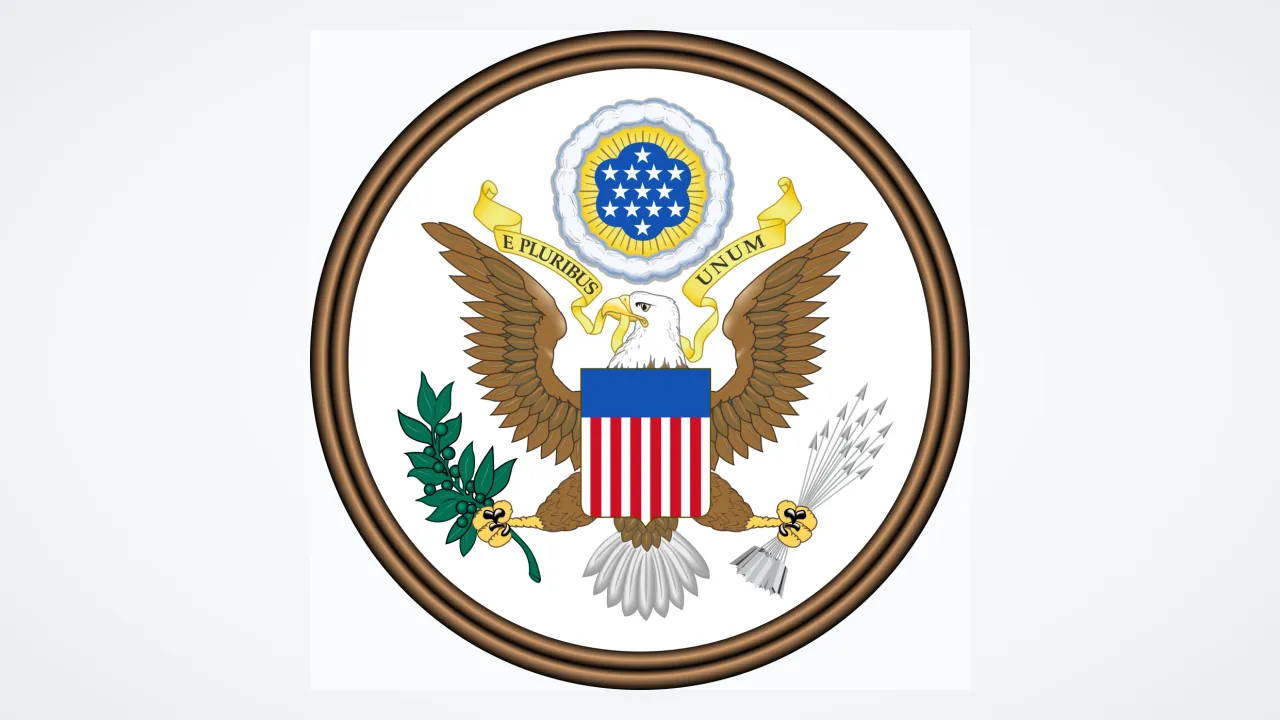
1. Which way does the bald eagle turn its head on the Great Seal?
2. Why does the number 13 show up so many times on the Great Seal?
🤯 Mind-Blowing Fact • Grade 2
Even the Latin motto 'E Pluribus Unum' has exactly thirteen letters—matching the thirteen stars, stripes, arrows, leaves, and olives!
✨ Word Sparks (Grade 2 Glossary)
Tap 🔊 to hear
motto
A short phrase sharing a guiding belief
virtue
Goodness, honesty, and strong character
symbol
An object that represents a deeper idea
🪝
Why did it take six whole years and three committees to design America's official Great Seal?
1
A Stamp for a New Nation
Imagine starting a brand-new country on July 4, 1776! That very afternoon, Congress asked Thomas Jefferson, John Adams, and Benjamin Franklin to design a Great Seal to stamp official treaties. Designing one proved tricky—it took three committees and six years!
2
Charles Thomson's Winning Eagle
In June 1782, Secretary of Congress Charles Thomson combined the best ideas around a native American bald eagle. A red, white, and blue shield rests on the eagle's chest all by itself, showing Americans rely on their own .
3
Out of Many, One
In its beak, the eagle carries a ribbon reading 'E Pluribus Unum'—Latin for 'Out of many, one'—celebrating thirteen states uniting as one nation!
1. What does the Latin motto 'E Pluribus Unum' mean in English?
2. Where can you easily see both the front and back of the Great Seal every day?
🤯 Mind-Blowing Fact • Grade 3
Although the bald eagle graced the Great Seal starting in 1782, Congress passed a special law in December 2024 officially naming the bald eagle America's National Bird in the U.S. Code!
✨ Word Sparks (Grade 3 Glossary)
Tap 🔊 to hear
obverse
The main front side of a coin or seal
constellation
A bright pattern formed by a group of stars
durability
Strength to last through many years
🪝
Why is there an unfinished stone pyramid on the flip side of the Great Seal?
1
Six Years of Sketching
Picture Benjamin Franklin, John Adams, and Thomas Jefferson brainstorming around a Philadelphia table on the evening of July 4, 1776! Every independent country needed a heavy metal die—a Great Seal—to press wax onto treaties so other nations knew America's signature was genuine. Congress finally approved Charles Thomson and William Barton's design on June 20, 1782.
2
Decoding the Front Side
On the front—called the —an American bald eagle holds an olive branch with thirteen leaves and thirteen olives in its right talon and thirteen arrows in its left. Turning its gaze toward the olive branch signals peace through strength, while a of thirteen stars shines through clouds overhead.
3
Decoding the Reverse Pyramid
Every seal also has a reverse side, printed on the left half of the one-dollar bill! Its thirteen-step stone pyramid stands for strength and —and it is deliberately left unfinished to show America is still growing and improving.
4
Roman Numerals at the Base
Carved along the bottom stone course are the Roman numerals MDCCLXXVI—spelling out 1776, the year of American independence!
1. Why was the thirteen-step pyramid on the back of the Great Seal drawn unfinished?
2. What year do the Roman numerals MDCCLXXVI at the bottom of the pyramid stand for?
🤯 Mind-Blowing Fact • Grade 4
Because the heavy steel master die wears down over decades of pressing thick paper, the United States is currently using its seventh engraved Great Seal die since 1782!
✨ Word Sparks (Grade 4 Glossary)
Tap 🔊 to hear
heraldry
Art and rules of designing symbolic coats of arms
vigilance
Careful watchfulness to keep people safe
valor
Great courage in the face of danger
🪝
How does every color, stripe, and feather on the Great Seal tell a story in the ancient language of heraldry?
1
Three Committees and One Breakthrough
Step into Philadelphia in June 1782 as Secretary of the Continental Congress Charles Thomson reviews folders from three earlier design committees! Even brilliant Founders like Jefferson, Adams, and Franklin had proposed crowded scenes packed with Greek goddesses or historical panoramas that would blur on a two-inch wax stamp. Consulting young Philadelphia artist and student William Barton, Thomson distilled everything into one bold American symbol: the bald eagle.
2
What the Colors Mean
Thomson wrote an official explanation of the shield's colors—which also explains the colors of the American flag! White signifies purity and innocence, red signifies hardiness and , and the solid blue band ('chief') uniting the thirteen vertical stripes represents , perseverance, and justice—plus Congress holding the thirteen states together.
3
Guarding the Physical Iron Die
Unlike the reverse side, which has never been cut as a metal stamp, the front of the Great Seal is engraved onto a heavy steel master die kept inside a glass enclosure at the U.S. Department of State in Washington, D.C., where an officer stamps treaties and ambassadors' commissions about 2,000 to 3,000 times a year.
4
Rescuing the Living Bald Eagle
By 1963, habitat loss and the pesticide DDT reduced bald eagles in the lower forty-eight states to just 417 nesting pairs! Thanks to the Endangered Species Act, banning DDT, and conservation along waterways like Virginia's James River and Chesapeake Bay, over 300,000 bald eagles soar across America today.
1. According to Charles Thomson's 1782 report, what do red, white, and blue symbolize on the Great Seal?
2. Which federal department serves as the official keeper of the physical Great Seal die in Washington, D.C.?
🤯 Mind-Blowing Fact • Grade 5
On September 15, 1789, Congress passed a law naming the U.S. Secretary of State—a post soon filled first by Virginian Thomas Jefferson—as official custodian of the Great Seal of the United States!
✨ Word Sparks (Grade 5 Glossary)
Tap 🔊 to hear
blazon
Formal written description defining a heraldic emblem
synthesize
To combine separate ideas into one unified whole
custodian
Official guardian responsible for protecting an artifact
🪝
Why did Charles Thomson's written 'blazon'—rather than a drawing—legally define the Great Seal of the United States in 1782?
1
A Written Blazon, Not a Sketch
Open the Journals of the Continental Congress for June 20, 1782, and you will notice something surprising: Congress adopted the Great Seal using purely written heraldic language—called a —without attaching an official painting! After committees in 1776, 1780, and 1782 contributed elements—from Pierre Eugène du Simitière's motto E Pluribus Unum and Eye of Providence, to Francis Hopkinson's red-and-white striped shield and thirteen-star constellation, to William Barton's eagle—Secretary Charles Thomson synthesized them into one crisp verbal specification.
2
Heraldic Precision on the Obverse
Every detail carries constitutional symbolism. The American bald eagle (Haliaeetus leucocephalus) appears 'displayed,' wings spread in vigor, bearing an unsupported 'escutcheon' (shield) on its breast to signify that Americans rely on their own civic virtue. Thirteen pales (vertical stripes) join into one solid blue chief, illustrating federal union: many states supporting Congress, and Congress uniting the states. Clasping an olive branch in its dexter (right, more honorable) talon and thirteen arrows in its sinister (left) talon, the eagle faces peace.
3
Latin Mottoes of the Reverse
Above the unfinished thirteen-course stone pyramid shines the Eye of Providence flanked by Annuit Coeptis ('Providence has favored our undertakings'), adapted from the Roman poet Virgil, while below unfurls Novus Ordo Seclorum ('A new order of the ages'), heralding an era of constitutional self-government begun in MDCCLXXVI.
4
Tiffany's 1885 Redesign and the 1935 Dollar
Early dies made the eagle look thin-necked until Tiffany & Co. chief designer James Horton Whitehouse created the bold, muscular 1885 die design still replicated today. Fifty years later, President Franklin D. Roosevelt and Treasury Secretary Henry Morgenthau Jr. placed both sides of the Great Seal onto the Series 1935 one-dollar Silver Certificate.
5
Ecological Comeback of a National Icon
Rescued from near-extinction through the 1940 Bald and Golden Eagle Protection Act, the 1972 DDT ban, and the Endangered Species Act, the living inspiration behind America's coat of arms thrives once again—especially along Virginia's tidal James, Rappahannock, and Potomac rivers, home to one of the densest bald eagle populations in the eastern United States!