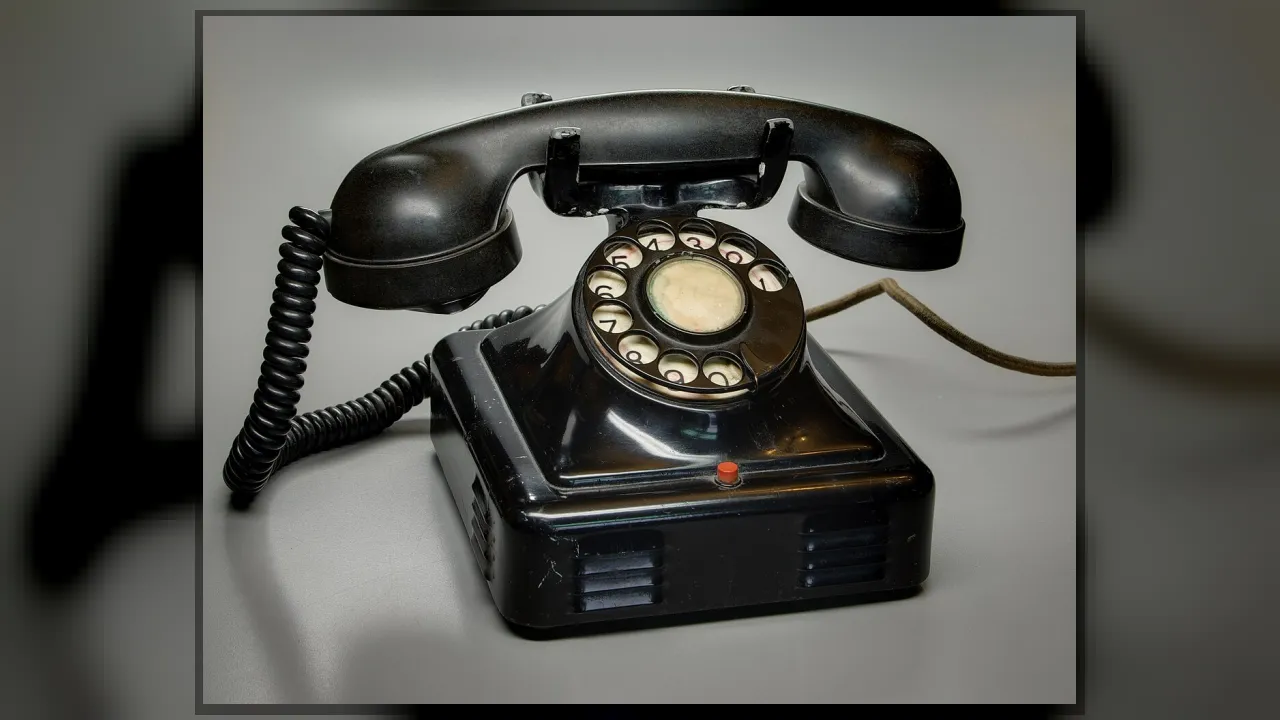
1. What happens in the air right when you speak into a telephone?
2. How did early telephones carry a person's voice to another house?
🤯 Mind-Blowing Fact • Grade 2
Early towns had no phone numbers at all—callers cranked a handle and asked a human switchboard operator for a neighbor by name!
✨ Word Sparks (Grade 2 Glossary)
Tap 🔊 to hear
telegraph
An older machine that sent coded wire clicks
diaphragm
A thin disk that vibrates with sound waves
operator
A worker who connected phone calls by hand
🪝
What if copper wires could carry not just clicking dots, but your actual voice?
1
Beyond Dots and Dashes
Click-clack, click-clack! In the 1800s, wires could only tap out secret codes of dots and dashes. Inventors dreamed of sending real laughs, songs, and spoken words across town.
2
Bell's Workshop Breakthrough
In March 1876, teacher and inventor Alexander Graham Bell worked in a Boston attic with builder Thomas Watson. Bell spoke into his liquid transmitter, and Watson heard every word clearly down the wire in another room!
3
Two Shaking Disks
A telephone mouthpiece holds a thin disk called a that vibrates when sound waves hit it. Electricity copies that exact wiggle along a wire until the earpiece disk vibrates to recreate your voice.
1. Who worked alongside Alexander Graham Bell to hear the first clear phone message in 1876?
2. How did callers connect to a friend in the earliest telephone networks?
🤯 Mind-Blowing Fact • Grade 3
The word telephone comes from two Greek words—tele meaning far away and phone meaning voice—literally translating to far-away voice!
✨ Word Sparks (Grade 3 Glossary)
Tap 🔊 to hear
transmitter
The part that changes sound into electrical signals
electromagnet
A wire coil that acts magnetic with electricity
receiver
The earpiece that turns electricity back into sound
🪝
How did studying the human ear inspire a machine that shrank the entire planet?
1
Six Famous Words in Boston
On March 10, 1876, Alexander Graham Bell leaned toward a cone-shaped in Boston and called out, "Mr. Watson—come here—I want to see you." Down the hall, Thomas Watson bounded in, stunned that copper wire had carried a living human voice.
2
Inspired by the Eardrum
Because Bell taught deaf students how sound waves move, he modeled his invention after the human eardrum. Earlier inventors, including Italian builder Antonio Meucci and German teacher Johann Philipp Reis, had also experimented with sending voices over wires.
3
Waves to Current and Back
When someone speaks, air pressure waves push a thin diaphragm back and forth inside the microphone. Those vibrations create matching rises and falls in an electrical current, which an in the turns back into matching sound waves.
4
From Wall Cranks to Pocket Phones
Soon Thomas Edison's carbon microphone made voices much louder and clearer over long distances. Overhead wires, rotary dials, undersea cables, and eventually wireless radio towers evolved from that first workshop call.
1. Which part of the human body inspired Bell's vibrating telephone disk?
2. What do the Greek roots 'tele' and 'phone' mean together?
🤯 Mind-Blowing Fact • Grade 4
In 1915, Bell and Watson repeated their famous 1876 workshop sentence—only this time Bell was in New York and Watson listened 3,400 miles away in San Francisco!
✨ Word Sparks (Grade 4 Glossary)
Tap 🔊 to hear
undulating
Rising and falling smoothly like ocean waves
resistance
How strongly a material slows flowing electric current
switchboard
A central panel for linking telephone lines together
🪝
Why did turning continuous sound waves into an 'undulating' current unlock instant global conversation?
1
Why On-and-Off Clicks Weren't Enough
Imagine pressing your ear against a brass earpiece in 1876 and hearing a friend whisper miles away! Traditional telegraphs worked by switching electricity completely on and off like a blinking lamp, which worked great for Morse code clicks but could never capture the smooth pitch and tone of human speech.
2
A Race of Brilliant Inventors
Several pioneers chased the dream of electric speech, including Italian immigrant Antonio Meucci, who built early voice devices in New York during the 1850s, and American inventor Elisha Gray. Alexander Graham Bell secured U.S. Patent 174,465 on March 7, 1876, describing an electrical current that mirrored continuous air vibrations.
3
Carbon Granules Amplify the Signal
Bell's earliest electromagnetic transmitter produced faint currents that faded quickly over miles of wire. Within two years, inventors like David Edward Hughes and Thomas Edison introduced loose carbon granules behind the diaphragm; squeezing those grains with sound waves sharply changed electrical , making distant voices loud and crisp.
4
Weaving a Worldwide Web of Voices
Manual soon gave way to Almon Strowger's automatic rotary switches, Coast-to-Coast lines in 1915, and transatlantic cables in 1956. Today's smartphones convert voice waves into digital packets of ones and zeros, yet every call still begins and ends with a tiny vibrating diaphragm.
1. Why couldn't an ordinary on-and-off telegraph circuit transmit a spoken human voice?
2. How did adding carbon granules inside early microphones improve telephone calls?
🤯 Mind-Blowing Fact • Grade 5
Bell Labs—founded from telephone research—later invented the transistor in 1947, the solar cell in 1954, and key foundations of cellular networks and computer operating systems!
✨ Word Sparks (Grade 5 Glossary)
Tap 🔊 to hear
transducer
A device converting one energy form into another
analog
A smooth continuous signal matching real physical waves
harmonics
Higher sound waves that give voices rich tone
🪝
How did acoustic transducers evolve from a drop of acid wire in 1876 into fiber-optic and cellular networks spanning Earth?
1
Cracking the Acoustic Bottleneck
Picture two copper wires humming between Boston attic rooms on March 10, 1876, carrying the complex vocal overtones of human speech for the very first time. Mid-nineteenth-century telegraphy transmitted only discrete on-off binary pulses, whereas intelligible human speech blends fundamental vocal-cord frequencies from roughly 85 to 255 hertz with delicate acoustic reaching past 3,400 hertz.
2
Pioneers, Patents, and Acoustic Transduction
Historical credit spans several determined innovators: Italian inventor Antonio Meucci demonstrated an electromagnetic voice link called the telettrofono in New York around 1856, German teacher Johann Philipp Reis coined the word telephone in 1861, and American engineer Elisha Gray filed a patent caveat hours after Alexander Graham Bell's landmark application on February 14, 1876. Bell's decisive breakthrough was continuous transduction—converting air-pressure waves into a proportional undulating electrical waveform.
3
Variable Resistance and Electromagnetic Receivers
Early magneto transmitters generated tiny currents until David Edward Hughes and Thomas Edison perfected roasted carbon-granule microphones. Whenever spoken sound waves pushed a thin metal diaphragm inward, thousands of loose carbon grains pressed closer together, lowering electrical resistance in exact step with vocal loudness and pitch; at the distant earpiece, copper coils around a permanent magnet flexed an iron diaphragm to recreate every syllable.
4
Amplifiers, Switching, and Pulse-Code Modulation
Spanning continents required Lee de Forest's vacuum-tube repeaters by 1915—and later Bell Laboratories' Nobel-winning 1947 solid-state transistor—to amplify fading signals along copper trunks without distortion. In the 1960s, engineers introduced digital pulse-code modulation (PCM), sampling voice waves 8,000 times per second according to the Nyquist theorem and encoding each measurement into crisp eight-bit binary numbers.
5
The Foundation of Modern Telecommunications
Today, microscopic MEMS silicon capacitor microphones etched onto smartphone chips convert speech into encrypted digital packets routed across fifth-generation microwave cell towers and submarine optical fibers pulsing infrared laser light across ocean floors. Even so, every modern call begins and ends with the exact acoustic-to-electrical principle unveiled in 1876.