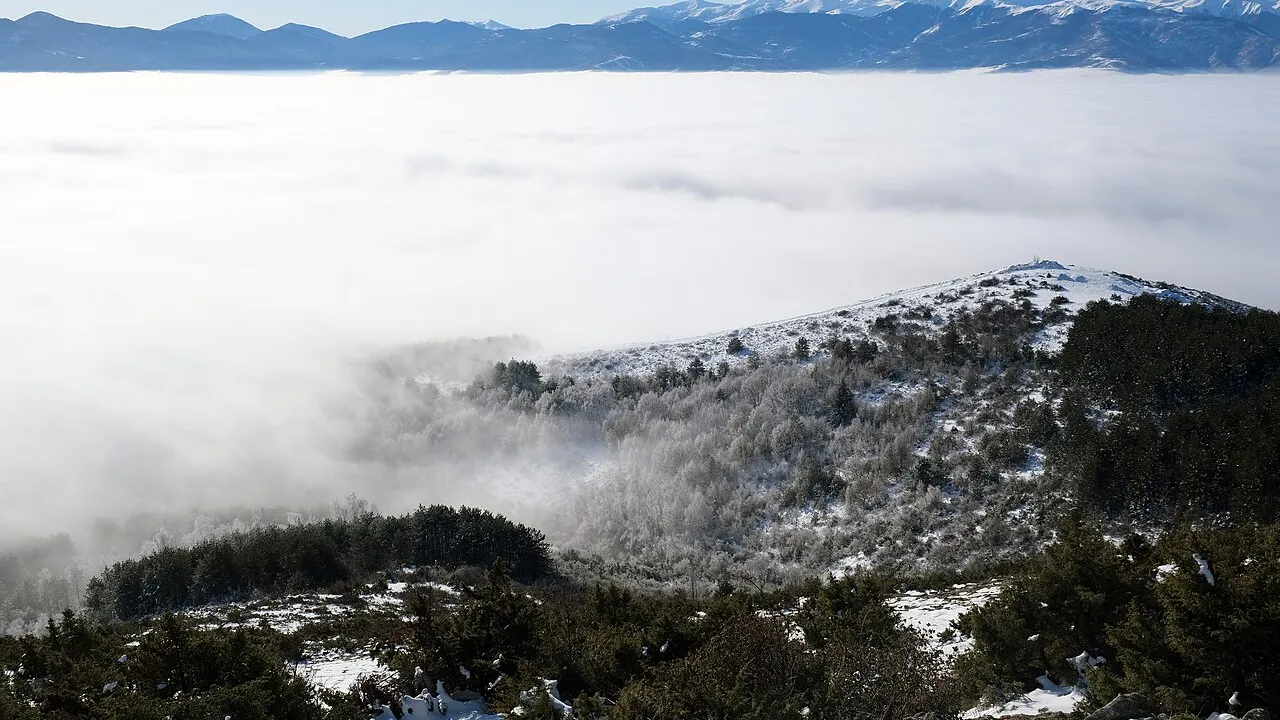
1. What does a sky covered in stratus clouds look like?
2. What kind of weather do thin stratus clouds usually bring?
🤯 Mind-Blowing Fact • Grade 2
Even on a gray overcast stratus day, pilots climb just a few thousand feet to find dazzling blue sky and sunshine right on top!
✨ Word Sparks (Grade 2 Glossary)
Tap 🔊 to hear
overcast
when clouds cover the whole sky completely
layer
a flat sheet spread over an area
snow grains
tiny white frozen bits smaller than rice
🪝
Why are some clouds flat and smooth instead of puffy like cotton balls?
1
Spread Out Across the Sky
Wake up on a cool autumn day when you cannot spot the Sun anywhere, just an even sheet of pearl-gray overhead. You are looking under stratus clouds! Their name comes from a Latin word meaning spread out or .
2
Calm Air Makes Flat Layers
Puffy cumulus clouds grow when warm air bubbles shoot straight up. Stratus clouds form differently, when a wide of damp, cool air lifts slowly and gently without strong upward gusts.
3
Hiding Hilltops in Mist
Floating below 6,500 feet, stratus sheets often wrap around tall bridges and mountain ridges. They rarely make heavy rain, dropping only misty drizzle or tiny .
2. How does air move to create smooth stratus clouds instead of bumpy cumulus clouds?
🤯 Mind-Blowing Fact • Grade 3
Along California's and Peru's cool ocean coasts, giant marine stratus decks keep summer beaches chilly while towns just ten miles inland bake in sunshine!
✨ Word Sparks (Grade 3 Glossary)
Tap 🔊 to hear
stable air
calm air that resists rising upward
evaporate
turn from liquid drops into invisible gas
featureless
smooth and even without bumps or shapes
🪝
What keeps stratus clouds smooth and flat from horizon to horizon?
1
Under a Dove-Gray Ceiling
Imagine hiking along a forest trail while a smooth, gray ceiling hangs just above the treetops, muffling distant sounds in cool mist. That low sky ceiling is a stratus cloud deck, sitting anywhere from ground level up to 2,000 meters high.
2
Stable Air Holds Down Bumps
Why don't stratus clouds puff upward like cauliflower? They form inside ! Instead of hot thermals bubbling skyward, an entire broad slab of moist air cools evenly—either by gliding over chilly ground or ocean water, or by lifting gently ahead of a warm front.
3
Drizzle Instead of Downpours
Because stratus layers are usually only a few hundred meters thick, water droplets inside do not have much room to collide and grow big. Most fall only as fine mist or gentle drizzle.
4
Morning Burn-Off
Once mid-morning sunshine warms the ground beneath a thin stratus blanket, the droplets often back into invisible gas, revealing clear blue afternoon skies!
1. Why do thin stratus clouds make tiny drizzle drops instead of big heavy raindrops?
2. What often happens to a thin morning stratus layer when midday sunlight warms the ground?
🤯 Mind-Blowing Fact • Grade 4
Vast sheets of low ocean stratus and stratocumulus reflect so much sunlight back into space that climate scientists call them Earth's air conditioners!
✨ Word Sparks (Grade 4 Glossary)
Tap 🔊 to hear
nimbostratus
thick dark layered cloud bringing steady rain
fractus
ragged, torn cloud shreds blown by wind
thermostat
something that regulates and balances temperature
🪝
How do vast low sheets of gray ocean stratus act like planet Earth's giant sun umbrella?
1
Widespread Cooling in Stable Skies
Look across Chesapeake Bay on a damp November morning when sky and water seem to blend into one soft silver-gray curtain. Overhead stretches stratus nebulosus—the classic uniform layer cloud of the lower troposphere. Unlike convective cumulus clouds triggered by localized hot spots, stratus decks develop when stable, humid air cools across hundreds of square kilometers simultaneously, either by sliding over cold surfaces or through gentle, widespread frontal lifting.
2
Stratus Versus Nimbostratus
Student meteorologists quickly learn an important distinction: ordinary stratus clouds are relatively shallow—often 100 to 500 meters thick—and produce at most light drizzle, mist, or tiny snow grains. If an approaching storm system deepens that layered cloud deck to several kilometers thick with steady, soaking rain or snow, its classification upgrades to , adding the Latin root nimbus for rain-bearing.
3
Ragged Shreds Under Wind
When brisk surface breezes tear at a lifting fog bank or drift beneath rain clouds, smooth stratus sheets can fray into ragged gray patches called stratus , often nicknamed scud clouds by storm watchers.
4
Earth's Bright Sunshade
From orbit, satellites reveal enormous decks of marine stratus and stratocumulus parked over cool eastern ocean currents. Their bright white tops reflect huge amounts of incoming sunlight back to space, helping keep Earth's global noticeably cooler!
1. How does a nimbostratus cloud differ from an ordinary thin stratus cloud?
2. How do giant decks of marine stratus clouds over oceans affect Earth's climate?
🤯 Mind-Blowing Fact • Grade 5
Stratus clouds actually stir themselves upside down at night because infrared cooling from their top surface sinks downward to keep the whole cloud deck alive!
✨ Word Sparks (Grade 5 Glossary)
Tap 🔊 to hear
inversion
warm air sitting above cooler surface air
coalescence
tiny cloud droplets bumping and merging together
subsidence
slow sinking of air under high pressure
🪝
Why does a temperature inversion trap stratus clouds near the ground while keeping air above crystal clear?
1
Stratiform Physics in a Stable Boundary Layer
Step onto a coastal bluff shrouded in cool mist while gulls vanish into a uniform slate ceiling barely 200 meters overhead. You are observing stratus—one of Luke Howard's three foundational 1802 cloud genera, derived from the Latin participle for 'spread out' or 'flattened.' Whereas cumuliform clouds thrive on vertical instability, stratiform decks require static stability within the planetary boundary layer below 2,000 meters.
2
Capped by Temperature Inversions
Normally, tropospheric air cools with height. Frequently, however, high-pressure or warm air riding over chilled marine currents creates a temperature —a lid of warmer air resting directly atop cooler, humid surface air. Rising moisture hits that warm ceiling, loses buoyancy, and spreads sideways into a flat, extensive stratus sheet.
3
Microphysics of Drizzle Formation
Because vertical updrafts inside stratus nebulosus rarely exceed a few centimeters per second, microscopic liquid droplets (5 to 15 micrometers in radius) grow slowly through gentle collision-. Once droplets reach roughly 100 to 500 micrometers—still far smaller than 2-millimeter raindrops—they settle downward as fine drizzle or subfreezing snow grains.
4
Radiative Cloud-Top Cooling
Interestingly, stratus decks sustain themselves overnight! Liquid droplets at the cloud top emit infrared radiation upward into clear sky, chilling the cloud top and triggering gentle upside-down convection that keeps moisture circulating through the layer.
5
High Albedo and Global Climate Cooling
Because low marine stratus decks reflect 40 to 70 percent of incoming solar radiation while radiating upward infrared energy at nearly the same warm temperature as the sea surface below, they exert one of the strongest net cooling effects in Earth's climate system.