1. Which sweet treat does Vermont make more of than any other state in America?
2. What makes Montpelier unique among all 50 state capitals?
🤯 Mind-Blowing Fact • Grade 2
Why did Vermonters put roofs over their wooden bridges? Not to keep travelers dry, but so winter snow and rain wouldn't rot the heavy floor beams—helping bridges last a hundred years!
✨ Word Sparks (Grade 2 Glossary)
Tap 🔊 to hear
quarry
open pit where workers cut building stone
colony
early settlement ruled by a distant country
foliage
colorful leaves growing on trees and bushes
🪝
Can you speak a little French just by saying the word 'Vermont'?
1
A Name That Means Green Mountains
Look up at Vermont's pine-covered peaks and you can solve a language puzzle! French explorers called these ridges 'les Verts Monts,' which means 'the Green Mountains.' Squeeze those words together and you get Vermont! In autumn, millions of sugar maples turn those green slopes bright red, gold, and orange.
2
Fourteenth Star on the Flag
After the original thirteen colonies formed the United States, Vermont became the very first new state to join—entering as number fourteen in 1791.
3
Lakes, Marble, and Cozy Montpelier
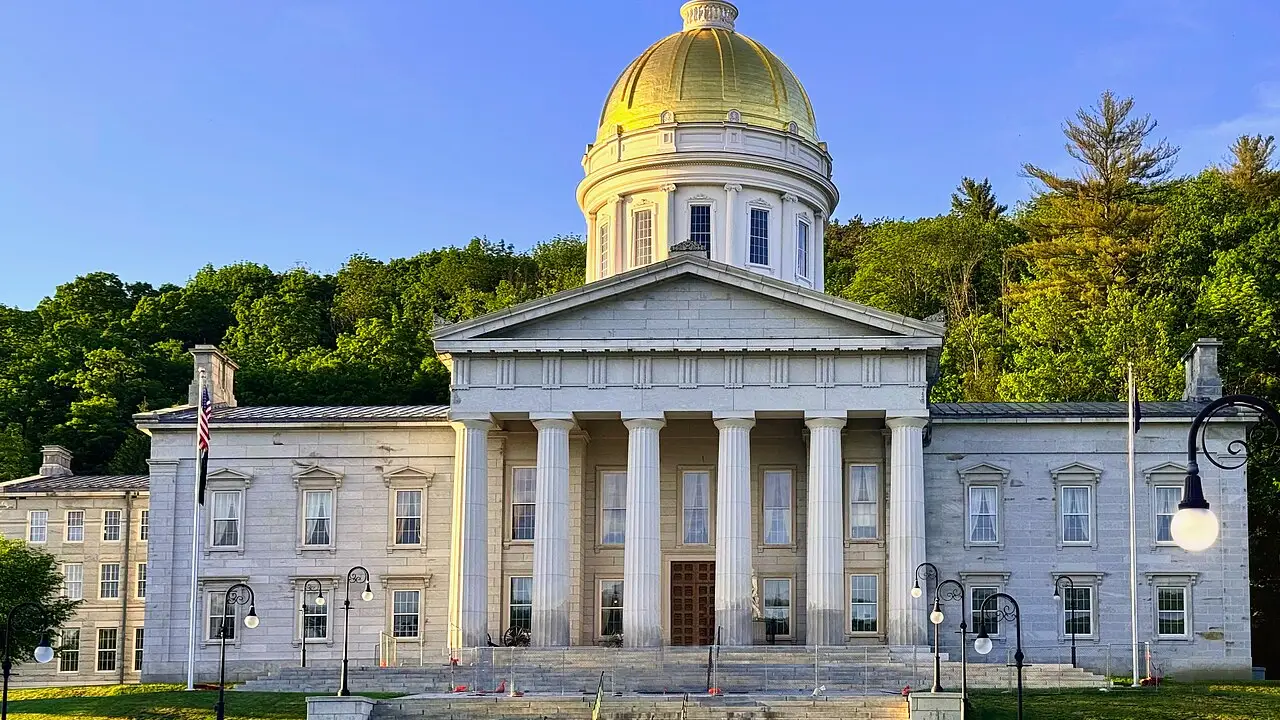
Long Lake Champlain shines along the western border near Burlington, while builders smooth marble and granite near the small gold-domed capital of Montpelier.
1. What do the French words 'Verts Monts'—which inspired Vermont's name—mean in English?
2. What was the main reason builders added roofs to Vermont's famous wooden covered bridges?
🤯 Mind-Blowing Fact • Grade 3
Vermont is the only state in New England that has zero coastline on the Atlantic Ocean, yet Lake Champlain gives it over five hundred miles of freshwater shoreline!
✨ Word Sparks (Grade 3 Glossary)
Tap 🔊 to hear
landlocked
surrounded by land without touching an ocean
mint
stamp metal into official coins for money
constitution
written plan of laws and citizen rights
🪝
Did you know Vermont minted its own copper coins as an independent republic for fourteen years?
1
Between a Great Lake and a Winding River
Trace Vermont's borders on a New England map and water frames both sides! Sparkling Lake Champlain—the sixth-largest freshwater lake in the United States—forms much of the western border with New York, while the Connecticut River winds along the entire eastern boundary beside New Hampshire. Notice too that Vermont is the only New England state that does not touch the Atlantic Ocean.
2
Green Mountain Boys and the 1777 Republic
In May 1775, Ethan Allen and the Green Mountain Boys helped capture British cannons at Fort Ticonderoga across Lake Champlain, hauling them through snow to aid George Washington at Boston. In 1777, Vermonters declared an independent Vermont Republic, operating their own post offices and minting copper coins!
3
Pioneering Freedom and Statehood
Vermont's 1777 was the first written constitution in North America to outlaw adult slavery. On March 4, 1791, Vermont joined the Union as the fourteenth state.
4
Granite, Dairy, and Sugarhouses
Today, steam rises from snowy maple sugarhouses each March, Barre quarries supply fine gray granite, and small towns still gather for direct-democracy Town Meeting Day.
1. How is Vermont geographically different from the other five New England states?
2. What milestone made Vermont's 1777 constitution the first of its kind in North America?
🤯 Mind-Blowing Fact • Grade 4
In August 1923, while visiting his family homestead in Plymouth Notch, Vermont, Vice President Calvin Coolidge took the presidential oath of office at 2:47 a.m. by kerosene lamplight—administered by his own father, a local notary public!
✨ Word Sparks (Grade 4 Glossary)
Tap 🔊 to hear
dispute
serious disagreement over borders, rules, or ownership
direct democracy
system where citizens vote on local laws themselves
homestead
family farmhouse together with its surrounding land
🪝
Why did New York and New Hampshire both claim Vermont's land—forcing Vermonters to run their own country for fourteen years?
1
Ancient Peaks Worn Smooth by Glaciers
Running north to south down the spine of Vermont, the Green Mountains are among the oldest mountain ranges in North America—pushed upward over four hundred million years ago and later rounded smooth by mile-thick Ice Age glaciers. Crowned by 4,393-foot Mount Mansfield, these forested ridges feed cold trout streams flowing west into Lake Champlain and east into the Connecticut River Valley.
2
Abenaki Homelands and Disputed Land Grants
For thousands of years, the Western Abenaki people—who taught newcomers how to tap sugar maples in late winter—hunted, fished, and farmed Vermont's valleys. During the 1700s, rival royal governors in both New Hampshire and New York sold overlapping land titles to the exact same valleys! Refusing to pay twice for their farms, settlers organized the Green Mountain Boys under Ethan Allen to defend their .
3
From Independent Republic to Fourteenth State
After fighting bravely in the Revolutionary War at Ticonderoga and Bennington, delegates met in Windsor in July 1777 to found an independent republic—first called New Connecticut and soon renamed Vermont. Their constitution banned adult slavery, allowed men to vote without owning property, and supported public schools. Once New York settled its border in 1790, Congress admitted Vermont on March 4, 1791, as the fourteenth state—balancing slaveholding Kentucky, which joined the next year.
4
Presidential Roots and Town Meeting Democracy
Two U.S. presidents—Chester A. Arthur and Calvin Coolidge—were born in rural Vermont villages. Every first Tuesday in March, neighbors still debate school budgets and road repairs face-to-face on Town Meeting Day.
1. Why did Vermont govern itself as an independent republic from 1777 until 1791 instead of joining the original 13 states right away?
2. What civic tradition gathers Vermonters on the first Tuesday every March to vote face-to-face on local budgets and laws?
🤯 Mind-Blowing Fact • Grade 5
In 1849, railway workers digging near Charlotte, Vermont—more than 150 miles from today's ocean—unearthed the 11,500-year-old fossil skeleton of a white beluga whale from when glacial meltwater briefly turned the Champlain Valley into a saltwater sea!
✨ Word Sparks (Grade 5 Glossary)
Tap 🔊 to hear
orogeny
geologic mountain-building collision of Earth plates
suffrage
constitutional right to vote in public elections
per-capita
measured fairly in proportion to total population
🪝
How did a small, landlocked mountain republic pioneer North America's boldest 1777 bill of rights and America's oldest long-distance hiking trail?
1
Appalachian Spine and Post-Glacial Valleys
Encompassing 9,616 square miles between the Hudson-Champlain Valley and the Connecticut River's western low-water mark, Vermont is New England's second-largest yet second-least-populous state—and its only state without oceanic tidewater. Formed during the Ordovician Taconic roughly 450 million years ago, the metamorphic schists and gneisses of the Green Mountains reach 4,393 feet atop Mount Mansfield. Retreating Laurentide ice sheets carved fertile Champlain lowland clays—which briefly held an arm of the Atlantic Ocean complete with fossilized beluga whale bones—while exposing world-renowned marble veins around Proctor and granite plutons at Barre.
2
Abenaki Stewardship and the New Hampshire Grants
Known to the Western Abenaki as Ndakinna ('Our Land'), these watersheds sustained seasonal canoe trade, maize cultivation, and the springtime art of boiling Acer saccharum (sugar maple) sap in birchbark vessels using heated stones. In the mid-eighteenth century, New Hampshire Governor Benning Wentworth issued more than 130 township charters west of the Connecticut River despite rival claims from the Province of New York, sparking fierce frontier resistance led by Ethan Allen, Seth Warner, and the Green Mountain Boys.
3
Revolutionary Strategy and the 1777 Windsor Constitution
During the American Revolution, Allen's dawn capture of Fort Ticonderoga in May 1775 supplied Henry Knox's artillery train to Dorchester Heights, while General John Stark and Seth Warner routed Hessian forces at the 1777 Battle of Bennington, crippling Burgoyne's Saratoga campaign. Meeting in a tavern during a summer thunderstorm on July 8, 1777, delegates adopted the Constitution of the Republic of Vermont—the first written charter in North America to prohibit adult slavery, institute universal adult male regardless of property, and endorse public schooling.
4
Fourteenth State, Abolitionism, and Conservation
Following boundary compensation to New York, Vermont entered the Union on March 4, 1791, becoming the first state admitted under the U.S. Constitution. Throughout the nineteenth century, Vermonters operated Underground Railroad safe houses and sent higher troop numbers to preserve the Union than nearly any other state. In 1910, volunteers blazed the 272-mile Long Trail cresting the Green Mountains from Massachusetts to Quebec—America's oldest long-distance hiking footpath and the direct inspiration for the Appalachian Trail.
5
Working Landscapes and Modern Civic Character
From Burlington's Lake Champlain research campuses to Montpelier's gold-domed State House—capped by granite quarried just miles away—Vermont balances working dairy and maple forests, strict scenic preservation laws (banning highway billboards since 1968), and vibrant Town Meeting democracy.