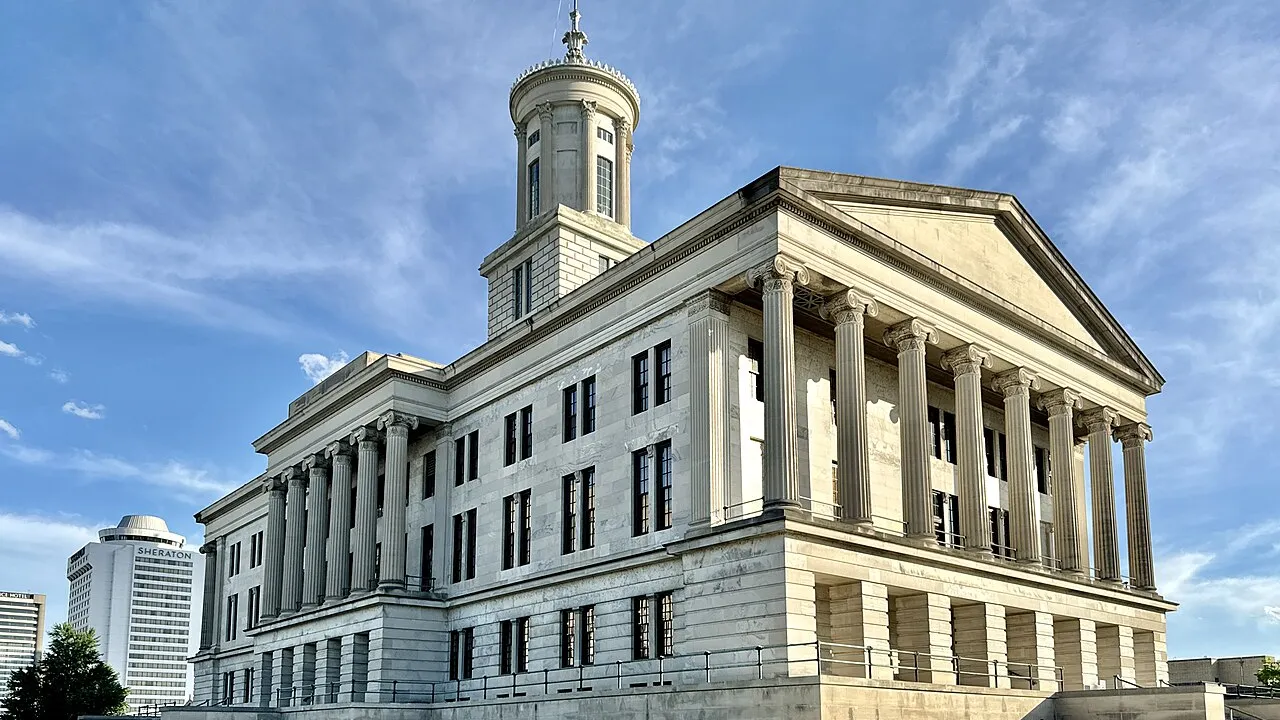
1. What do the three white stars on Tennessee's flag stand for?
2. Which music-loving city is the capital of Tennessee?
🤯 Mind-Blowing Fact • Grade 2
Great Smoky Mountains National Park is the most visited national park in the entire United States, welcoming more than twelve million explorers every year!
✨ Word Sparks (Grade 2 Glossary)
Tap 🔊 to hear
water vapor
invisible gas form of water in the air
volunteer
person who offers to help without being forced
ridge
long narrow top of a mountain chain
🪝
Where does the 'smoke' in the Great Smoky Mountains actually come from?
1
Breathing Forest Mist
Look across eastern Tennessee at sunrise and bluish fog curls above the like campfire smoke. Nothing is burning! Millions of trees and plants release tiny droplets of into the mountain air, giving Great Smoky Mountains National Park its magical name.
2
Three Grand Regions
Stretch a map of Tennessee out wide. Tall mountains fill the east, rolling horse pastures surround the capital of Nashville in the middle, and flat farmland meets the mighty Mississippi River near Memphis in the west.
3
Why It Is the Volunteer State
Long ago, thousands of brave Tennesseans stepped forward right away when their country asked for helpers, earning the proud nickname 'The State.'
1. What creates the bluish 'smoke' floating over the Great Smoky Mountains?
2. How many other states share a border with Tennessee?
🤯 Mind-Blowing Fact • Grade 3
More than ten thousand underground caves—more than in any other U.S. state—wind beneath Tennessee's limestone hills, including one cave holding America's largest underground lake!
✨ Word Sparks (Grade 3 Glossary)
Tap 🔊 to hear
basin
bowl-shaped lowland surrounded by higher hills
bluff
high steep riverbank overlooking flat water
hydroelectric
making electricity from the force of flowing water
🪝
How did one long state become a powerhouse for bluegrass, country, and blues music all at once?
1
Three Grand Divisions
Drive 440 miles from Bristol in the east to Memphis in the west and you cross Tennessee's official 'Three Grand Divisions.' East Tennessee rises into the Appalachian ridges of the Great Smoky Mountains. Middle Tennessee opens into the fertile Nashville , while West Tennessee slopes gently to the Mississippi River .
2
Sixteenth State and Volunteer Spirit
Originally formed from western lands ceded by North Carolina, Tennessee joined the Union on June 1, 1796, as the sixteenth state. During the War of 1812 and again in the 1840s, so many citizens answered calls for service that America nicknamed Tennessee the Volunteer State.
3
A Soundtrack Heard Worldwide
Music echoes across every region! Appalachian string tunes grew in eastern valleys, Nashville earned fame as 'Music City' with the Grand Ole Opry, and musicians on Beale Street in Memphis shaped soulful blues and early rock-and-roll.
4
Rivers Hard at Work
The Tennessee River loops twice across the state, turning dams that light homes and factories.
1. Which Tennessee city sits on bluffs above the Mississippi River and is famous for Beale Street blues music?
2. Before becoming the 16th state in 1796, Tennessee's land was once the western frontier of which state?
🤯 Mind-Blowing Fact • Grade 4
In August 1920, twenty-four-year-old Tennessee legislator Harry T. Burn changed his tie-breaking vote after reading a letter in his pocket from his mother urging him to help women win the right to vote!
✨ Word Sparks (Grade 4 Glossary)
Tap 🔊 to hear
plateau
high flat-topped highland rising above valleys
amendment
official change or addition to the Constitution
detour
curved path around a natural barrier
🪝
Why does the Tennessee River flow south into Alabama and then make a giant U-turn right back north across Tennessee?
1
Geography of Ridges, Plateaus, and River Loops
Follow a raindrop falling on 6,643-foot Kuwohi in the Great Smoky Mountains and watch Tennessee's dramatic geography unfold. Streams rush down into Knoxville, where the Holston and French Broad rivers join to form the Tennessee River. Blocked by the steep Cumberland , the river southwest past Chattanooga into Alabama before curving north across West Tennessee toward the Ohio and Mississippi rivers—carving natural boundaries between East, Middle, and West Tennessee.
2
Cherokee Homelands and Frontier Gap Trails
Long before European pioneers arrived, Cherokee towns such as Tanasi—whose name inspired 'Tennessee'—thrived along eastern river valleys, while Chickasaw communities hunted across the western bluffs. In the 1770s, settlers traveled through Cumberland Gap at the meeting corner of Virginia, Kentucky, and Tennessee, forming early self-governing settlements like the Watauga Association before statehood on June 1, 1796.
3
Pivotal Crossroads and the Nineteenth Amendment
Because its rivers and railroads linked North and South, Tennessee saw major Civil War battles at Shiloh, Stones River, and Chattanooga. Over half a century later, in August 1920, Nashville became the stage for a historic civic milestone: Tennessee cast the thirty-sixth and final state ratification vote needed to add the Nineteenth to the U.S. Constitution, guaranteeing women's right to vote nationwide.
4
Science, Conservation, and Song
In the 1930s and 1940s, the Tennessee Valley Authority tamed devastating floods with dams, while Oak Ridge National Laboratory grew into a world-leading science center alongside flourishing healthcare, automotive, and music industries.
1. Where did the name 'Tennessee' originally come from?
2. What landmark constitutional milestone happened in Nashville in August 1920?
🤯 Mind-Blowing Fact • Grade 5
Great Smoky Mountains National Park shelters thirty different species of salamanders—earning eastern Tennessee the scientific title 'Salamander Capital of the World'!
✨ Word Sparks (Grade 5 Glossary)
Tap 🔊 to hear
karst
limestone landscape full of caves and sinkholes
enfranchise
grant citizens the legal right to vote
watershed
entire land area draining into one river system
🪝
How did a ribbon of land stretching from Appalachian spruce-fir summits to Mississippi floodplains shape presidential leadership, hydropower, and supercomputing?
1
Six Physiographic Provinces and Three Grand Divisions
Stretching 440 miles east to west across 42,144 square miles, Tennessee intersects eight neighboring states—Virginia, Kentucky, Missouri, Arkansas, Mississippi, Alabama, Georgia, and North Carolina. State law formally recognizes East, Middle, and West Tennessee—symbolized by three stars bound inside a blue circle on Colonel LeRoy Reeves's 1905 state flag design. From 6,643-foot Appalachian summits and the caverns of the Cumberland Plateau, elevations descend into the limestone Nashville Basin before leveling across Gulf Coastal Plain loess bluffs overlooking the Mississippi River.
2
Indigenous Heritage, Cumberland Gap, and Statehood
Mississippian mound-builders, Cherokee towns in the eastern valleys—including Tanasi—and Chickasaw territories in the west shaped Tennessee's earliest human geography. After frontier trailblazers widened the Wilderness Road through Cumberland Gap in 1775, settlers drafted the Watauga Compact and the Cumberland Compact along the Cumberland River at Fort Nashborough (later Nashville). Administered briefly as the Southwest Territory, Tennessee entered the Union on June 1, 1796, as the sixteenth state—and later sent three residents to the White House: Andrew Jackson, James K. Polk, and Andrew Johnson.
3
Civil War Crossroads, Suffrage, and Civil Rights
As the last Southern state to secede in 1861 and the first readmitted to the Union in 1866, Tennessee witnessed decisive campaigns along its strategic rail and river arteries at Fort Donelson, Shiloh, Chattanooga, and Nashville. In August 1920, Tennessee secured its place in constitutional history as the thirty-sixth state to ratify the Nineteenth Amendment, enfranchising millions of American women. During the 1960s, nonviolent student sit-ins in Nashville and sanitation workers' marches in Memphis played transformative roles in the national Civil Rights Movement.
4
TVA Engineering and Oak Ridge Supercomputing
Created in 1933, the Tennessee Valley Authority constructed an integrated system of navigation locks and hydroelectric dams across the Tennessee River , bringing rural electrification and flood control. Nearby Oak Ridge National Laboratory today operates frontier-class supercomputers advancing materials science, clean energy, and medical isotopes.
5
Biodiversity and Cultural Resonance
Meanwhile, Great Smoky Mountains National Park—designated an International Biosphere Reserve—shelters over 19,000 documented species, including thirty salamander species that earn it the title 'Salamander Capital of the World,' while Bristol, Nashville, and Memphis sustain America's richest musical triad.