1. What historic invention flew for the first time at Kitty Hawk, North Carolina in 1903?
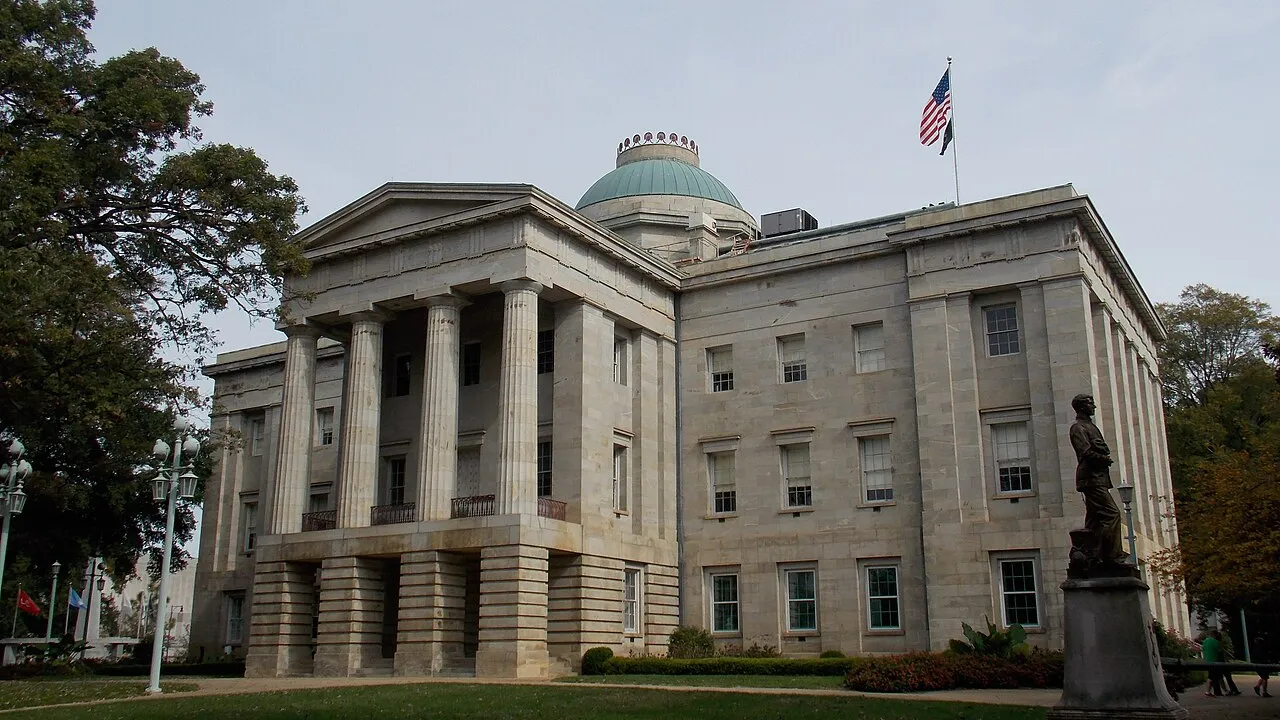
2. Which city is the state capital of North Carolina?
🤯 Mind-Blowing Fact • Grade 2
In 1999, engineers gently jacked up the massive 4,800-ton Cape Hatteras Lighthouse and rolled it 2,900 feet inland to save it from ocean waves!
✨ Word Sparks (Grade 2 Glossary)
Tap 🔊 to hear
piedmont
Rolling hilly land at mountain foothills
colony
Early settlement governed by a distant country
biplane
Early airplane built with two stacked wings
🪝
Why did the Wright brothers pick North Carolina's windy Outer Banks to test their flying machines?
1
Twelve Seconds That Changed the World
Feel brisk Atlantic breezes blowing across soft sand hills on the Outer Banks! Those steady winds and soft landings drew Wilbur and Orville Wright to Kitty Hawk. On December 17, 1903, their Flyer lifted off for the world's first powered airplane flight!
2
Islands, Oaks, and Tallest East Peak
Just south of Virginia, North Carolina stretches from ribbon-like barrier islands across rolling hills around capital city Raleigh to the smoky Blue Ridge Mountains. At 6,684 feet, Mount Mitchell stands taller than any other peak east of the Mississippi River!
3
Mystery Colony to Twelfth State
Long before becoming the twelfth state on November 21, 1789, English settlers landed on Roanoke Island in 1587—and mysteriously vanished, leaving only the carved word 'CROATOAN'!
What happened to the 'Lost Colony' on Roanoke Island—and how did pine trees give North Carolinians their nickname?
1
Three Steps from Sea to Sky
Travel west across North Carolina and climb three giant geographic steps! First come the sandy Outer Banks and flat Coastal Plain, where pine forests supplied sticky tar, pitch, and for wooden ships—inspiring the nickname Tar Heel State. Next rise the rolling red-clay Piedmont hills around Raleigh and Charlotte, followed by the mist-wrapped Blue Ridge and Great Smoky Mountains.
2
Indigenous Peoples and Roanoke's Mystery
Cherokee, Tuscarora, Lumbee, Catawba, and Algonquian nations lived across these mountains and for millennia. In 1587, English families established a colony on Roanoke Island where Virginia Dare was born; when supply ships returned in 1590, every colonist had vanished!
3
Halifax Resolves and Bill of Rights
On April 12, 1776, North Carolina's Halifax became the first official colonial vote authorizing delegates to declare independence! Waiting until Congress proposed the Bill of Rights, North Carolina ratified the U.S. Constitution as the twelfth state on November 21, 1789.
4
First in Flight
At Kill Devil Hills near Kitty Hawk on December 17, 1903, Orville Wright piloted a twelve-second, 120-foot flight before Wilbur flew 852 feet that same morning!
1. Why did North Carolina wait until November 1789 to ratify the U.S. Constitution?
2. What tree products used on wooden ships gave North Carolina its 'Tar Heel' nickname?
🤯 Mind-Blowing Fact • Grade 4
Twelve-year-old Conrad Reed found a shiny seventeen-pound rock in a North Carolina creek in 1799—his family used it as a heavy doorstop for three years before learning it was solid gold!
✨ Word Sparks (Grade 4 Glossary)
Tap 🔊 to hear
shoal
Shallow underwater sandbar dangerous to passing ships
segregated
Unfairly separated by laws based on race
aeronautics
Science of designing and flying aircraft
🪝
How did North Carolina pioneer America's earliest gold rush, first public university opening, powered flight, and student civil rights?
1
Graveyard of the Atlantic to Smoky Summits
Spanning 53,819 square miles directly south of Virginia, North Carolina showcases dramatic relief. Offshore along the 200-mile Outer Banks, the warm Gulf Stream collides with cold Labrador currents over shifting Diamond —creating the 'Graveyard of the Atlantic' guarded by 198-foot Cape Hatteras Lighthouse. Westward across Albemarle and Pamlico Sounds, the Coastal Plain climbs across the Fall Line into the Piedmont's Research Triangle (Raleigh, Durham, and Chapel Hill) before soaring to 6,684-foot Mount Mitchell inside the Appalachian Mountains.
2
Cherokee Heritage, Colonial Firsts, and Statehood
Long stewarded by Cherokee (Aniyvwiya) mountain towns, Catawba potters, and coastal Algonquians, North Carolina hosted England's earliest American ventures on Roanoke Island (1585–1587). In April 1776, its Provincial Congress adopted the Halifax Resolves—the first official colonial call for independence—and Continental troops under Nathanael Greene wore down Cornwallis's army at Guilford Courthouse in March 1781, hastening British surrender at Yorktown, Virginia! After Congress proposed the Bill of Rights, North Carolina ratified the Constitution on November 21, 1789, and in 1795 opened classes at Chapel Hill as the first operational public state university.
3
Cabarrus Gold and Kill Devil Hills
In 1799—fifty years before California's Forty-Niners—twelve-year-old Conrad Reed pulled a seventeen-pound gold nugget from Little Meadow Creek, sparking America's first gold rush and a Charlotte U.S. Mint! A century later, on December 17, 1903, Wilbur and Orville Wright launched the Aviation Age across Kill Devil Hills' windswept dunes.
4
Greensboro's Sit-In and Research Triangle
On February 1, 1960, four North Carolina A&T college freshmen peacefully sat at a Woolworth lunch counter in Greensboro, igniting nationwide youth sit-ins for civil rights.
1. How did the March 1781 Battle of Guilford Courthouse in North Carolina help win the Revolutionary War?
2. What peaceful civil rights action began on February 1, 1960, in Greensboro, North Carolina?
🤯 Mind-Blowing Fact • Grade 5
On Wilbur Wright's fourth flight down the beach at Kill Devil Hills on December 17, 1903, the Wright Flyer covered 852 feet in 59 seconds—longer than two and a half football fields!
✨ Word Sparks (Grade 5 Glossary)
Tap 🔊 to hear
endemic
Growing naturally in only one specific place
insectivorous
Trapping insects to gain extra plant nutrients
lagoon
Shallow coastal bay shielded by sandy islands
🪝
Why did North Carolina's barrier islands, Piedmont crossroads, and Blue Ridge summits become pivotal stages for Revolutionary independence, the Bill of Rights, human flight, and modern biotechnology?
1
Barrier Sounds, Fall Line Piedmont, and Highest Eastern Summit
Extending more than five hundred miles from Cape Hatteras to Murphy across 53,819 square miles, North Carolina exhibits the broadest elevation span east of the Mississippi River. Along the Atlantic rim, slender Holocene barrier islands—the Outer Banks—enclose Albemarle and Pamlico Sounds, America's largest lagoonal estuarine complex, while longleaf pine savannas near Wilmington shelter Venus flytraps ('Dionaea muscipula'). Inland across the Fall Line, red-clay Piedmont hills anchor capital city Raleigh and financial hub Charlotte before ancient Precambrian Blue Ridge and Great Smoky ranges soar to 6,684 feet atop Mount Mitchell, surveyed and measured by University of North Carolina professor Elisha Mitchell.
2
Indigenous Nations, Roanoke, and the Road to 1789 Ratification
Across centuries, Cherokee towns in western valleys, Catawba and Waxhaw communities in the Piedmont, Lumbee families along the Lumber River, and Tuscarora and Roanoke peoples on the Coastal Plain shaped regional lifeways. Following Sir Walter Raleigh's ill-fated 1585–1587 Roanoke Island expeditions, backcountry Carolina developed stubborn self-reliance. On April 12, 1776, delegates at Halifax adopted the Halifax Resolves—the first official colonial empowerment for national independence—and Nathanael Greene's grueling March 1781 engagement at Guilford Courthouse crippled Lord Cornwallis's southern campaign ahead of Yorktown. Refusing to ratify the 1787 Constitution at Hillsborough in 1788 until protective amendments were assured, North Carolina approved ratification at Fayetteville on November 21, 1789, once Congress submitted the Bill of Rights.
3
Public Higher Education, Reed Gold, and Three Presidents
North Carolina opened the nation's first student-enrolling public university at Chapel Hill in 1795 and sparked America's earliest gold rush at Cabarrus County's Reed Gold Mine in 1799, leading to a federal branch mint at Charlotte in 1837. Three U.S. presidents—Andrew Jackson (born along the Waxhaws border), James K. Polk, and Andrew Johnson—traced roots to North Carolina.
4
Aerodynamic Triumph at Kill Devil Hills
Combining Dayton wind-tunnel math with U.S. Weather Bureau data, Wilbur and Orville Wright selected Kill Devil Hills near Kitty Hawk for four seasons of glider tests (1900–1902), culminating on December 17, 1903, in four controlled, powered flights—peaking at 59 seconds and 852 feet—that inaugurated modern aviation.
5
Greensboro Sit-Ins and the Research Triangle
On February 1, 1960, North Carolina A&T students Ezell Blair Jr. (Jibreel Khazan), Franklin McCain, Joseph McNeil, and David Richmond sat peacefully at Greensboro's Woolworth counter, catalyzing the Student Nonviolent Coordinating Committee (SNCC) founded at Raleigh's Shaw University. Simultaneously, state, academic, and business leaders established Research Triangle Park (1959), linking Raleigh, Durham, and Chapel Hill into a premier global center of medicine, microelectronics, and environmental science.