2. What famous giant waterfall thunders on New York's western border?
🤯 Mind-Blowing Fact • Grade 2
Adirondack Park in northern New York is so huge that Yellowstone, Yosemite, Grand Canyon, and Glacier National Parks could all fit inside it together!
✨ Word Sparks (Grade 2 Glossary)
Tap 🔊 to hear
canal
Human-made waterway built for boats to travel
immigrant
Person moving to build life in another country
inauguration
Ceremony swearing a new president into office
🪝
How did a hand-dug water highway connect the Atlantic Ocean to the Great Lakes?
1
Harbors, Mountains, and Falls
Feel cool rainbow spray on your cheeks beside roaring Niagara Falls! Beyond the bright skyscrapers of New York City, the Empire State holds long Finger Lakes, apple orchards, and millions of forested acres in the Adirondack Mountains.
2
First Oath and Capital Albany
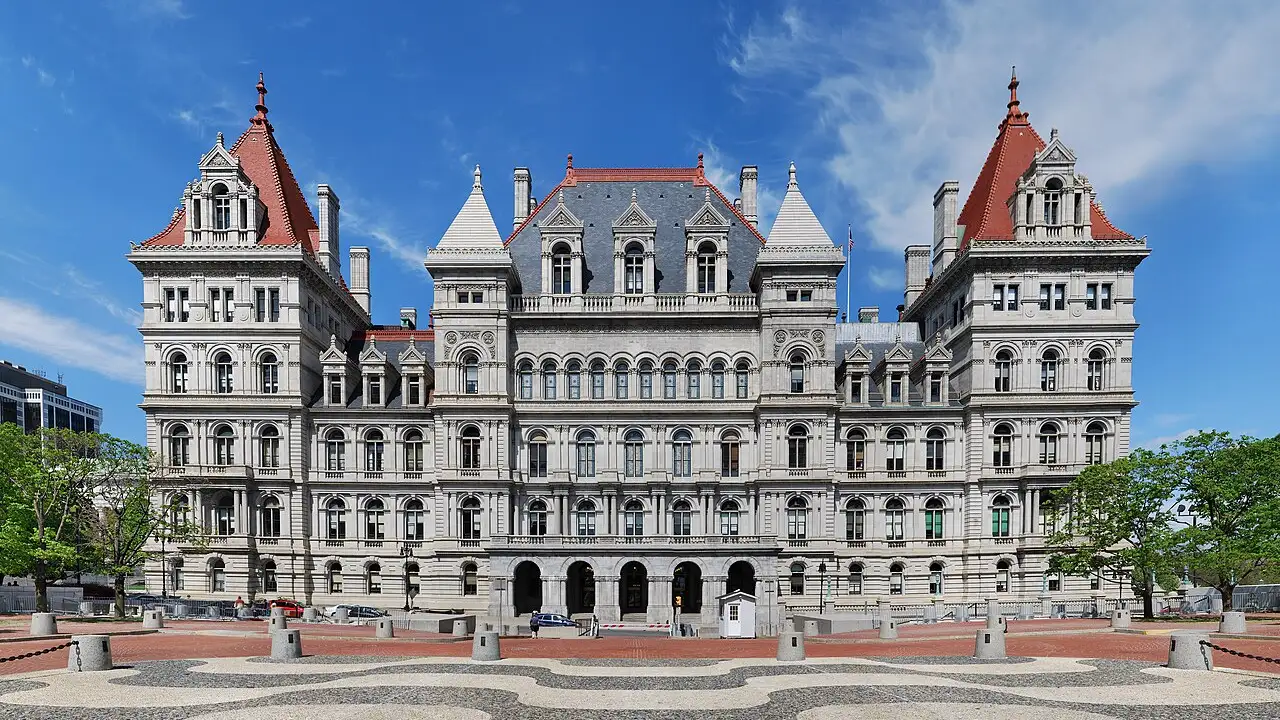
New York ratified the U.S. Constitution as the eleventh state on July 26, 1788. One year later in New York City, George Washington took the oath as America's very first president! Farther up the Hudson River sits Albany, the state capital.
3
Canal Boats and Ellis Island
In 1825, workers finished digging the 363-mile Erie from Albany to Buffalo, letting mules pull cargo barges to the Great Lakes! Down in New York Harbor, Ellis Island and the Statue of Liberty welcomed millions of hopeful .
1. What human-made waterway opened in 1825 to connect the Hudson River at Albany with Lake Erie?
2. Where did George Washington take the oath of office as the first U.S. President in 1789?
🤯 Mind-Blowing Fact • Grade 3
More than forty percent of all Americans today can trace at least one ancestor who arrived through Ellis Island in New York Harbor between 1892 and 1954!
✨ Word Sparks (Grade 3 Glossary)
Tap 🔊 to hear
confederacy
League of nations united under shared rules
ally
Partner nation helping another in tough times
convention
Large organized meeting for a shared goal
🪝
Why did one upstate New York battle convince France to help America win independence?
1
From Long Island to the Great Lakes
Sail past the Statue of Liberty—a copper gift of friendship from France in 1886—and follow the deep Hudson River 150 miles north to capital city Albany! New York stretches all the way from Atlantic beaches on Long Island to freshwater shores on Lake Ontario, Lake Erie, and Lake Champlain.
2
Haudenosaunee Confederacy and Dutch Roots
Long before Dutch traders founded New Amsterdam and Fort Orange (now Albany) in the 1620s, the Haudenosaunee—Six Nations of the Iroquois —governed upstate woodlands under the Great Law of Peace, uniting Mohawk, Oneida, Onondaga, Cayuga, Seneca, and Tuscarora peoples.
3
Turning Point at Saratoga
In October 1777, American forces won a decisive victory at the Battle of Saratoga north of Albany. That triumph convinced France to become America's , helping secure independence! New York ratified the Constitution as the eleventh state on July 26, 1788.
4
Equal Rights at Seneca Falls
In 1848, Elizabeth Cady Stanton and Lucretia Mott organized the Seneca Falls in New York, launching the movement for women's voting rights.
1. Why is the 1777 Battle of Saratoga in New York remembered as the turning point of the American Revolution?
2. What landmark 1848 gathering in Seneca Falls, New York launched the organized women's rights movement?
🤯 Mind-Blowing Fact • Grade 4
Before opening the Erie Canal in 1825, shipping one ton of wheat from Buffalo to New York City cost one hundred dollars and took three weeks; on the canal, it cost under ten dollars and took about a week!
✨ Word Sparks (Grade 4 Glossary)
Tap 🔊 to hear
hydroelectric
Electricity generated by falling or rushing water
corridor
Natural low passageway through tall mountain barriers
abolition
Movement working to end slavery completely
🪝
How did a low mountain gap across central New York unlock the Midwest and inspire the nickname 'The Empire State'?
1
The Mohawk Gap and Glacial Wonders
All along the eastern United States, the Appalachian Mountains stood like a steep wall between Atlantic ports and western farms—except in central New York, where the Mohawk River Valley cuts a natural low ! Around that gateway spread 54,555 square miles of striking landscapes: eleven narrow, glacier-carved Finger Lakes, the 5,344-foot summit of Mount Marcy in the Adirondacks, Catskill peaks, and Niagara Falls, which also spins giant turbines.
2
Haudenosaunee Governance and Revolutionary Hub
Centered around Onondaga Lake near Syracuse, the Haudenosaunee Confederacy practiced representative council governance centuries before 1776, while Algonquian Lenape and Mohican communities lived along the Hudson Valley. Renamed New York by the English in 1664, the colony hosted John Peter Zenger's 1735 freedom-of-the-press trial, turned the Revolutionary tide at Saratoga in 1777, and inspired Alexander Hamilton and John Jay to co-write 'The Federalist Papers' with Virginia's James Madison before ratifying the Constitution on July 26, 1788.
3
The Erie Canal Transformation
Championed by Governor DeWitt Clinton and opened in 1825, the 363-mile Erie Canal used eighty-three stone locks to link Albany on the tidal Hudson River with Buffalo on Lake Erie. Freight costs plunged by ninety percent, turning Buffalo, Rochester, Syracuse, and New York City into thriving boomtowns!
4
Voices of Reform and Global Culture
From abolitionists Harriet Tubman in Auburn and Frederick Douglass in Rochester to five New York-born U.S. presidents—including Theodore Roosevelt and Franklin D. Roosevelt—and United Nations headquarters in Manhattan, New York shapes national and global life.
1. What geographic feature allowed builders to dig the Erie Canal across New York without climbing high mountains?
2. Which two New Yorkers teamed up with Virginian James Madison to write 'The Federalist Papers' explaining the U.S. Constitution?
🤯 Mind-Blowing Fact • Grade 5
In 1895 at Niagara Falls, New York, engineers switched on the world's first large-scale alternating-current hydroelectric power plant—designed with Nikola Tesla's patents—transmitting clean electricity twenty-six miles to light up Buffalo!
✨ Word Sparks (Grade 5 Glossary)
Tap 🔊 to hear
fjord
Deep glacial valley flooded by ocean tides
escarpment
Long steep cliff separating two land levels
libel
Printing false statements to harm someone's reputation
🪝
Why did George Washington foresee New York as 'the seat of the Empire,' and how did its waterways, constitutional essays, and immigrant gateways fulfill that vision?
1
Fjord-Tidal Hudson, Mohawk Pass, and Adirondack Dome
Spanning 54,555 square miles from Montauk Point on Long Island to the Niagara and St. Lawrence River, New York possesses North America's most strategically connected waterway geometry. The lower Hudson River is actually a drowned glacial —called 'Muhheakunnuk' ('river that flows both ways') by Mohican navigators—carrying ocean tides 150 miles inland to Albany. There, the Mohawk River Valley cuts the sole low-altitude gap through the Appalachian chain toward the Great Lakes plain, flanked northward by the uplifted billion-year-old metamorphic dome of the six-million-acre Adirondack Park ('Forever Wild' under New York's 1894 constitution) and southward by eleven glacier-gouged Finger Lakes.
2
Haudenosaunee Great Law, New Netherland, and Press Liberty
Centuries before Henry Hudson sailed upstream in 1609, the Haudenosaunee Confederacy—Mohawk, Oneida, Onondaga, Cayuga, Seneca, and later Tuscarora—established participatory council federalism under the Great Law of Peace across upstate longhouses. Dutch West India Company settlements at Fort Orange (1624) and New Amsterdam (1626) fostered commercial pluralism before English takeover in 1664. In 1735, New York printer John Peter Zenger's acquittal established the foundational colonial precedent that truth is a defense against , safeguarding a free press.
3
Saratoga, The Federalist Papers, and First Federal Capital
During the Revolutionary War, nearly one-third of all engagements occurred on New York soil, highlighted by General Horatio Gates and Benedict Arnold's October 1777 victory at Saratoga, which secured the Franco-American Alliance. During the 1787–1788 ratification debate, New Yorkers Alexander Hamilton and John Jay joined Virginian James Madison as 'Publius' to author 'The Federalist Papers'; Poughkeepsie's convention ratified the Constitution as the eleventh state on July 26, 1788, and George Washington took the first presidential oath at Manhattan's Federal Hall on April 30, 1789.
4
Erie Canal Engineering, Reform Movements, and Ellis Island
Completed in 1825 across 363 miles and 570 feet of elevation change via eighty-three locks, the Erie Canal knit Great Lakes grain to New York's ice-free harbor while carrying reform ideas across western New York: Rochester hosted Frederick Douglass's 'North Star' newspaper, Auburn sheltered Harriet Tubman's homestead, and Seneca Falls convened the 1848 women's rights convention. Between 1892 and 1954, twelve million immigrants passed through Ellis Island beneath Frédéric Auguste Bartholdi's Statue of Liberty.
5
Five Presidents, Hydroelectric Power, and Global Diplomacy
Birthplace of five U.S. presidents—Martin Van Buren, Millard Fillmore, Theodore Roosevelt, Franklin D. Roosevelt, and Donald Trump—and site of Nikola Tesla and George Westinghouse's 1895 alternating-current power plant at Niagara Falls, New York today hosts the United Nations alongside global finance, arts, and semiconductor research.