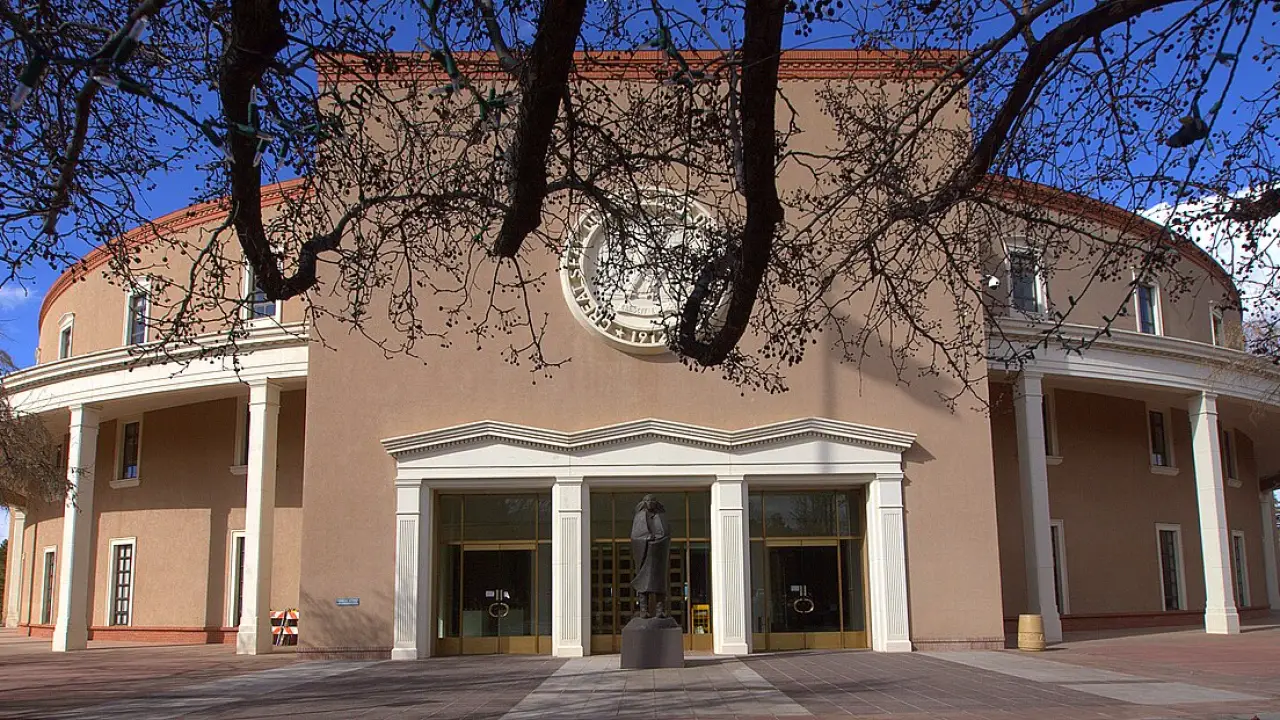
1. Which New Mexico city is the oldest state capital in the United States?
2. What floats across Albuquerque's autumn morning sky during a world-famous festival?
🤯 Mind-Blowing Fact • Grade 2
Smokey Bear—America's famous wildfire-prevention symbol—was a real black bear cub rescued from a 1950 forest fire in New Mexico's Capitan Mountains!
✨ Word Sparks (Grade 2 Glossary)
Tap 🔊 to hear
gypsum
Soft white mineral forming cool desert dunes
cavern
Huge natural chamber deep inside underground rock
enchantment
Feeling of wonder caused by extraordinary beauty
🪝
How can one Southwestern state hold giant bat caves, cool white dunes, and thousand-year-old towns?
1
Land of Enchantment
Watch hundreds of rainbow-colored hot-air balloons drift above the winding Rio Grande! Snow-topped Rocky Mountains in northern New Mexico slope southward into painted red mesas and sunny deserts, inspiring the nickname Land of .
2
Ancient Pueblos and Santa Fe
Families at Taos Pueblo have lived in stacked earth-brick adobe homes for roughly one thousand years! Founded around 1610, seven thousand feet high in the mountains, Santa Fe serves as America's oldest state capital. New Mexico became the forty-seventh state on January 6, 1912.
3
White Sands and Bat Caves
Down south, White Sands shimmers with rare crystals that reflect sunlight instead of absorbing heat. Nearby at Carlsbad , hundreds of thousands of bats swirl out of giant underground caves at dusk!
1. Why do the dunes at White Sands National Park feel cool even on sunny summer days?
2. Which famous wildfire-safety bear cub came from New Mexico's Capitan Mountains?
🤯 Mind-Blowing Fact • Grade 3
Santa Fe sits 7,199 feet above sea level—higher in the sky than any other state capital in the United States!
✨ Word Sparks (Grade 3 Glossary)
Tap 🔊 to hear
astronomy
Science studying stars, planets, and outer space
millennium
Long span of one thousand full years
chile
Flavorful green or red pepper pod
🪝
Why does New Mexico's bright yellow-and-red flag display an ancient sun symbol?
1
Mountains, Mesas, and the Rio Grande
Follow the ribbon of green cottonwood trees lining the Rio Grande from snowy Sangre de Cristo peaks—topping 13,167 feet at Wheeler Peak—down through sunlit Chihuahuan Desert valleys! Across America's fifth-largest state, volcanic cones, carved canyons, and 275 square miles of White Sands gypsum dunes dazzle travelers.
2
Pueblo, Navajo, Apache, and Spanish Roots
Ancestral Puebloans engineered giant stone 'great houses' aligned with the sun and moon at Chaco Canyon over a ago. Nineteen Pueblo communities, along with Navajo (Dine) and Apache nations, blended over centuries with Spanish settlers who founded Santa Fe around 1610—nearly ten years before the Mayflower landed in Massachusetts!
3
Santa Fe Trail to Statehood
After 1821, merchant wagons rolled from Missouri along the Santa Fe Trail to trade silver, wool, and manufactured goods. Admitted on January 6, 1912, as the forty-seventh state, New Mexico honored Zia Pueblo's sacred four-rayed sun symbol on its flag.
4
Caverns, Telescopes, and Art
From Carlsbad Caverns' underground limestone halls to giant radio telescopes listening to distant galaxies, New Mexico pairs ancient artistry with space-age science.
1. What ancient Indigenous design shines at the center of New Mexico's state flag?
2. How does Santa Fe's founding around 1610 compare with the Pilgrims' 1620 landing at Plymouth?
🤯 Mind-Blowing Fact • Grade 4
New Mexico got its name in the 1560s—more than two hundred fifty years before the country of Mexico won independence and adopted that name!
✨ Word Sparks (Grade 4 Glossary)
Tap 🔊 to hear
solstice
Longest summer day or shortest winter day
bilingual
Speaking and using two languages with ease
gyroscope
Spinning wheel keeping a flying rocket steady
🪝
How did thousand-year-old Pueblo astronomy, Spanish plazas, and modern rocket pioneers meet under New Mexico's clear skies?
1
Four Provinces Across Enchanted Terrain
Covering 121,590 square miles, New Mexico brings together four major North American regions: the snowy Southern Rocky Mountains, the colorful Colorado Plateau mesas in the northwest, the sweeping Great Plains in the east, and desert Basin and Range valleys in the south. Inside the Tularosa Basin glistens White Sands National Park—the largest gypsum dunefield on Earth—while sulfuric-acid-carved chambers plunge more than 750 feet underground at Carlsbad Caverns National Park.
2
Chaco Canyon, Living Pueblos, and Santa Fe
Between 850 and 1250 CE, Ancestral Puebloan architects built multi-story sandstone complexes like Pueblo Bonito in Chaco Canyon, orienting walls precisely to solar and lunar cycles. Today, nineteen sovereign Pueblos—including continuously inhabited Taos and Acoma ('Sky City') Pueblos—thrive alongside the Navajo Nation and Jicarilla and Mescalero Apache tribes. Named 'Nuevo Mexico' long before the nation of Mexico took its name in 1821, the province centered on Santa Fe (founded c. 1610), linked eastward after 1821 by the 900-mile Santa Fe Trail.
3
Bilingual Constitution and Navajo Code Talkers
Entering the Union as the forty-seventh state on January 6, 1912, New Mexico drafted a forward-looking constitution protecting both English- and Spanish-speaking citizens' civic and educational rights. During World War II, Navajo Marines from New Mexico and Arizona created an unbreakable military code based on the Dine language that helped win vital victories across the Pacific!
4
Rockets, Radio Dishes, and Desert Canvases
In the 1930s near Roswell, physicist Robert H. Goddard tested the world's first gyroscopically steered liquid-fueled rockets. Today, twenty-seven giant dish antennas at the Very Large Array scan deep space while painters inspired by Georgia O'Keeffe celebrate New Mexico's glowing cliffs.
1. How did Navajo Marines from New Mexico and Arizona help the United States during World War II?
2. Which rocket pioneer tested early liquid-fueled rockets near Roswell, New Mexico in the 1930s?
🤯 Mind-Blowing Fact • Grade 5
Unlike ordinary limestone caves carved from the top down by rainwater, Carlsbad Caverns in New Mexico was dissolved from the bottom up by sulfuric acid inside a 265-million-year-old fossil ocean reef!
✨ Word Sparks (Grade 5 Glossary)
Tap 🔊 to hear
caldera
Giant bowl-shaped crater formed after volcanic collapse
equinox
Day when daytime and nighttime last equally
cryptographic
Using secret codes to protect important messages
🪝
Why does New Mexico stand unmatched in the United States as a living synthesis of Indigenous archaeoastronomy, Hispanic civic heritage, and frontier physics?
1
Rift Valleys, Evaporite Dunes, and Sulfuric Karst
Fifth largest among U.S. states at 121,590 square miles, New Mexico straddles the Rio Grande Rift—a crustal fault trough guiding the Rio Grande southward between the 13,167-foot Sangre de Cristo Rockies and the volcanic Jemez , where Valles Caldera preserves a thirteen-mile-wide supervolcano crater. In the southern Tularosa Basin, seasonal Lake Lucero evaporates dissolved Permian selenite crystals that winds sculpt into 275 square miles of dazzling calcium-sulfate dunes at White Sands National Park. Farther southeast in the Guadalupe Mountains—an uplifted fossil Permian coral reef—upward-migrating hydrogen sulfide gas dissolved massive chambers like the eight-acre Big Room inside Carlsbad Caverns.
2
Chacoan Archaeoastronomy and Sovereign Indigenous Continuity
More than a thousand years ago, Ancestral Puebloan engineers constructed monumental masonry great houses across Chaco Culture National Historical Park, linking outlier communities via straight ceremonial roads and marking with precision petroglyph 'sun daggers.' Their descendants sustain nineteen sovereign Pueblos—including multi-story Taos Pueblo and mesa-top Acoma Pueblo, among the oldest continuously inhabited communities in North America—alongside the Dine (Navajo) Nation and Jicarilla, Mescalero, and Fort Sill Apache tribes.
3
El Camino Real, Santa Fe, and the 1912 Bilingual Compact
Traversed north-to-south starting in 1598 by El Camino Real de Tierra Adentro ('Royal Road of the Interior Land') from Mexico City, Santa Fe became provincial capital around 1610, making its Palace of the Governors the oldest continuously occupied public building in the United States. After Mexican independence (1821) opened trade along the overland Santa Fe Trail from Missouri and the 1848 Treaty of Guadalupe Hidalgo transferred the territory to the United States, New Mexico entered the Union as the forty-seventh state on January 6, 1912, under a state constitution expressly safeguarding Spanish- and English-language voting and teacher training.
4
Goddard's Rockets, Code Talkers, and National Laboratories
Drawn by cloudless skies in 1930, physicist Robert H. Goddard launched supersonic and gyro-stabilized liquid-propellant rockets near Roswell—forerunners of Apollo Moon vehicles. During World War II, Navajo Code Talkers provided decisive speed in the Pacific theater, while Los Alamos and Sandia National Laboratories transformed New Mexico into a global center of nuclear physics, supercomputing, and solar energy.
5
Radio Interferometry, Ballooning, and Artistic Light
From twenty-seven rail-mounted radio telescopes on the Plains of San Agustin (the Very Large Array) and Spaceport America to Albuquerque's International Balloon Fiesta and Georgia O'Keeffe's Abiquiu landscapes, the Land of Enchantment bridges ancient earth and deep cosmos.