1. Which famous inventor built his lightbulb laboratory in New Jersey?
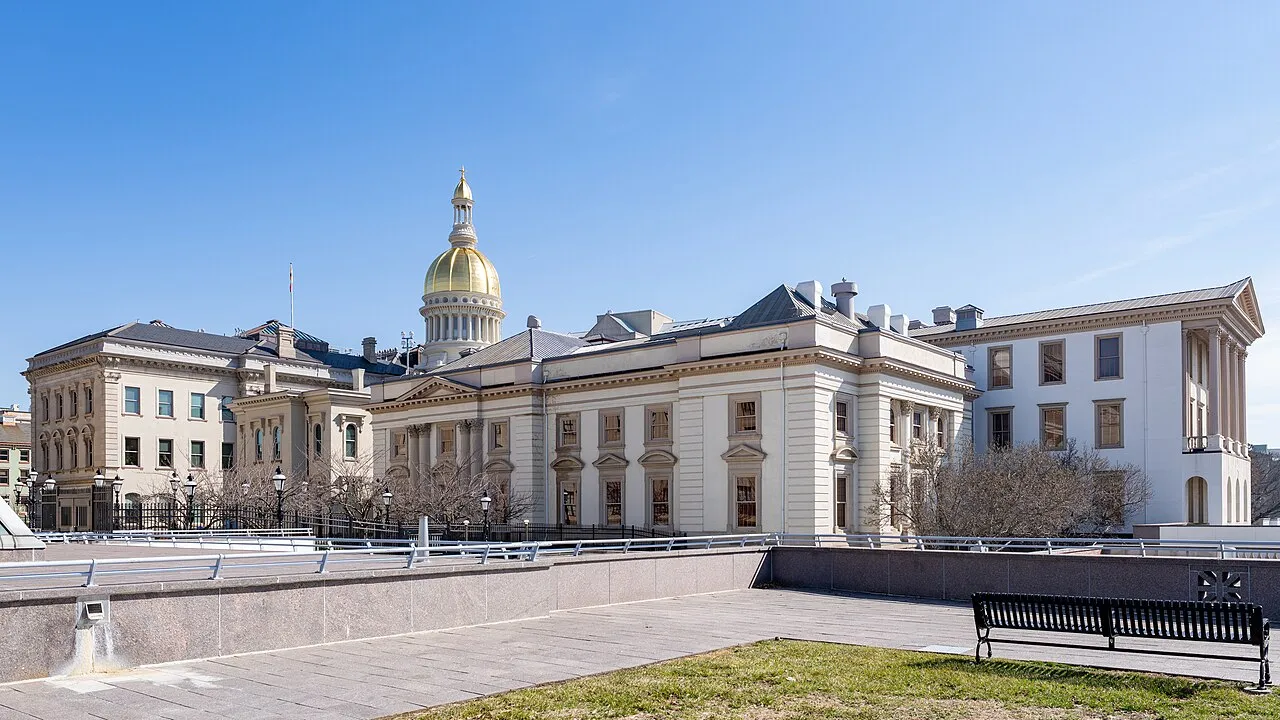
2. Which city is the state capital of New Jersey?
🤯 Mind-Blowing Fact • Grade 2
New Jersey has more diners per mile than anywhere else on Earth, earning it the fun title 'Diner Capital of the World'!
✨ Word Sparks (Grade 2 Glossary)
Tap 🔊 to hear
phonograph
Early machine recording and playing back sound
unanimous
Agreed upon by every single voter together
cranberry
Tart red berry grown in sandy bogs
🪝
Why did George Washington cross an icy river into New Jersey on a snowy December night?
1
Beaches, Pines, and Berry Farms
Stroll along a wooden boardwalk beside crashing Atlantic waves! Despite busy cities, lush farms growing corn, cranberries, and blueberries give New Jersey its proud nickname, the Garden State. Quiet cedar streams wind through the sandy Pine Barrens.
2
Crossing the Icy Delaware
On Christmas night in 1776, General George Washington led tired troops across the freezing Delaware River and won a surprise victory at Trenton, today's state capital! New Jersey unanimously approved the U.S. Constitution on December 18, 1787, becoming the third state.
3
The Wizard of Menlo Park
A century later in Menlo Park and West Orange, Thomas Edison and his team invented the record player, movie camera, and practical electric lightbulb!
1. What river did George Washington cross on Christmas night in 1776 to reach Trenton, New Jersey?
2. Why is New Jersey nicknamed 'The Garden State'?
🤯 Mind-Blowing Fact • Grade 3
In 1789, New Jersey became the very first state in the nation to ratify the Bill of Rights!
✨ Word Sparks (Grade 3 Glossary)
Tap 🔊 to hear
skirmish
Short, sudden clash between two opposing armies
laboratory
Workshop equipped for testing scientific experiments
barrier
Long narrow sand island protecting mainland shores
🪝
Why do historians call New Jersey the 'Crossroads of the American Revolution'?
1
A Peninsula Between Two Giant Neighbors
Look closely at a map of New Jersey—water borders almost the entire state! The Delaware River separates it from Pennsylvania on the west, while the Hudson River and Atlantic Ocean frame the east across 130 miles of sandy beaches.
2
Lenape Trails and Colonial Towns
For thousands of years, the Lenni-Lenape ('Original People') fished coastal bays, farmed river valleys, and blazed footpaths connecting the Delaware and Hudson Rivers. Dutch, Swedish, and English settlers later built towns along those very same trails.
3
Crossroads of the Revolution
Tucked directly between Philadelphia and New York City, New Jersey witnessed nearly three hundred Revolutionary War battles and ! After Washington's bold victories at Trenton and Princeton and freezing winter camps at Morristown, New Jersey became the third state to ratify the Constitution on December 18, 1787.
4
World's First Research Lab
In 1876, Thomas Edison opened his Menlo Park 'invention factory,' pioneering teamwork in science that illuminated cities worldwide.
1. Why were so many Revolutionary War battles fought across New Jersey?
2. Which Indigenous people were the original stewards of New Jersey's rivers and coasts?
🤯 Mind-Blowing Fact • Grade 4
Scientists working at Bell Labs in New Jersey won nine separate Nobel Prizes, including the 1947 invention of the transistor that powers every computer on Earth!
✨ Word Sparks (Grade 4 Glossary)
Tap 🔊 to hear
patent
Official legal protection granted for an invention
transistor
Tiny electronic switch powering modern computer chips
densely
Crowded closely together inside a measured space
🪝
How did America's most densely populated state preserve a million-acre pine wilderness and invent modern electronics?
1
Four Regions from Ridge to Shore
Squeezed into 8,723 square miles, New Jersey is the most populated state in the United States, yet forests and farms still cover nearly half its land! In the northwest, the Appalachian Ridge and Valley rises to High Point (1,803 feet) above the Delaware Water Gap. Southward stretch rolling Piedmont cities, fertile Inner Coastal Plain orchards, and the 1.1-million-acre Pinelands National Reserve, perched atop the pure underground Kirkwood-Cohansey Aquifer.
2
Ten Crucial Days and the New Jersey Plan
During the bleak December of 1776, General George Washington's daring Delaware River crossing and twin victories at Trenton and Princeton—known as the 'Ten Crucial Days'—saved the Patriot cause, followed by the sweltering 1778 Battle of Monmouth. At the 1787 Constitutional Convention, delegate William Paterson proposed the 'New Jersey Plan,' championing equal representation for smaller states—an idea preserved today in the two-senator-per-state U.S. Senate! Satisfied by that Great Compromise, New Jersey ratified unanimously as the third state on December 18, 1787.
3
Waterfalls, Lightbulbs, and Blueberries
Guided by Alexander Hamilton in 1791, Paterson harnessed the seventy-seven-foot Great Falls of the Passaic River to build America's earliest planned industrial city. Nearby, Thomas Edison's Menlo Park and West Orange labs earned over a thousand , while botanist Elizabeth Coleman White teamed up with Frederick Coville at Whitesbog in 1916 to cultivate the world's first commercial blueberries!
4
Transistors and Cosmic Echoes
In the twentieth century, New Jersey scientists at Bell Labs invented the —the tiny electronic switch inside every computer and smartphone—and detected cosmic background energy from the birth of the universe!
1. How did William Paterson's 'New Jersey Plan' at the 1787 Constitutional Convention help shape Congress today?
2. Who partnered with botanist Frederick Coville in New Jersey's Pine Barrens to cultivate the first farm-grown blueberries?
🤯 Mind-Blowing Fact • Grade 5
In 1964 at Holmdel, New Jersey, Bell Labs physicists Arno Penzias and Robert Wilson tuned a giant horn antenna and accidentally discovered the faint microwave echo left over from the birth of the universe!
✨ Word Sparks (Grade 5 Glossary)
Tap 🔊 to hear
biosphere
Protected living ecosystem of plants and wildlife
incandescent
Glowing brightly with light when heated electrically
photovoltaic
Converting sunlight directly into useful electric current
🪝
Why did a compact peninsula wedged between the Hudson and Delaware Rivers become indispensable to the U.S. Constitution, industrial R&D, and the Digital Age?
1
Physiographic Diversity and the Pinelands Biosphere
Almost entirely encircled by water—the Delaware River and Bay on the west, the Atlantic Ocean on the east, and the Hudson River and Upper New York Bay on the northeast—New Jersey encompasses 8,723 square miles across four geologic provinces. From 1,803-foot High Point in the Kittatinny Ridge and the basaltic Watchung cliffs of the Piedmont, the terrain drops across the Fall Line near Trenton and New Brunswick onto the Atlantic Coastal Plain. There, acidic sandy soils shelter the 1.1-million-acre Pinelands (Pine Barrens), an internationally recognized reserve protecting dwarf pitch pines, carnivorous sundews, and seventeen trillion gallons of pristine groundwater.
2
Lenapehoking, Strategic Campaigns, and Constitutional Compromise
Across ancestral Lenapehoking, Munsee- and Unami-speaking Lenni-Lenape communities maintained seasonal footpaths later widened into colonial turnpikes linking New York and Philadelphia. During the War for Independence, General George Washington spent more time in New Jersey than anywhere else: crossing the ice-choked Delaware on December 25, 1776, to turn the war's momentum at Trenton and Princeton, fighting to a standstill at Monmouth in June 1778, and enduring brutal winters at Morristown. In Philadelphia in 1787, New Jersey delegate William Paterson countered James Madison's Virginia Plan with the New Jersey Plan to safeguard small-state equality—paving the way for the Connecticut Compromise, New Jersey's unanimous third-state ratification on December 18, 1787, and its November 1789 distinction as the first state to ratify the Bill of Rights.
3
Hamilton's Great Falls and the Invention of Industrial Research
Chartered with Treasury Secretary Alexander Hamilton's backing in 1791, the Society for Establishing Useful Manufactures harnessed Paterson's Great Falls to manufacture textiles, Colt revolvers, and steam locomotives. A century later, Thomas Alva Edison institutionalized collaborative engineering at Menlo Park (1876) and West Orange (1887), yielding practical lighting, sound recording, and motion pictures.
4
Bell Labs, Einstein's Princeton, and Modern Life Sciences
Twentieth-century New Jersey became a cradle of theoretical and applied physics: Albert Einstein researched for twenty-two years at Princeton's Institute for Advanced Study, while Bell Laboratories engineers in Murray Hill and Holmdel invented the transistor (1947), solar cell (1954), laser concepts, UNIX software, and radio astronomy proof of the Big Bang.
5
Presidential Ties and Gateway Logistics
Birthplace of twenty-second and twenty-fourth President Grover Cleveland (Caldwell) and political launchpad of twenty-eighth President Woodrow Wilson, the Garden State today anchors global pharmaceutical research, maritime container ports at Newark-Elizabeth, and specialty horticulture.