1. Why is New Hampshire nicknamed 'The Granite State'?
2. Which city is the state capital of New Hampshire?
🤯 Mind-Blowing Fact • Grade 2
New Hampshire has the shortest ocean coastline of any coastal U.S. state—just eighteen scenic miles along the Atlantic!
✨ Word Sparks (Grade 2 Glossary)
Tap 🔊 to hear
quarry
Open pit where workers cut building stone
decisive
Settling an important question once and for all
astronaut
Trained explorer who travels up into space
🪝
Why did all of America cheer when messengers galloped out of Concord, New Hampshire in June 1788?
1
White Mountains and Covered Bridges
Crunch through colorful autumn maple leaves toward a red wooden covered bridge! In northern New Hampshire, the rugged White Mountains rise up to 6,288-foot Mount Washington, the tallest peak in the Northeast. Down southeast, waves splash along eighteen miles of Atlantic coast.
2
The Decisive Ninth State
Under Article Seven, nine states needed to approve the new U.S. Constitution before it could take effect. On June 21, 1788, delegates in New Hampshire cast that historic ninth 'yes' vote! Lawmakers still meet in Concord, the state capital.
3
Granite Quarries and Space Pioneers
Workers cut blocks of sturdy gray stone from Concord quarries, earning the nickname Granite State. Centuries later, Alan Shepard from Derry, New Hampshire became the very first American in space!
1. Why was New Hampshire's ratification vote on June 21, 1788 so important?
2. Which famous astronaut from Derry, New Hampshire became the first American in space?
🤯 Mind-Blowing Fact • Grade 3
New Hampshire's 400-member House of Representatives is the largest state legislative chamber in America, paying citizen lawmakers just one hundred dollars a year!
✨ Word Sparks (Grade 3 Glossary)
Tap 🔊 to hear
observatory
Station built to study weather or stars
ratification
Formal vote making a constitution official law
sap
Watery plant liquid boiled into maple syrup
🪝
How can one cozy New England state hold both record mountain winds and two giant constitutional 'firsts'?
1
Extreme Weather on Mount Washington
Brace yourself at the summit of Mount Washington, 6,288 feet high in New Hampshire's White Mountains! Three storm tracks collide above its rocky cone, where weather scientists once measured a 231-mile-per-hour wind gust. Farther south, sparkling Lake Winnipesaukee and historic wooden covered bridges dot rolling valleys.
2
Abenaki Homelands and Early Ports
For thousands of years, Abenaki and Pennacook peoples fished salmon runs along the Merrimack and Connecticut Rivers and tapped sugar maples each spring. English fishermen settled near Portsmouth harbor in 1623, building tall ships from towering white pines.
3
Two Huge Constitutional Milestones
In January 1776—six months before the Declaration of Independence—New Hampshire became the very first colony to adopt its own independent constitution! Then on June 21, 1788, meeting in Concord, New Hampshire cast the ninth vote that officially launched the United States Constitution.
4
Granite Pride and Civic Tradition
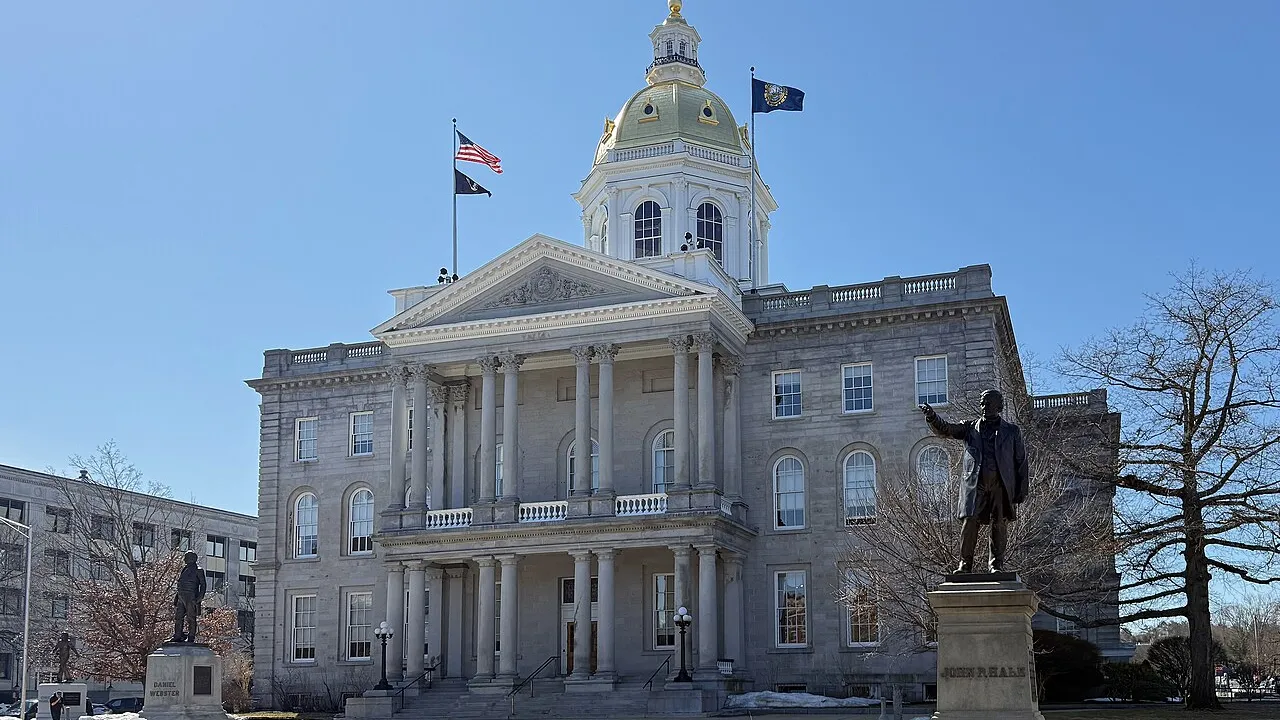
Built in 1819 in Concord, the Granite State's capitol still hosts America's largest state legislature—four hundred citizen representatives!
1. What mountain in New Hampshire's White Mountains is the tallest peak in the Northeast?
2. What colonial milestone did New Hampshire achieve in January 1776?
🤯 Mind-Blowing Fact • Grade 4
The famous wooden stagecoaches that rolled across the Wild West in movies and history were actually built right in Concord, New Hampshire!
✨ Word Sparks (Grade 4 Glossary)
Tap 🔊 to hear
magma
Melted hot rock deep beneath Earth's surface
motto
Short guiding phrase expressing shared values
primary
Early election choosing candidates for high office
🪝
How did New Hampshire granite, Merrimack River mills, and independent town meetings leave an outsized mark on the nation?
1
Granite Plutons, Lakes, and Sea
Beneath New Hampshire's 9,349 square miles lies cooled ancient that crystallized into ultra-durable gray granite, exposed by Ice Age glaciers across the Presidential Range of the White Mountains. For generations, travelers marveled at the 'Old Man of the Mountain,' a natural granite cliff profile in Franconia Notch that remains the state emblem even after gravity toppled the ledge in 2003. Southward, glacial lakes feed the Merrimack River while the Connecticut River forms the western border with Vermont.
2
Revolutionary Spirit and the Ninth Pillar
Long home to Western Abenaki and Pennacook communities, New Hampshire demonstrated fierce independence early: in December 1774, colonial militia seized gunpowder at Fort William and Mary near Portsmouth, and General John Stark later penned the bold phrase 'Live Free or Die,' now the state . After adopting the first colonial state constitution in January 1776, New Hampshire earned everlasting constitutional fame on June 21, 1788, when its convention in Concord delivered the ninth ratification required under Article VII—officially transforming the U.S. Constitution from parchment proposal into living national government, just four days before Virginia ratified as the tenth!
3
Stagecoaches, Brick Mills, and World Peace
Craftspeople in Concord built sturdy Abbott-Downing 'Concord Coaches' that carried mail across the American West, while Manchester's Amoskeag Manufacturing Company along the Merrimack River grew into one of the world's largest nineteenth-century cotton textile complexes.
4
Diplomacy, Primaries, and Spaceflight
Portsmouth hosted the 1905 peace treaty ending the Russo-Japanese War, and Bretton Woods hosted the 1944 Allied economic conference. From poet Robert Frost's Derry farm to astronaut Alan Shepard and America's first-in-the-nation presidential , New Hampshire prizes active citizenship.
1. Which Revolutionary War general from New Hampshire wrote the words that became the state motto, 'Live Free or Die'?
2. What famous western vehicles were manufactured by craftsmen in Concord, New Hampshire?
🤯 Mind-Blowing Fact • Grade 5
In July 1944, delegates from forty-four nations met at the Mount Washington Hotel in Bretton Woods, New Hampshire to design the modern global financial system, creating the World Bank and International Monetary Fund!
✨ Word Sparks (Grade 5 Glossary)
Tap 🔊 to hear
tundra
Cold treeless zone high above mountain timberlines
pluton
Massive body of granite cooled underground
charter
Legal document founding a school or town
🪝
Why did a compact New England state of granite peaks and river valleys repeatedly step onto the global stage in constitutional law, industrial design, and international diplomacy?
1
Plutonic Bedrock, Glacial Notches, and Alpine Meteorology
Extending 9,349 square miles from an eighteen-mile Atlantic shoreline at Portsmouth and Hampton Beach northward to the Quebec border, New Hampshire owes its 'Granite State' identity to Devonian-age granitic sculpted by Pleistocene ice sheets. In the White Mountains, U-shaped glacial valleys—called 'notches,' such as Franconia and Crawford—slice beneath the Presidential Range, crowned by 6,288-foot Mount Washington. Positioned at the convergence of Atlantic, Gulf, and Arctic storm tracks, Mount Washington's treeless alpine recorded a 231-mile-per-hour surface wind gust in April 1934 and inspired Sylvester Marsh's pioneering 1869 rack-and-pinion Cog Railway.
2
Ndakinna Homelands and Revolutionary Precedents
For millennia across Ndakinna ('Our Land'), Western Abenaki and Pennacook confederacies cultivated river-intervale maize and harvested Atlantic salmon along the Merrimack, Piscataqua, and Connecticut watersheds. Following permanent English fishing settlements at Odiorne Point in 1623, shipbuilding flourished around Portsmouth's ice-free harbor. Four months before Lexington and Concord, patriots raided Fort William and Mary in December 1774, and on January 5, 1776, New Hampshire's Provincial Congress adopted the first independent state constitution in British North America.
3
The Ninth Pillar and Supreme Court Jurisprudence
Under Article VII, ratification by nine states was required to establish the U.S. Constitution. Reconvening in Concord, New Hampshire delegates voted 57–47 to ratify on June 21, 1788, erecting the decisive ninth constitutional pillar just ahead of Virginia and New York. Three decades later, New Hampshire orator Daniel Webster argued 'Dartmouth College v. Woodward' (1819) before Chief Justice John Marshall, establishing vital constitutional protections for private and contracts nationwide. Franklin Pierce of Hillsborough later served as the fourteenth U.S. President.
4
Amoskeag Textiles, Concord Coaches, and Global Summits
Harnessing Amoskeag Falls on the Merrimack River, Manchester's brick millyards stretched over a mile long as a powerhouse of nineteenth-century textile weaving, while Concord's Abbot-Downing Company engineered shock-absorbing leather thoroughbrace stagecoaches prized across six continents. Twice New Hampshire hosted historic international diplomacy: President Theodore Roosevelt brokered the 1905 Treaty of Portsmouth—earning the Nobel Peace Prize—and forty-four nations met at Bretton Woods in July 1944 to establish the International Monetary Fund and World Bank.
5
Citizen Legislature and Aerospace Heritage
Home to Concord's 1819 granite State House, a 400-seat volunteer-spirit House of Representatives, Derry astronaut Alan Shepard, and robotics pioneers in Manchester's revitalized millyard, New Hampshire pairs town-meeting democracy with enduring technical ingenuity.