1. Which tree-planting holiday started in Nebraska in 1872?
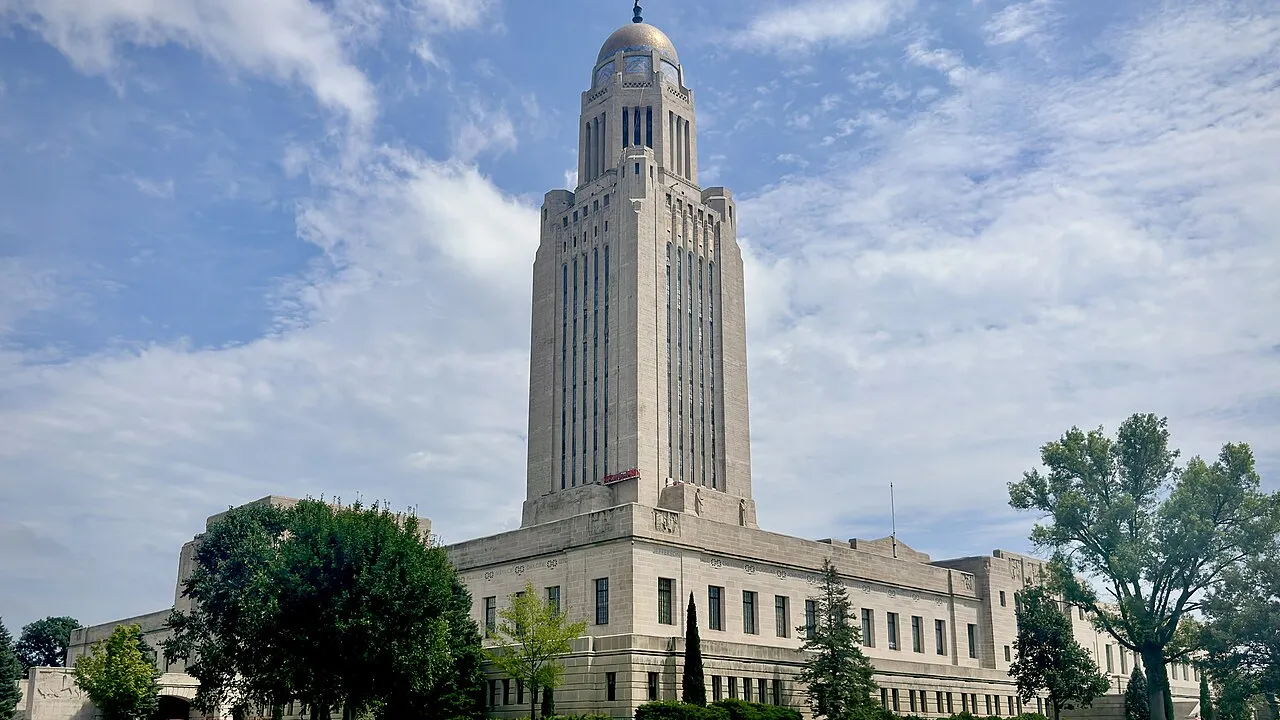
2. Which city is the state capital of Nebraska?
🤯 Mind-Blowing Fact • Grade 2
Nebraska's State Capitol in Lincoln rises four hundred feet like a skyscraper, earning the nickname 'Tower on the Plains'!
✨ Word Sparks (Grade 2 Glossary)
Tap 🔊 to hear
windbreak
Row of trees blocking strong prairie winds
homestead
Farm home built by settlers on prairie land
braided
River splitting into many sandy weaving channels
🪝
Why did families on the prairie celebrate a brand-new holiday just for planting trees?
1
River of Flat Water
Listen to thousands of sandhill cranes bugling above a wide, shimmering river! Nebraska's name comes from Native Otoe and Omaha words meaning 'flat water,' describing the broad Platte River flowing across the state.
2
Wagons, Trains, and Capital Lincoln
Covered wagons rolled beside the Platte River past towering Chimney Rock and Scotts Bluff on the Oregon Trail. Soon workers in Omaha began laying steel tracks westward for America's first cross-country railroad! Nebraska became the thirty-seventh state on March 1, 1867, naming its capital Lincoln.
3
The First Arbor Day
Wide grasslands had very few shade trees for or firewood. In 1872, J. Sterling Morton inspired Nebraskans to create Arbor Day, and families planted over one million trees in a single day!
1. What does the Indigenous name behind 'Nebraska' mean?
2. What rock tower in western Nebraska guided covered-wagon travelers on the Oregon Trail?
🤯 Mind-Blowing Fact • Grade 3
Beneath Nebraska lies the thickest part of the Ogallala Aquifer—enough underground fresh water to fill Lake Huron!
✨ Word Sparks (Grade 3 Glossary)
Tap 🔊 to hear
aquifer
Underground rock and sand holding fresh water
unicameral
State legislature having just one lawmaking house
stabilized
Held firmly in place by plant roots
🪝
What giant hidden treasure lies underground beneath Nebraska's golden farms and grassy sand dunes?
1
Highway Across the Great Plains
Stand beside the wagon ruts still carved into solid rock at Scotts Bluff and imagine wooden wheels creaking west! Gently rising from the Missouri River in the east toward the Rocky Mountain foothills, Nebraska guided Oregon, California, and Mormon Trail pioneers along the Platte River Valley.
2
Pawnee, Omaha, and Homesteaders
Pawnee, Omaha, Ponca, Otoe-Missouria, and Lakota peoples lived and hunted bison across these plains for centuries. Under the Homestead Act of 1862, newcomer families claimed 160-acre farms—including one of the very first claims near Beatrice, Nebraska! Admitted on March 1, 1867, Nebraska chose Lincoln as its capital.
3
Grass-Covered Dunes and Hidden Water
North-central Nebraska holds the Sandhills, vast rolling sand dunes anchored in place by thick prairie grass! Deep underground sits the massive Ogallala , storing ancient fresh water that nourishes cornfields, cattle ranches, and wetlands.
4
One-of-a-Kind Lawmaking
Unlike all forty-nine other states that divide lawmakers into two chambers, Nebraska governs with a single-house legislature called the !
1. How is Nebraska's state legislature different from the legislatures of all other forty-nine U.S. states?
2. What underground water source helps irrigate farms across Nebraska?
🤯 Mind-Blowing Fact • Grade 4
Halsey's Bessey Ranger District in central Nebraska is the largest hand-planted forest in the Western Hemisphere, grown tree by tree across prairie sandhills!
✨ Word Sparks (Grade 4 Glossary)
Tap 🔊 to hear
irrigation
Piping water onto fields to grow crops
nonpartisan
Working together without official political party labels
porous
Full of tiny spaces where water soaks
🪝
How did sod houses, transcontinental steel rails, and a single-chamber Capitol make Nebraska a Great Plains innovator?
1
From Tallgrass Bluffs to the Sandhills
Travel westward across Nebraska's 77,348 square miles and watch annual rainfall gradually drop as tallgrass prairies near Omaha give way to mixed-grass plains and the sweeping Nebraska Sandhills—nearly twenty thousand square miles of grass-stabilized dunes, the largest such formation in the Western Hemisphere! Beneath those hills, gravel holds the heart of the Ogallala Aquifer, feeding crystal rivers and center-pivot farm sprinklers that look like giant green circles from airplanes.
2
Indigenous Homelands, Trails, and Rails
Derived from Otoe 'Ni Brasge' and Omaha 'Ni Bthaska' ('flat water'), Nebraska honors the broad Platte River corridor long stewarded by Pawnee earth-lodge farmers, Omaha, Ponca, and Lakota horse nations. Between the 1840s and 1860s, more than 350,000 emigrants followed the Great Platte River Road past Courthouse Rock, Chimney Rock, and Scotts Bluff. Simultaneously, Union Pacific crews began laying tracks westward from Omaha in 1865 to forge the First Transcontinental Railroad.
3
Homesteads, Statehood, and Arbor Day
Minutes after midnight on January 1, 1863, Daniel Freeman filed one of the nation's first claims under President Lincoln's Homestead Act near Beatrice; lacking timber, prairie families cut thick grass-root bricks to build cozy 'soddies.' Admitted as the thirty-seventh state on March 1, 1867, Nebraska renamed Lancaster as its capital, Lincoln. Five years later in Nebraska City, J. Sterling Morton launched Arbor Day, later expanding into the Nebraska National Forest—America's largest hand-planted forest!
4
Standing Bear's Landmark Trial and the Unicameral
In an 1879 Omaha federal courtroom, Ponca Chief Standing Bear won a landmark ruling affirming that Native Americans are 'persons within the meaning of the law' entitled to constitutional rights. Voters again made civic history in 1934 by adopting a streamlined, unicameral legislature.
1. Why did many early Nebraska homesteaders build 'sod houses'?
2. What constitutional milestone resulted from Ponca Chief Standing Bear's 1879 court case in Omaha?
🤯 Mind-Blowing Fact • Grade 5
Bailey Yard in North Platte, Nebraska is the largest railroad classification yard in the entire world, sorting roughly ten thousand rail cars across more than three hundred miles of track every single day!
✨ Word Sparks (Grade 5 Glossary)
Tap 🔊 to hear
terminus
Starting or ending station of a railway
recharge
Refill underground water layers with soaking rain
moniker
Familiar nickname describing a person or place
🪝
Why did the braided Platte River valley become the central artery of nineteenth-century westward migration, civil rights jurisprudence, and groundwater agriculture?
1
Great Plains Geomorphology, Sandhills, and the Ogallala Aquifer
Rising steadily from 840 feet along the southeastern Missouri River bluffs to 5,424 feet at Panorama Point near the Wyoming-Colorado corner, Nebraska spans 77,348 square miles of Central Lowland and Great Plains terrain. Its signature waterway, the braided Platte River—named from Otoe 'Ni Brasge' ('flat water')—bisects the state beneath an annual spring migration corridor used by eighty percent of the world's sandhill cranes. Covering roughly one-quarter of the state, the Nebraska Sandhills represent the Western Hemisphere's largest stabilized dune sea, acting as a gigantic natural sponge recharging the underlying High Plains (Ogallala) Aquifer.
2
Indigenous Earth Lodges and the Great Platte River Road
For centuries, semi-sedentary Pawnee, Omaha, Ponca, and Otoe-Missouria nations built timber-and-earth lodges along eastern river terraces while Lakota, Cheyenne, and Arapaho bands hunted bison across western tablelands. Because the Platte's gentle grade offered dependable water and grass, multiple historic routes—the Oregon, California, and Mormon Pioneer Trails alongside the 1860 Pony Express and 1861 transcontinental telegraph—converged into the 'Great Platte River Road,' guided westward by Oligocene siltstone monuments at Courthouse Rock, Chimney Rock, and Scotts Bluff.
3
Homestead Act, Transcontinental Rails, and 1867 Statehood
Organized by the Kansas-Nebraska Act of 1854, the territory surged ahead under two transformative 1862 laws signed by Abraham Lincoln: the Homestead Act—memorialized at Beatrice where Daniel Freeman filed minutes into January 1, 1863—and the Pacific Railway Act, which made Omaha the eastern of the Union Pacific Railroad. Entering the Union as the thirty-seventh state on March 1, 1867, Nebraska established its capital at Lincoln and soon embraced J. Sterling Morton's 1872 Arbor Day initiative, earning the early 'Tree Planter's State.'
4
Standing Bear v. Crook and the Nonpartisan Unicameral
In May 1879 in Omaha, U.S. District Judge Elmer Dundy issued his landmark 'Standing Bear v. Crook' writ of habeas corpus after Ponca Chief Standing Bear eloquently testified for human dignity, recognizing Native Americans as legal persons under federal law. Five decades later, championed by U.S. Senator George W. Norris during the Great Depression, Nebraska voters amended their constitution in 1934 to create the nation's sole nonpartisan unicameral legislature, housed inside Bertram Goodhue's 400-foot Art Deco Capitol.
5
Literary Voice and Agricultural Engineering
Celebrated in Willa Cather's Red Cloud novels and Red Cloud-inspired prairie prose, modern Nebraska pioneers center-pivot irrigation conservation, beef and corn production, and rail logistics at North Platte's Bailey Yard—the largest railroad classification yard on Earth.