1. Which famous dinosaur's very first skeleton was dug up in Montana?
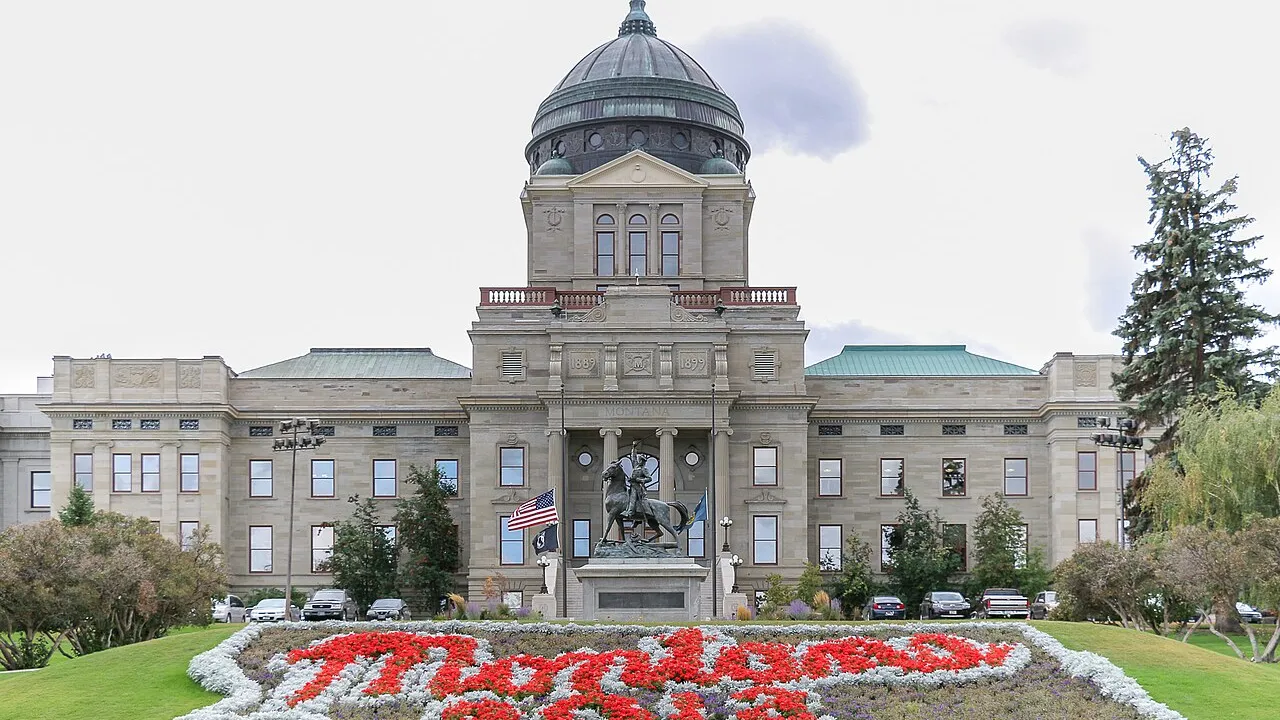
2. Which city is the state capital of Montana?
🤯 Mind-Blowing Fact • Grade 2
Montana has nearly three times as many cows grazing on its wide ranches as people living in the entire state!
✨ Word Sparks (Grade 2 Glossary)
Tap 🔊 to hear
paleontologist
Scientist who studies ancient fossils in rock
ranch
Large western farm raising cattle or horses
alpine
High up on cold, snowy mountainsides
🪝
Why is Montana called both 'Big Sky Country' and 'The Treasure State'?
1
Mountains in the Name
Breathe in crisp pine air beside an icy blue mountain lake! Montana gets its name from the Spanish word 'montana,' meaning mountain. Snow-topped Rocky Mountains fill western Montana, while golden prairies roll across the east beneath an endless sky.
2
Gold, Copper, and Helena
Miners found shimmering gold, silver, and copper inside these hills, earning Montana the nickname Treasure State! One lucky gold strike became Helena, the state capital. Montana entered the Union as the forty-first state on November 8, 1889.
3
Parks and Prehistoric Giants
Bighorn sheep and grizzly bears roam Glacier National Park in the north, and part of Yellowstone National Park sits along Montana's southern edge. Out on the eastern plains, unearth world-famous dinosaur skeletons!
1. What Spanish word gave the State of Montana its name?
2. Why is Montana nicknamed 'The Treasure State'?
🤯 Mind-Blowing Fact • Grade 3
During one twenty-four-hour winter weather swing in Browning, Montana in 1916, the temperature plunged an astonishing one hundred degrees—from 44°F down to minus 56°F!
✨ Word Sparks (Grade 3 Glossary)
Tap 🔊 to hear
portage
Carrying boats overland around steep river waterfalls
sapphire
Sparkling blue gemstone mined from rocky gravel
vein
Ribbon of valuable mineral inside underground rock
🪝
Where do three clear mountain rivers join together to launch North America's longest river?
1
Crown of the Continent
Wind along the cliffside Going-to-the-Sun Road in Glacier National Park, where waterfalls tumble down carved valleys! As America's fourth-largest state by area, Montana straddles the Continental Divide in the Rocky Mountains before opening eastward onto sweeping Great Plains.
2
Indigenous Nations and Three Forks
Blackfeet, Crow, Cheyenne, Salish, Kootenai, Assiniboine, and Sioux nations have lived across these mountains and bison plains for generations. In 1805, guided by Sacagawea, Lewis and Clark reached Three Forks in Montana, where the Jefferson, Madison, and Gallatin Rivers unite to form the Missouri River.
3
Richest Hill on Earth
Gold rushes in the 1860s gave birth to capital city Helena, while massive copper under Butte wired America's early electric cities with copper cables! Montana became the forty-first state on November 8, 1889.
4
First Woman in Congress
In 1916—four years before the Nineteenth Amendment—Montana voters elected Jeannette Rankin of Missoula as the very first woman in the United States Congress!
1. What historic first did Jeannette Rankin of Montana achieve in 1916?
2. Which major river begins at Three Forks, Montana, where the Jefferson, Madison, and Gallatin Rivers meet?
🤯 Mind-Blowing Fact • Grade 4
Snowmelt trickling down Triple Divide Peak in Montana's Glacier National Park splits toward three separate oceans—Pacific, Atlantic, and Arctic!
✨ Word Sparks (Grade 4 Glossary)
Tap 🔊 to hear
badlands
Dry rocky hills carved deeply by wind
hydrological
Relating to how water moves across Earth
sovereign
Self-governing nation managing its own community affairs
🪝
How did Montana's Hell Creek fossils transform dinosaur science while its copper mines electrified modern cities?
1
Two Landscapes Across One Huge State
Covering 147,040 square miles along the Canadian border, Montana splits into two striking worlds: the Western two-fifths bristle with over fifty named Rocky Mountain ranges peaking at Granite Peak (12,807 feet), while the Eastern three-fifths roll across and shortgrass prairies. High in Glacier National Park stands Triple Divide Peak, a rare summit whose melting snows feed the Pacific Ocean, the Atlantic's Gulf of Mexico, and Arctic Hudson Bay!
2
Plains Nations, Lewis and Clark, and Copper Boomtowns
Blackfeet, Apsaalooke (Crow), Northern Cheyenne, Confederated Salish and Kootenai, Chippewa Cree, Fort Belknap, and Fort Peck nations maintain vibrant homelands across Montana today. In 1805–1806, the Lewis and Clark Expedition spent more trail miles in Montana than in any other state, portaging eighteen miles around the Great Falls of the Missouri. Gold strikes at Bannack and Last Chance Gulch—now state capital Helena—preceded Butte's 'Richest Hill on Earth,' whose copper ore supplied wiring for Thomas Edison's electric grids before statehood on November 8, 1889.
3
Cretaceous Secrets in the Badlands
In eastern Montana's Hell Creek and Two Medicine rock formations, paleontologist Barnum Brown excavated the first Tyrannosaurus rex in 1902. Decades later, Montana paleontologist Jack Horner discovered Maiasaura—'good mother lizard'—nests at Egg Mountain, proving that certain dinosaurs lived in herds and fed warm-blooded youngsters!
4
Conservation and Civic Pioneers
From Jeannette Rankin's groundbreaking 1916 election to Congress to wildlife corridors linking Yellowstone and Glacier ecosystems, Montana celebrates wide-open stewardship.
1. Why did Butte, Montana become famous in the late 1800s as 'The Richest Hill on Earth'?
2. What breakthrough discovery did paleontologist Jack Horner make at Montana's 'Egg Mountain'?
🤯 Mind-Blowing Fact • Grade 5
In 1932, Montana's Glacier National Park and Canada's Waterton Lakes National Park joined together to form the very first International Peace Park anywhere on Earth!
✨ Word Sparks (Grade 5 Glossary)
Tap 🔊 to hear
cordillera
Extensive chain of parallel mountain ranges
suffrage
Constitutional right of citizens to vote
placer
Streambed gravel holding loose gold flakes
🪝
Why do geologists, historians, and ecologists alike view Montana's 147,040 square miles as one of North America's greatest natural and historical archives?
1
Cordilleran Peaks, Triple Divide Hydrology, and Great Plains
Fourth in area among U.S. states at 147,040 square miles, Montana spans 550 miles from the Idaho Bitterroot crest eastward to North Dakota. Along its western , ancient Precambrian sedimentary strata thrust skyward during mountain-building events to form Glacier National Park's sculpted horns and the Beartooth Range's 12,807-foot Granite Peak. Atop 8,020-foot Triple Divide Peak, precipitation parts toward three oceanic basins: the Columbia-Pacific, the Missouri-Mississippi-Atlantic, and the Saskatchewan-Nelson-Hudson Bay systems. East of the Rocky Mountain Front, rain-shadowed shortgrass plains and eroded Late Cretaceous badlands stretch toward the Yellowstone and Missouri valleys.
2
Sovereign Tribal Homelands and the Corps of Discovery
Twelve Indigenous nations—including the Blackfeet, Apsaalooke (Crow), Northern Cheyenne, Salish, Pend d'Oreille, Kootenai, Assiniboine, Gros Ventre, Sioux, and Little Shell Chippewa—stewarded vast bison commons and intermountain passes for millennia. Between 1805 and 1806, Meriwether Lewis, William Clark, and Lemhi Shoshone interpreter Sacagawea traversed more distance in present-day Montana than in any other territory: portaging the five cataracts of the Great Falls, naming the Jefferson, Madison, and Gallatin headwaters at Three Forks, and later splitting to explore the Marias and Yellowstone Rivers.
3
Frontier Conflicts, Mineral Empires, and 1889 Statehood
Following 1862–1864 gold discoveries at Bannack, Virginia City, and Last Chance Gulch (future capital Helena), rapid settlement collided with Lakota, Cheyenne, and Arapaho treaty lands, culminating in the June 1876 Battle of the Little Bighorn and the 1877 Nez Perce trek under Chief Joseph. Meanwhile, Marcus Daly and rival 'Copper Kings' transformed Butte into an underground mining powerhouse supplying copper for global electrification, propelling Montana to statehood as the forty-first state on November 8, 1889.
4
Suffrage Leadership and Paleontological Revolutions
Granting women full in 1914, Montana elected Missoula reformer Jeannette Rankin to the U.S. House of Representatives in 1916—the first woman seated in Congress. In paleontology, Barnum Brown's 1902 Hell Creek excavation of Tyrannosaurus rex and Jack Horner's 1978 discovery of colonial Maiasaura nests revolutionized evolutionary biology.
5
Crown of the Continent Stewardship
Linking Yellowstone—the world's first national park (1872)—with Waterton-Glacier International Peace Park (1932), Montana sustains intact grizzly, wolf, elk, and bison ecosystems alongside wheat farming and photonics research in Bozeman.