1. What giant shiny landmark stands beside the river in St. Louis, Missouri?
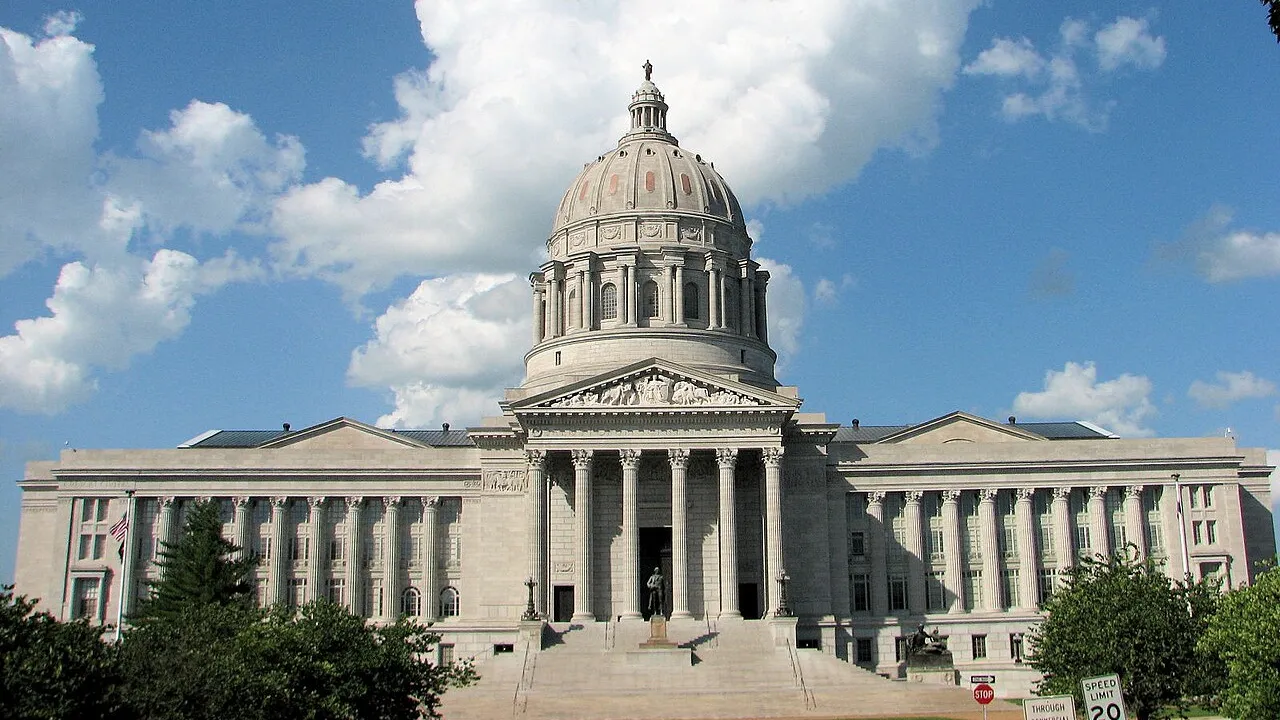
2. Which city is the state capital of Missouri?
🤯 Mind-Blowing Fact • Grade 2
The Gateway Arch in St. Louis is exactly as wide at its base as it is tall—630 feet in both directions!
✨ Word Sparks (Grade 2 Glossary)
Tap 🔊 to hear
expedition
Carefully planned journey to explore new places
gateway
Entrance leading into a big new region
limestone
Soft pale rock where water carves caves
🪝
Why did explorers, covered wagons, and fast mail riders all start their journeys in Missouri?
1
Gateway to the West
Stand beneath the gleaming 630-foot Arch in St. Louis and feel like you are stepping through a giant doorway! Just north of town, America's two longest rivers—the Missouri and the Mississippi—flow together in a swirling rush.
2
Trails, Ponies, and Jefferson City
In 1804, Lewis and Clark paddled up the Missouri River to map the West. Later, covered wagons rolled out of Independence on the Oregon Trail, and Pony Express riders galloped from St. Joseph! Lawmakers meet in Jefferson City, the state capital.
3
Caves of the Show-Me State
Missouri became the twenty-fourth state on August 10, 1821. Down in the wooded Ozark hills, underground streams have carved more than seven thousand cool caves!
1. Which two famous explorers set off up the Missouri River from near St. Louis in 1804?
2. What famous nickname belongs to the State of Missouri?
🤯 Mind-Blowing Fact • Grade 3
Missouri has over 7,500 recorded caves tucked beneath its Ozark hills, earning it the unofficial title 'The Cave State'!
✨ Word Sparks (Grade 3 Glossary)
Tap 🔊 to hear
dugout
Boat hollowed out from one giant tree
compromise
Agreement where each side gives a little
saddlebag
Leather pouch carried on a horse's back
🪝
How did wooden dugout canoes, riverboats, and wagon trains make Missouri the crossroads of America?
1
People of the Wooden Canoes
Paddle onto the wide, muddy currents north of St. Louis where the Missouri River pours into the Mississippi! Missouri gets its name from the Indigenous Missouria people, meaning 'people of the big canoes.' Rolling prairies stretch across the north while forested Ozark mountains and clear springs fill the south.
2
Jumping-Off Point for the West
After President Thomas Jefferson completed the Louisiana Purchase in 1803, Meriwether Lewis and William Clark launched their Corps of Discovery from Missouri in May 1804. Soon pioneers gathered in Independence to pack wagons for the Santa Fe, Oregon, and California Trails.
3
Compromise and Statehood
Following the Missouri in Congress, Missouri entered the Union as the twenty-fourth state on August 10, 1821, naming its new capital Jefferson City. In 1860, fearless Pony Express riders raced westward from St. Joseph carrying mail in leather .
4
Storytellers and Scientists
Author Mark Twain grew up watching steamboats in Hannibal, while plant scientist George Washington Carver began his remarkable life near Diamond, Missouri.
1. What does the Indigenous name 'Missouria' mean?
2. Which famous scientist, born near Diamond, Missouri, discovered hundreds of uses for peanuts and sweet potatoes?
🤯 Mind-Blowing Fact • Grade 4
Big Spring in Missouri's Ozark National Scenic Riverways gushes nearly three hundred million gallons of icy underground water every single day!
✨ Word Sparks (Grade 4 Glossary)
Tap 🔊 to hear
karst
Limestone landscape filled with caves and springs
bisect
Cut or divide into two main parts
hemisphere
Half of planet Earth divided on maps
🪝
Why did Missouri sit right at the center of America's westward trails, river commerce, and nineteenth-century debates?
1
Glaciated Plains and Ozark Karst
Bisected from west to east by the winding Missouri River and bordered on the east by the Mississippi, Missouri unites two dramatic landscapes across 69,707 square miles. North of the Missouri River lie fertile, glacier-smoothed prairies rich in corn and soybeans. Southward rises the ancient Ozark Plateau, a wonderland where rainwater dissolves underground limestone to feed crystal-clear giant springs and more than 7,500 caves.
2
Confluence of Cultures and Trails
Osage, Missouria, Otoe, and Illiniwek peoples hunted and traded along these river highways long before French fur traders founded Ste. Genevieve and St. Louis in the 1700s. Following the 1803 Louisiana Purchase, Missouri became the nation's premier western launchpad: Lewis and Clark departed from Camp Dubois and St. Charles in 1804, Santa Fe and Oregon Trail wagon trains rolled out of Independence, and Pony Express riders sprinted from St. Joseph to Sacramento in just ten days.
3
The Missouri Compromise and Statehood
When Missouri applied for statehood, Congress debated fiercely over whether slavery would expand westward. Crafted by Henry Clay in 1820, the Missouri Compromise admitted Maine as a free state and Missouri as the twenty-fourth state on August 10, 1821, while drawing a latitude boundary across the remaining Louisiana Territory. Lawmakers sited the capital on bluffs at Jefferson City, honoring Virginia's Thomas Jefferson.
4
Monuments, Literature, and Leadership
Missouri gave America writer Samuel Clemens—known worldwide as Mark Twain—botanist George Washington Carver, and thirty-third U.S. President Harry S. Truman of Independence. Completed in 1965, Eero Saarinen's 630-foot stainless-steel Gateway Arch crowns St. Louis as the tallest monument in the Western .
1. Which other state entered the Union alongside Missouri as part of the 1820 Missouri Compromise?
2. Which U.S. president hailed from Independence, Missouri?
🤯 Mind-Blowing Fact • Grade 5
Architect Eero Saarinen designed the 630-foot Gateway Arch using a mathematical curve called a weighted catenary—the exact balanced shape a hanging chain forms upside down!
✨ Word Sparks (Grade 5 Glossary)
Tap 🔊 to hear
catenary
Graceful balanced curve of a hanging chain
emigrant
Traveler leaving home to settle new territory
sectional
Dividing different geographic regions of one country
🪝
How did the meeting place of North America's two longest rivers shape continental exploration, constitutional law, and Heartland culture?
1
Continental Confluence and Three Physiographic Zones
Roughly fifteen miles north of downtown St. Louis at Columbia Bottom, the sediment-laden Missouri River—North America's longest river at 2,341 miles—merges into the mighty Mississippi, draining over one-third of the contiguous United States. Across Missouri's 69,707 square miles, geography divides into three distinct realms: fertile glaciated till plains north of the Missouri River, the uplifted Precambrian granite domes of the St. Francois Mountains (cresting at 1,772-foot Taum Sauk Mountain) and carbonate karst caverns of the Ozark Plateau, and the flat alluvial Bootheel floodplain in the southeast.
2
Indigenous Riverways and the Funnel of Westward Expansion
For centuries, Osage and Missouria nations controlled trade along these river valleys—Mississippian builders even raised mounds opposite present-day St. Louis before French merchants Pierre Laclède and Auguste Chouteau established a fur-trading post there in 1764. Acquired from France in the 1803 Louisiana Purchase, Missouri rapidly became the geographic funnel of nineteenth-century expansion: Meriwether Lewis and William Clark ascended the Missouri in May 1804, traders blazed the Santa Fe Trail from Franklin and Independence in 1821, hundreds of thousands of outfitted wagons in Independence and Westport for the Oregon and California Trails, and St. Joseph launched the Pony Express in April 1860.
3
Statehood, Constitutional Reckonings, and Border Struggles
Missouri's petition for statehood ignited a pivotal congressional debate resolved temporarily by the Missouri Compromise of 1820, leading to Missouri's admission as the twenty-fourth state on August 10, 1821, with Jefferson City laid out on limestone bluffs above the Missouri River. In St. Louis's Old Courthouse, enslaved couple Dred and Harriet Scott sued for their freedom, producing an 1857 Supreme Court ruling that deepened crisis; during the Civil War, Missouri remained in the Union despite fierce internal conflict, before abolishing slavery by state convention in January 1865.
4
Literary Realism, Ragtime, and Scientific Ingenuity
From Hannibal steamboat pilot Samuel Clemens (Mark Twain) and Sedalia ragtime composer Scott Joplin to Diamond-born agricultural chemist George Washington Carver—honored at America's first national monument dedicated to an African American—and Kansas City jazz innovators, Missouri enriched global arts and science.
5
Modern Crossroads Beneath the Gateway Arch
Home to thirty-third President Harry S. Truman's library in Independence, aerospace and plant-science hubs in St. Louis, and Eero Saarinen's stainless-steel Gateway Arch National Park, the Show-Me State endures as America's central crossroads.