1. What piece of winter clothing looks like Michigan's Lower Peninsula?
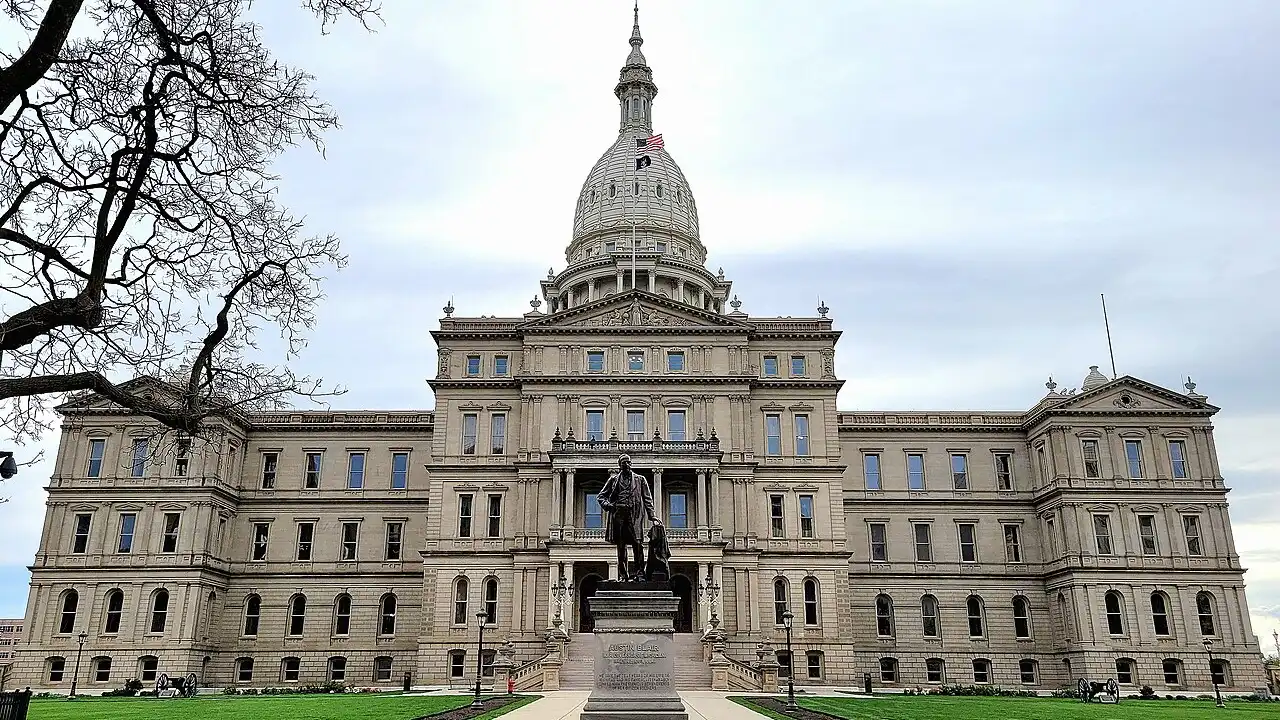
2. Which city is the state capital of Michigan?
🤯 Mind-Blowing Fact • Grade 2
Michigan has more lighthouses than any other state in America—over one hundred twenty stand guard along its Great Lakes shores!
✨ Word Sparks (Grade 2 Glossary)
Tap 🔊 to hear
strait
Narrow water passage linking two big lakes
assembly
Putting parts together step by step
dune
Tall hill of wind-blown beach sand
🪝
How do travelers drive between Michigan's two giant pieces of land?
1
Two Peninsulas and One Giant Bridge
Look down from an airplane and see waves sparkling everywhere! Michigan is the only state made of two big peninsulas. The five-mile-long Mackinac Bridge stretches high above deep blue water to connect the Upper and Lower Peninsulas.
2
Shores of the Great Lakes
Michigan's name comes from a Native Ojibwe word meaning 'large lake.' Four Great Lakes—Superior, Michigan, Huron, and Erie—surround the state with sandy and tall lighthouses. Lawmakers meet in Lansing, the state capital.
3
Motor City and Music
Michigan joined the Union as the twenty-sixth state in 1837. Later, Henry Ford built fast moving lines in the Detroit area so families could afford automobiles. Detroit also gave the world joyful Motown music!
1. How many of the five Great Lakes touch the shores of Michigan?
2. Why did Detroit earn the famous nickname 'Motor City'?
🤯 Mind-Blowing Fact • Grade 3
On Mackinac Island between Michigan's two peninsulas, personal cars are banned—residents and visitors travel by horse carriage, bicycle, or foot!
✨ Word Sparks (Grade 3 Glossary)
Tap 🔊 to hear
lock
Water elevator raising ships between lake levels
ore
Natural rock holding valuable metal like iron
shoreline
Measured length where land meets open water
🪝
How can an inland Midwest state have a longer coastline than almost every ocean state?
1
Freshwater Seas All Around
Climb the towering sand hills of Sleeping Bear Dunes and gaze across Lake Michigan—you cannot even see the opposite shore! Touching Lakes Superior, Michigan, Huron, and Erie, Michigan boasts over 3,200 miles of freshwater coastline, the longest in the nation. Only Alaska has more total !
2
Three Fires and Early Waterways
For centuries, the Anishinaabe Council of Three Fires—the Ojibwe, Odawa, and Potawatomi nations—traveled these waterways in birchbark canoes, harvesting wild rice, whitefish, and copper. French explorers later built trading posts at Sault Ste. Marie and Detroit before Michigan became the twenty-sixth state on January 26, 1837.
3
Locks, Mines, and Timber
In the forested Upper Peninsula, miners uncovered rich copper and iron while giant engineering at Sault Ste. Marie lifted cargo ships twenty-one feet between Lake Huron and Lake Superior. Meanwhile, Lansing became the centrally located state capital in 1847.
4
Putting America on Wheels
In 1913, Henry Ford introduced the moving assembly line near Detroit, slashing the time needed to build a Model T car from twelve hours to ninety-three minutes and transforming everyday American travel.
1. Which Great Lake is the ONLY one that does NOT touch Michigan?
2. What do the Soo Locks at Sault Ste. Marie help giant cargo ships do?
🤯 Mind-Blowing Fact • Grade 4
Lake Superior holds so much fresh water along Michigan's northern shore that it could cover all of North and South America in a foot of water!
✨ Word Sparks (Grade 4 Glossary)
Tap 🔊 to hear
suspension
Bridge deck hung from thick steel cables
chassis
Base frame supporting an automobile's body
moderate
Keep weather from getting too hot or cold
🪝
Why did copper cliffs, freshwater ship canals, and Detroit inventors turn Michigan into an industrial powerhouse?
1
A Tale of Two Peninsulas
Glance at North America from orbit and Michigan stands out instantly—its mitten-shaped Lower Peninsula and rugged Upper Peninsula jut right into the heart of the Great Lakes basin! Separated by the five-mile-wide Straits of Mackinac, the two landmasses were linked in 1957 by the mighty span of the Mackinac Bridge. Lake breezes temperatures along the western 'Fruit Belt,' helping farmers harvest millions of pounds of tart cherries, apples, and blueberries without sudden spring freezes.
2
Anishinaabe Heritage and the Road to 1837
Michigan takes its name from the Ojibwe word 'mishigami,' meaning 'great water.' Ojibwe, Odawa, and Potawatomi communities mastered Great Lakes navigation and mined pure native copper on the Keweenaw Peninsula thousands of years ago. Carved from the Northwest Territory, Michigan briefly argued with Ohio over a border strip near Toledo—winning the mineral-rich western Upper Peninsula instead—before entering the Union as a free state on January 26, 1837.
3
Detroit's Assembly Line Revolution
Abundant Upper Peninsula iron ore shipped through the Soo Locks met Great Lakes coal and timber in southeastern Michigan. Pioneers like Ransom Olds in Lansing and Henry Ford near Detroit revolutionized manufacturing. When Ford's Highland Park plant launched its moving assembly line in 1913, conveyor belts brought parts directly to specialized workers, making cars affordable for ordinary teachers, farmers, and shopkeepers.
4
Culture, Conservation, and Modern Engineering
In 1959, Berry Gordy Jr. founded Motown Records in Detroit, blending gospel, jazz, and pop into timeless hits that united listeners nationwide. Today, Michigan pairs electric-vehicle and robotics research with wild treasures like Isle Royale National Park and Pictured Rocks National Lakeshore.
1. How do Lake Michigan's waters help cherry and blueberry farmers along Michigan's western coast?
2. How did Michigan gain the western part of its Upper Peninsula before becoming a state in 1837?
🤯 Mind-Blowing Fact • Grade 5
Archaeologists have discovered copper tools crafted from Michigan's Keweenaw Peninsula over five thousand years ago—making its ancient Indigenous pits among the oldest metalworking sites on Earth!
✨ Word Sparks (Grade 5 Glossary)
Tap 🔊 to hear
ordinance
Foundational law organizing territories into future states
precambrian
Dating from Earth's earliest billion-year geologic eras
freighter
Giant ship designed to haul heavy cargo
🪝
How did Ice Age glaciers, Indigenous copper trails, and mass-production engineering converge to make Michigan the crossroads of freshwater North America?
1
Glacial Basins and the World's Largest Freshwater Coast
Roughly ten thousand years ago, retreating Laurentide ice sheets gouged deep bedrock troughs that filled with meltwater to become the Great Lakes, leaving two distinct Michigan peninsulas rising between them. Covering 96,714 square miles—over forty percent of which is Great Lakes water surface—Michigan borders Lakes Superior, Michigan, Huron, and Erie across 3,288 miles of freshwater shoreline, plus more than 11,000 inland lakes. While glacial drift created fertile rolling farmland across the Lower Peninsula, ancient rock formations in the Upper Peninsula rise to 1,979 feet at Mount Arvon in the Huron Mountains.
2
Indigenous Copper Smiths and Northwest Ordinance Roots
As early as 5,000 years ago, Indigenous peoples hammered remarkably pure native copper from Keweenaw Peninsula and Isle Royale deposits into tools traded as far south as the Gulf Coast. Centuries later, the Anishinaabe Council of Three Fires—Ojibwe, Odawa, and Potawatomi—governed seasonal trade networks across the Straits of Mackinac. Organized under the Northwest of 1787, which prohibited slavery and championed public education, Michigan resolved its bloodless 'Toledo War' boundary dispute with Ohio by accepting the western Upper Peninsula and entered the Union as the twenty-sixth state on January 26, 1837.
3
Underground Railroad Gateways and Maritime Arteries
Separated from Ontario, Canada only by the narrow Detroit and St. Clair Rivers, communities like Battle Creek—home for years to abolitionist orator Sojourner Truth—and Detroit served as vital final stations on the Underground Railroad. Opened in 1855 at Sault Ste. Marie, the Soo Locks bypassed the rapids of the St. Marys River, enabling massive lake to haul Upper Peninsula iron and copper ore to Great Lakes steel mills.
4
Highland Park, Willow Run, and the Arsenal of Democracy
Building on carriage-making expertise and marine engines, Ransom Eli Olds pioneered stationary assembly in Lansing before Henry Ford's engineers perfected the continuous moving assembly line at Highland Park in December 1913. During World War II, Michigan factories converted rapidly into the 'Arsenal of Democracy,' with Willow Run turning out a massive B-24 liberator aircraft nearly every hour while welcoming women ('Rosie the Riveter') and Great Migration workers.
5
Motown Harmony and Freshwater Stewardship
From Berry Gordy Jr.'s Hitsville U.S.A. studio in Detroit to automated mobility labs, cereal pioneers in Battle Creek, and binational Great Lakes water-quality compacts centered around Lansing and Ann Arbor, Michigan blends industrial ingenuity with stewardship of twenty percent of Earth's surface fresh water.