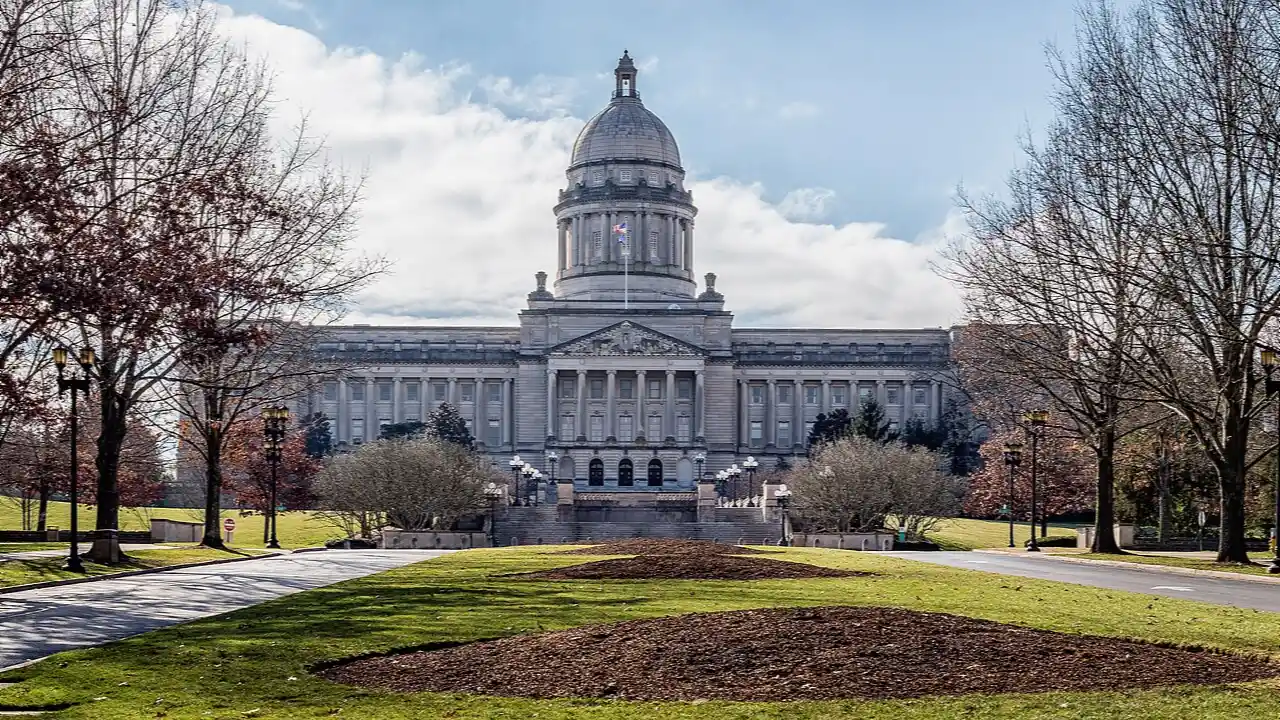
1. What amazing record does Mammoth Cave in Kentucky hold?
2. What is the capital city of the State of Kentucky?
🤯 Mind-Blowing Fact • Grade 2
Cumberland Falls in Kentucky is one of the only waterfalls in the entire Western Hemisphere that regularly creates a nighttime rainbow—called a moonbow—under a full moon!
✨ Word Sparks (Grade 2 Glossary)
Tap 🔊 to hear
gap
Low natural pass through steep mountains
moonbow
Nighttime rainbow lit by bright moonlight
commonwealth
State title highlighting government for everyone's good
🪝
How did pioneers cross a mountain doorway from Virginia into Kentucky?
1
Walking Through the Cumberland Gap
Follow pioneer trailblazer Daniel Boone along a narrow mountain pass called the Cumberland ! In 1775, woodsmen widened this natural doorway through the Appalachian Mountains from Virginia into Kentucky—which used to be part of Virginia before becoming our fifteenth state on June 1, 1792.
2
Why Grass Grows So Strong Here
Around Lexington and the capital city of Frankfort, limestone rock under the soil adds healthy calcium to the grass. That mineral-rich grass helps raise strong Thoroughbred horses!
3
A Rainbow Under the Moon!
At Cumberland Falls in southern Kentucky, misty waterfall spray catches bright full-moon light at night to make a rare glowing ''!
1. Which natural mountain pass on Virginia's border helped pioneers like Daniel Boone reach Kentucky?
2. Which existing state was Kentucky originally part of before becoming the fifteenth U.S. state in 1792?
🤯 Mind-Blowing Fact • Grade 3
Only four U.S. states carry the official title 'Commonwealth' instead of 'State': Virginia, Massachusetts, Pennsylvania, and Kentucky!
✨ Word Sparks (Grade 3 Glossary)
Tap 🔊 to hear
caprock
Hard top rock layer protecting caves underneath
bullion
Pure gold or silver shaped into bars
trailblazer
Explorer who marks a safe new path
🪝
Why is Kentucky officially called a 'Commonwealth,' and where does America store thousands of gold bars?
1
First State West of the Appalachians
Stand at the tri-state peak above Cumberland Gap where Virginia, Kentucky, and Tennessee meet! After thousands of settlers traveled Daniel Boone's Wilderness Road, Virginia agreed to let its western district become a new state. Admitted on June 1, 1792, as the fifteenth state, Kentucky kept Virginia's civic title—the Commonwealth of Kentucky.
2
How Water Carved Mammoth Cave
Beneath central Kentucky lies thick limestone topped by a protective sandstone roof! Rainwater dissolved more than 420 miles of multi-level passages while the sandstone kept the giant tunnels from collapsing.
3
Falls of the Ohio and Fort Knox
Along Kentucky's northern border flows 664 miles of the Ohio River. At Louisville, explorers Meriwether Lewis and William Clark joined forces in October 1803! Nearby Fort Knox guards a giant vault holding much of the U.S. Treasury's gold reserves.
4
Lincoln's Log Cabin Birthplace
Near Hodgenville, sixteen-president-to-be Abraham Lincoln was born on February 12, 1809, beside Sinking Spring.
1. What prevents the 420-plus miles of limestone tunnels in Mammoth Cave from caving in from rain above?
2. What famous treasure is safeguarded inside the U.S. vault at Fort Knox, Kentucky?
🤯 Mind-Blowing Fact • Grade 4
Middlesboro, Kentucky—right beside the Cumberland Gap—is the only town in the United States built entirely inside the three-mile-wide bowl of an ancient meteor crater!
✨ Word Sparks (Grade 4 Glossary)
Tap 🔊 to hear
meteorite
Space rock that strikes Earth's rocky surface
phosphorus
Essential mineral helping build strong healthy bones
tributary
Smaller river flowing into a larger river
🪝
How did an ancient meteor impact create the doorway in the Appalachians that opened America's westward migration?
1
Surprise Secret Behind the Cumberland Gap
Every Virginia student learns how Shawnee hunters, Cherokee travelers, and Daniel Boone's 1775 pioneers walked through the Cumberland Gap along the Wilderness Road—but geologists discovered an astonishing twist! Roughly 300 million years ago, a slammed into present-day Middlesboro, Kentucky, shattering surrounding mountain rock and weakening the ridge where erosion carved the Cumberland Gap pass!
2
Five Regions Bound by Mighty Rivers
Surrounded on three sides by rivers—the Big Sandy on the east, the Ohio along the entire north, and the Mississippi on the west—Kentucky spans five regions from 4,145-foot Black Mountain in the eastern Appalachian coalfields across the limestone Pennyroyal karst plain to the Jackson Purchase lowlands.
3
Phosphorus-Rich Limestone and Thoroughbred Champions
Around Lexington and Frankfort, Ordovician limestone rich in calcium and weathers into fertile soil where Kentucky bluegrass (Poa pratensis) flourishes. Grazing on mineral-rich grass strengthens young foals' bones, making the Bluegrass region world-famous for horses and Louisville's historic Kentucky Derby, run continuously every May since 1875.
4
Manufacturing, Waterways, and Music
From Louisville Slugger baseball bats and major automotive assembly plants in Georgetown and Bowling Green to Bill Monroe's string-band 'bluegrass music' heritage, Kentucky blends craftsmanship with tradition.
1. Why does grazing in Kentucky's Bluegrass region help young horses grow especially strong bones?
2. What surprising astronomical event helped weaken the mountain ridge at the Cumberland Gap?
🤯 Mind-Blowing Fact • Grade 5
Nineteenth-century guide Stephen Bishop explored miles of previously unknown passages in Mammoth Cave by lantern light, discovered blind cave fish, and drew an amazingly accurate underground map completely from memory!
✨ Word Sparks (Grade 5 Glossary)
Tap 🔊 to hear
brachiopod
Ancient hinged-shell sea creature preserved as fossils
exclave
Small piece of state separated by borders
biosphere
Globally protected ecosystem of unique living species
🪝
How did Devonian coral reefs at the Falls of the Ohio, Article IV constitutional statehood from Virginia, and world-record karst hydrology shape the fifteenth state?
1
Devonian Reefs, Mammoth Karst, and the Bend Bubble
Encompassing 40,408 square miles, the Commonwealth of Kentucky showcases textbook sedimentary geology. At the Falls of the Ohio beside Louisville—the only natural limestone rapids along the entire 981-mile Ohio River—390-million-year-old Devonian fossil beds expose hundreds of species of ancient corals and . Southward in the Pennyroyal Plateau, subterranean Green River tributaries beneath protective Big Clifty Sandstone dissolved more than 426 mapped miles inside Mammoth Cave National Park, a UNESCO World Heritage Site and International Reserve. Remarkably, earthquakes along the New Madrid Seismic Zone in 1811–1812 combined with an early survey line at 36°30′ N left 'the Kentucky Bend'—a tiny peninsula wrapped inside a Mississippi River loop reachable by road only through Tennessee!
2
Indigenous Hunting Grounds to 1792 Constitutional Admission
Cherokee, Shawnee, Chickasaw, and Yuchi peoples prized Kentucky's salt licks—such as Big Bone Lick, birthplace of North American vertebrate paleontology where Ice Age mastodon bones were studied by Thomas Jefferson—and canebrakes. Organized first as Kentucky County of Virginia in 1776 after Daniel Boone's Wilderness Road expedition through the Cumberland Gap, ten conventions in Danville petitioned Richmond and Congress under Article IV, Section 3 of the U.S. Constitution, admitting Kentucky on June 1, 1792, as the fifteenth state and first state west of the Appalachians.
3
National Crossroads: Clay, Lincoln, and Lewis & Clark
In October 1803, Meriwether Lewis met William Clark at Clarksville and Louisville beside the Falls of the Ohio to recruit the core 'Nine Young Men from Kentucky' for the Corps of Discovery. In Washington, Lexington statesman Henry Clay—'the Great Compromiser'—served thrice as Speaker of the House, while Kentucky-born Abraham Lincoln later preserved the constitutional Union.
4
African American Cave Explorers
Much of Mammoth Cave's early nineteen-century mapping was accomplished by brilliant explorer Stephen Bishop, who crossed the terrifying Bottomless Pit on a wooden ladder in 1838, discovered eyeless cavefish, and drew an astonishingly accurate map from memory.
5
Modern Logistics, Aluminum, and Electric Mobility
Today, global air-cargo hubs in Louisville and Northern Kentucky pair with major automotive, battery, aluminum, and agricultural industries across the Bluegrass Commonwealth.