🇺🇸 U.S. HISTORY
🏛️ 34th U.S. State • The Sunflower State
VA History & Social Science SOL K.1, 1.2, 2.4, VS.1–VS.10, USI & USII
State of Kansas
Golden Sunflowers in America's Exact Heart
Grade 1 • Early Reader • 58 words
⏳ Era / StatehoodAdmitted January 29, 1861 (34th State)
🗺️ Region / CapitalGreat Plains / Midwestern U.S. • Capital: Topeka
📜 Key MilestoneGeographic Center of 48 States, Winter Wheat, Aviation & Brown v. Board
⚡ Historical SparkSits at the exact geographic center of the lower 48 states while feeding the nation with golden wheat and building airplanes in Wichita
🤯 Mind-Blowing Fact • Grade 1
Young sunflower buds actually turn slowly from east to west each day to follow the warm sun across the sky!
✨ Word Sparks (Grade 1 Glossary)
Tap 🔊 to hear
wheat
Golden grain ground into flour for bread
plains
Wide, open, mostly flat grassy land
center
The exact middle point of a map
🪝
Where do millions of bright yellow flowers turn their faces toward the warm sun?
1
Fields of Yellow Gold
Stand in a sunny breeze as tall yellow sunflowers nod hello! Kansas sits right in the middle of the forty-eight connected states.
2
Bread From Golden Wheat
Waving fields of golden stretch as far as your eyes can see. Flour from Kansas wheat bakes warm bread and fluffy pancakes!
3
Topeka and Meadowlarks
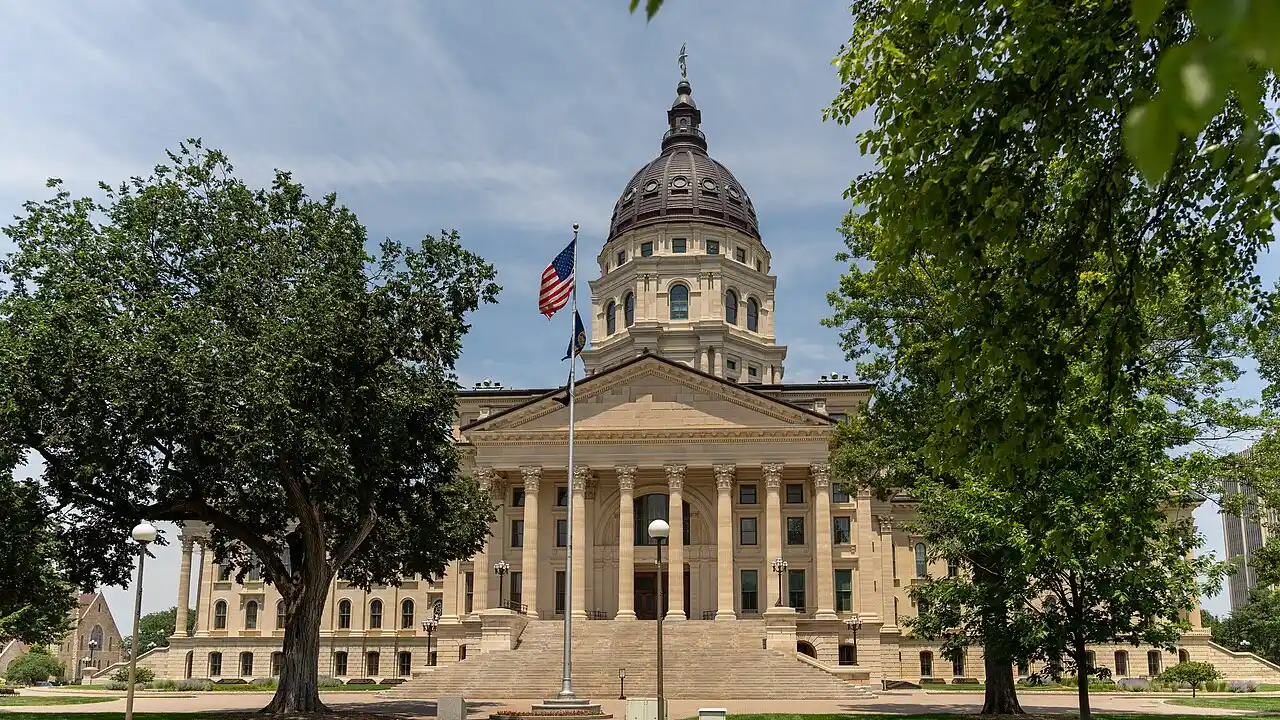
Topeka is the state capital, where yellow-breasted western meadowlarks sing cheerful morning tunes.
1. Which bright yellow flower gives Kansas its sunny nickname?
2. What is the capital city of the State of Kansas?
🤯 Mind-Blowing Fact • Grade 2
Near the small town of Lebanon, Kansas, a stone marker shows the exact geographic center point of all forty-eight connected U.S. states!
✨ Word Sparks (Grade 2 Glossary)
Tap 🔊 to hear
aviation
Designing, building, and flying airplanes safely
pioneer
Early traveler settling or exploring new places
bison
Large shaggy grazing mammal of the plains
🪝
Why did Kansas become famous for brave pilots and millions of airplanes?
1
Wide Skies for Flying
Listen to airplane propellers hum across wide-open blue skies! Flat grassy fields in Wichita made natural runways for early airplane builders, earning Wichita the title Air Capital of the World. Famous pilot Amelia Earhart also grew up in Atchison, Kansas!
2
Thirty-Fourth State and Trail Ruts
Named after the Kanza (Kaw) Native people, Kansas became our thirty-fourth state on January 29, 1861. Visitors can still spot deep wagon-wheel ruts pressed into prairie grass along the historic Santa Fe and Oregon trails.
3
Fair Schools in Topeka
In the capital city of Topeka, brave families stood up in court in 1954 so children of all backgrounds could learn together in equal public schools.
1. Which pioneering female aviator was born and raised in Atchison, Kansas?
2. Why is Wichita, Kansas, called the Air Capital of the World?
🤯 Mind-Blowing Fact • Grade 3
One of the most famous fossils ever found in Kansas shows a fourteen-foot prehistoric 'bulldog fish' with a whole six-foot fish fossilized right inside its stomach!
✨ Word Sparks (Grade 3 Glossary)
Tap 🔊 to hear
chalk
Soft white limestone made of tiny sea shells
segregation
Unfairly separating people into different public places
chert
Hard flint rock embedded inside limestone hills
🪝
Why do giant ocean fish fossils turn up inside chalk cliffs in the middle of dry Kansas prairies?
1
An Ancient Sea Over the Plains
Touch the tall white towers of Monument Rocks in western Kansas and imagine sharks swimming overhead! Eighty-five million years ago, a warm ocean called the Western Interior Seaway covered Kansas, leaving behind fossils of giant sea turtles, winged pterosaurs, and twenty-foot fishes.
2
Saving the Last Tallgrass Prairie
In east-central Kansas rise the rolling Flint Hills. Because bands of hard flint rock called lay too close to the surface for steel plows, these hills preserved North America's largest remaining stretch of native tallgrass prairie, where bison still graze!
3
Statehood, Eisenhower, and Equal Schools
Admitted as a free state on January 29, 1861, Kansas adopted the Latin motto Ad Astra per Aspera—'To the Stars through Difficulties.' Thirty-fourth President Dwight D. Eisenhower grew up in Abilene, and Topeka's 1954 Brown v. Board of Education case ended legal school nationwide.
4
Winter Wheat Breadbasket
Farmers plant hardy winter wheat in autumn; it sleeps beneath winter snow and ripens into amber waves of grain each June!
1. Why was the native tallgrass prairie in Kansas's Flint Hills never plowed up into farmland?
2. Which thirty-fourth U.S. President grew up in Abilene, Kansas?
🤯 Mind-Blowing Fact • Grade 4
Kansas's state motto, Ad Astra per Aspera, means 'To the Stars through Difficulties'—capturing its challenging 1850s journey to become a free state!
✨ Word Sparks (Grade 4 Glossary)
Tap 🔊 to hear
dormant
Resting quietly alive through cold winter months
unanimous
Agreed upon by every single judge together
shortgrass
Drought-hardy low prairie grass of dry plains
🪝
How does Kansas gradually climb more than three thousand feet toward the Rockies—and how did winter wheat transform the Great Plains?
1
Tilted Gently Like a Giant Ramp
People often joke that Kansas is flat as a pancake, yet a drive west on Interstate 70 tells a different story! From 679 feet above sea level in southeastern Montgomery County, the land climbs steadily westward for four hundred miles until reaching 4,039 feet at Mount Sunflower near the Colorado border—shifting from humid eastern oak woodlands across the Flint Hills to dry High Plains.
2
Kanza Wind People and the 1861 Free-State Struggle
Named for the Kanza (Kaw) Nation—known as the 'People of the South Wind' alongside Osage, Pawnee, Cheyenne, and Comanche peoples—Kansas Territory became a national focal point after the 1854 Kansas-Nebraska Act let settlers vote on slavery. Free-state citizens prevailed, and Kansas entered the Union on January 29, 1861, just months before the Civil War.
3
Turkey Red Wheat and Ogallala Groundwater
Spring-planted wheat often withered in hot Kansas summers until Mennonite immigrant families arriving in the 1870s brought trunks of hardy 'Turkey Red' winter wheat seeds. Planted in autumn and harvested in early summer, it turned Kansas into America's Breadbasket, supported in the west by the underground Ogallala Aquifer.
4
Constitutional Milestone in Topeka
When Linda Brown's family and the NAACP challenged segregated Topeka schools, the U.S. Supreme Court unanimously ruled in Brown v. Board of Education (1954) that 'separate educational facilities are inherently unequal.'
1. Why did 'Turkey Red' winter wheat succeed so well on the Kansas plains starting in the 1870s?
2. What landmark 1954 U.S. Supreme Court case began in Kansas's capital city of Topeka?
🤯 Mind-Blowing Fact • Grade 5
Kansas native Jack Kilby, who grew up in Great Bend, invented the world's first integrated circuit microchip in 1958—the tiny invention inside every smartphone, laptop, and spacecraft today!
✨ Word Sparks (Grade 5 Glossary)
Tap 🔊 to hear
paleontology
Scientific study of ancient life through fossils
escarpment
Long steep slope at a plateau's edge
microchip
Tiny silicon circuit powering modern electronics
🪝
What links Niobrara marine chalk paleontology, 1850s constitutional self-determination, integrated-circuit Nobel physics, and Equal Protection law in the thirty-fourth state?
1
Cretaceous Chalk Seas and the Flint Hills Escarpment
Spanning 82,278 square miles across the central Great Plains, Kansas preserves an extraordinary record of the Late Cretaceous Western Interior Seaway. In western Gove and Logan counties, eighty-five-million-year-old Niobrara Chalk towers such as Monument Rocks and Castle Rock yielded world-renowned fossils of Tylosaurus mosasaurs, tooth-billed Hesperornis diving birds, and twenty-foot Wingspan Pteranodon reptiles that revolutionized nineteenth-century American . Farther east, differential erosion of Permian limestones embedded with weather-resistant chert nodules sculpted the Flint Hills—protecting the continent's largest surviving tallgrass prairie ecosystem.
2
Indigenous Crossroads, Territorial Crucible, and 1861 Statehood
For centuries, Kanza, Osage, Wichita, and Pawnee villages balanced river-bottom horticulture with seasonal bison hunts before overland commerce carved the 900-mile Santa Fe Trail diagonally from Missouri through Council Grove and Dodge City. Following the 1854 Kansas-Nebraska Act, rival pro-slavery and antislavery legislatures clashed until voters ratified the antislavery Wyandotte Constitution—admitting Kansas as the thirty-fourth state on January 29, 1861.
3
Topeka and the Fourteenth Amendment
Nearly a century later, Topeka parents led by Oliver Brown joined four allied cases before the U.S. Supreme Court. On May 17, 1954, Chief Justice Earl Warren delivered the 9–0 decision in Brown v. Board of Education of Topeka, holding that state-segregated schools violated the Equal Protection Clause of the Fourteenth Amendment.
4
Aerospace Metallurgy and the Microchip
In the 1920s, Wichita pioneers Walter Beech, Clyde Cessna, and Lloyd Stearman launched general and commercial aviation engineering that still fabricates wing and fuselage structures for global jetliners today. Meanwhile, Great Bend, Kansas, native Jack Kilby demonstrated the world's first working monolithic integrated circuit () in 1958, earning the 2000 Nobel Prize in Physics!
5
Conserving the Ogallala and Harnessing Plains Winds
Today, Kansas pairs precision center-pivot irrigation conservation over the High Plains Ogallala Aquifer with utility-scale wind farms generating nearly half of the state's electricity.