🇺🇸 U.S. HISTORY
🏛️ 29th U.S. State • The Hawkeye State
VA History & Social Science SOL K.1, 1.2, 2.4, VS.1–VS.10, USI & USII
State of Iowa
Framed by Two Mighty Flowing Rivers
Grade 1 • Early Reader • 60 words
⏳ Era / StatehoodAdmitted December 28, 1846 (29th State)
🗺️ Region / CapitalMidwestern U.S. • Capital: Des Moines
📜 Key MilestoneMississippi & Missouri River Borders, #1 U.S. Corn Harvest & Wind Power
⚡ Historical SparkOnly U.S. state bordered completely on both east and west by major rivers, and America's #1 producer of corn and wind-powered electricity share
🤯 Mind-Blowing Fact • Grade 1
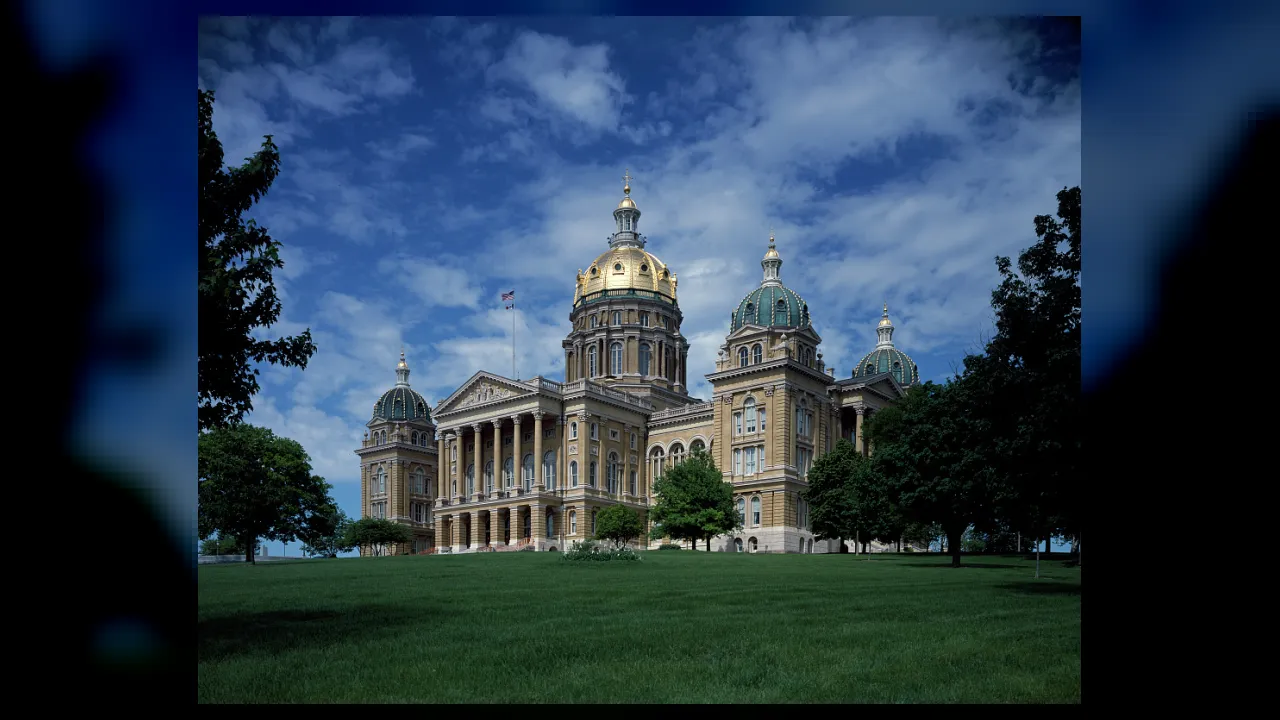
Iowa's state Capitol in Des Moines is the only capitol building in America topped with five shining golden domes!
✨ Word Sparks (Grade 1 Glossary)
Tap 🔊 to hear
border
Dividing line between two states or places
harvest
Gathering ripe crops from farm fields
turbine
Tall spinning windmill that makes clean electricity
🪝
Which state has a giant river hugging both its left side and its right side?
1
Two Big River Borders
Trace your fingers down both sides of Iowa on a map! On the east flows the wide Mississippi River, and on the west flows the Missouri River.
2
Tall Green Corn
Rich black dirt helps green cornstalks grow taller than grown-ups! Bright yellow goldfinches hop on purple wild roses.
3
Golden Dome in Des Moines
Des Moines is the state capital, where five shiny gold domes sparkle in the sunshine!
1. Which farm crop does Iowa grow more of than any other state in America?
2. What is the capital city of the State of Iowa?
🤯 Mind-Blowing Fact • Grade 2
Clean wind turbines spinning across Iowa's rolling hills generate more than half of all the electricity produced inside the state!
✨ Word Sparks (Grade 2 Glossary)
Tap 🔊 to hear
effigy
Sculpted shape representing an animal or person
barge
Long flat-bottomed boat carrying heavy river cargo
geode
Hollow round rock lined inside with crystals
🪝
Where did ancient builders shape giant hills to look like bears and flying birds?
1
Animal Shapes on High Bluffs
Stand on a wooded bluff high above the Upper Mississippi River in northeastern Iowa! More than a thousand years ago, Native American builders carried baskets of earth to sculpt giant grassy mounds shaped like marching bears and soaring eagles at Mounds.
2
Twenty-Ninth State Between Rivers
Named after the Ioway (Báxoje) Native people, Iowa joined the Union on December 28, 1846, as the twenty-ninth state. carry grain down both its Mississippi and Missouri river borders.
3
Spinning Windmills on Rolling Hills
Across breezy farm hills spin thousands of tall white wind turbines, making clean electricity for homes, schools, and farms!
1. What shapes did ancient Native American builders create at Effigy Mounds in northeastern Iowa?
2. Which two major rivers form Iowa's eastern and western borders?
🤯 Mind-Blowing Fact • Grade 3
Ice cream lovers cheer for Le Mars, Iowa—officially nicknamed the Ice Cream Capital of the World because a single family-founded dairy there churns more ice cream in one spot than anywhere else!
✨ Word Sparks (Grade 3 Glossary)
Tap 🔊 to hear
confluence
Spot where two flowing rivers join together
agronomist
Scientist who studies soil and healthy crops
topsoil
Uppermost nutrient-rich layer of earth
🪝
What sparkling surprise hides inside Iowa's round gray state rock when you crack it open?
1
Hidden Crystals Inside Geodes
Pick up a bumpy, cannonball-shaped stone along a creek near Keokuk in southeastern Iowa. From the outside it looks totally plain—until cracking it open reveals hundreds of glittering quartz crystals lining a hollow cave inside! That treasure is the geode, Iowa's official state rock.
2
World-Class Glacial Topsoil
Admitted on December 28, 1846, as the twenty-ninth state, Iowa owes its farming superpower to Ice Age glaciers and tallgrass prairies. Glaciers ground mineral-rich rock into fine silt, and deep prairie roots enriched it into fertile black .
3
Scientists Who Fed Millions
At Iowa State University, young George Washington Carver studied plant science in the 1890s before teaching at Tuskegee. Decades later, Iowa farm boy Norman Borlaug developed hardy wheat seeds that saved hundreds of millions of people worldwide from hunger, winning the Nobel Peace Prize!
4
Des Moines and Civic Participation
At the of the Des Moines and Raccoon rivers sits Des Moines, a national center for agriculture, insurance, and lively town-hall civic traditions.
1. Which Nobel Peace Prize–winning plant scientist grew up on an Iowa farm near Cresco and helped feed millions around the world?
2. What do you find inside an Iowa geode when it is opened?
🤯 Mind-Blowing Fact • Grade 4
In a basement lab in Ames, Iowa, between 1937 and 1942, John Atanasoff and Clifford Berry built the world's first automatic electronic digital computer using binary ones and zeroes!
✨ Word Sparks (Grade 4 Glossary)
Tap 🔊 to hear
loess
Fine, windblown glacial silt forming steep hills
driftless
Region untouched by recent Ice Age glaciers
binary
Computer number code using ones and zeroes
🪝
Why does western Iowa rise in steep wind-sculpted Loess Hills found almost nowhere else on Earth outside China?
1
Rare Windblown Loess Hills and the Driftless Corner
Many travelers picture Iowa as completely flat, yet its western and northeastern edges tell dramatic Ice Age stories! Along the Missouri River Valley rise the Hills—steep, wrinkly ridges up to two hundred feet tall formed when fierce winds blew powdery glacial 'rock flour' (called loess) into towering drifts, a landform seen on such a scale almost nowhere else except northern China. Meanwhile, northeastern Iowa's Area escaped the latest ice sheets altogether, preserving deep limestone bluffs, cold trout streams, and underground caves.
2
Only State Framed East and West by Rivers
Iowa is the only U.S. state whose eastern and western borders are formed entirely by rivers: the Mississippi on the east, and the Missouri and Big Sioux on the west. Following the 1803 Louisiana Purchase—and Sergeant Charles Floyd's 1804 Lewis and Clark campsite at present-day Sioux City—Iowa entered the Union as the twenty-ninth state on December 28, 1846.
3
Leading the Nation in Corn, Soybeans, and Wind
Nearly ninety percent of Iowa's land supports agriculture, ranking number one nationally in corn and egg production and near the top in soybeans. Rising high above the crops, wind turbines generate roughly sixty percent of Iowa's electricity—the highest wind-power share of any U.S. state!
4
Birthplace of the Electronic Digital Computer
Between 1937 and 1942 in a basement physics lab at Iowa State College in Ames, Professor John Vincent Atanasoff and graduate student Clifford Berry built the Atanasoff-Berry Computer (ABC), pioneering math and electronic vacuum-tube switches.
1. How did western Iowa's unusual Loess Hills form at the end of the Ice Age?
2. What breakthrough machine did John Atanasoff and Clifford Berry build in Ames, Iowa, by 1942?
🤯 Mind-Blowing Fact • Grade 5
University of Iowa physicist James Van Allen built the science instrument on America's very first satellite, Explorer 1, in 1958—discovering the giant magnetic radiation belts around Earth now named the Van Allen Belts!
✨ Word Sparks (Grade 5 Glossary)
Tap 🔊 to hear
eolian
Carried, shaped, or deposited by blowing wind
hybrid
Plant bred from two strong parent varieties
precedent
Early court decision guiding future fair laws
🪝
What connects Des Moines Lobe prairie potholes, Báxoje heritage, landmark early civil rights rulings, and global agronomy in the Hawkeye State?
1
Quaternary Glaciation, Loess Stratigraphy, and Mollisols
Spanning 56,273 square miles between the Upper Mississippi and Missouri-Big Sioux river valleys, Iowa sits at the ecological heart of North America's former tallgrass prairie biome. Fourteen thousand years ago, the Wisconsinan Des Moines Lobe glacier advanced as far south as the present-day capital before melting back across north-central Iowa, leaving poorly drained kettle wetlands alongside calcareous glacial till. Combined with millennia of deep-rooted Andropogon gerardii (big bluestem) organic matter, over a quarter of the nation's highest-grade Class I agricultural mollisols lie within Iowa's borders, flanked by Loess Hills in the west and Paleozoic karst ridges in the northeastern Driftless Area.
2
Indigenous Nations and Constitutional Precedents
The state's name honors the Báxoje (Ioway) Nation, who stewarded these river valleys alongside Meskwaki, Sauk, Otoe, Dakota, and Omaha peoples; notably, the Meskwaki Nation purchased back ancestral land along the Iowa River in 1857 to establish the sovereign Meskwaki Settlement rather than accepting distant relocation. Admitted on December 28, 1846, as the twenty-ninth state, Iowa's Supreme Court issued pioneering early rulings—declaring in its very first 1839 territorial opinion (In the Matter of Ralph) that an enslaved man living freely in Iowa could not be returned to bondage, and ruling in Clark v. Board of Directors (1868) against segregated public schools eighty-six years before Brown v. Board of Education!
3
Agronomic Science From Carver to Borlaug and Wallace
Iowa transformed global food security through biological science: Henry A. Wallace popularized high-yielding seed corn in the 1920s; George Washington Carver earned bachelor's and master's degrees in botany at Ames before leading Tuskegee's research; and Cresco native Norman Borlaug spearheaded disease-resistant dwarf wheat varieties that launched the Green Revolution, honored each October by the World Food Prize in Des Moines.
4
Electronic Computing and Space Physics
Beyond agriculture, Iowa State's Atanasoff-Berry Computer pioneered binary electronic logic, while University of Iowa physicist James Van Allen designed the Geiger-counter instrument aboard America's first satellite, Explorer 1 (1958), discovering Earth's protective Van Allen radiation belts!
5
Renewable Grid Leadership
Today, Iowa harvests over two billion bushels of corn annually while generating roughly sixty percent of its electrical power from wind energy—the highest proportion in the nation.