🇺🇸 U.S. HISTORY
🏛️ 19th U.S. State • The Hoosier State
VA History & Social Science SOL K.1, 1.2, 2.4, VS.1–VS.10, USI & USII
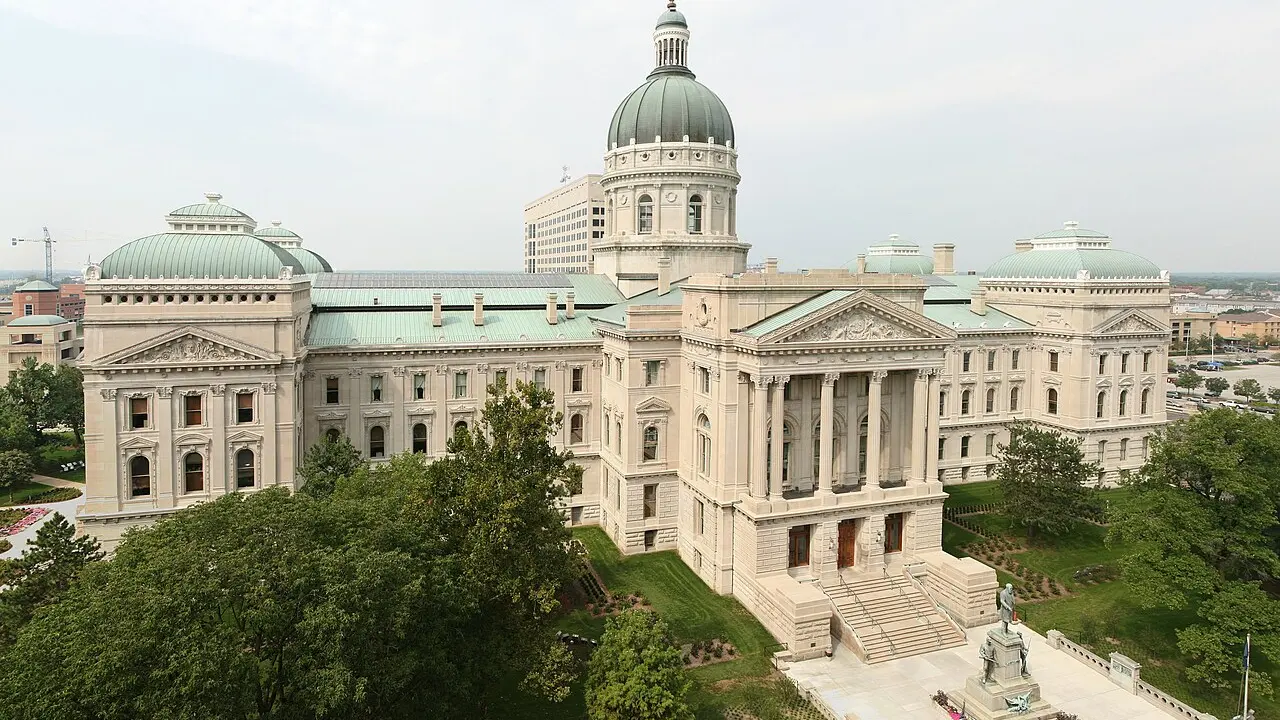
State of Indiana
Singing Lake Dunes and Crossroads of America
Grade 1 • Early Reader • 60 words
⏳ Era / StatehoodAdmitted December 11, 1816 (19th State)
🗺️ Region / CapitalMidwestern U.S. • Capital: Indianapolis
📜 Key MilestoneCrossroads of America, Indiana Dunes, Salem Limestone & Indy Innovation
⚡ Historical SparkQuarried the prized limestone that built the Empire State Building and Pentagon while connecting more interstate highways in its capital than almost any U.S. city
🤯 Mind-Blowing Fact • Grade 1
People born or living in Indiana are proudly called 'Hoosiers,' one of America's oldest and friendliest state nicknames!
✨ Word Sparks (Grade 1 Glossary)
Tap 🔊 to hear
dune
Tall hill of sand piled by wind
crossroads
Central spot where many main roads meet
quarry
Open pit where workers cut building stone
🪝
Where does beach sand actually squeak and 'sing' beneath your bare feet?
1
Singing Sand Dunes
Step barefoot across tall sandy hills beside blue Lake Michigan! Clean quartz grains rub together and make a funny squeaking hum at Indiana .
2
Crossroads Capital
Indianapolis sits right in the middle of Indiana as the state capital. Highways meet there from every direction like spokes on a bicycle wheel!
3
Red Cardinals and Covered Bridges
Bright red cardinals whistle near cozy wooden covered bridges and golden cornfields.
1. What is a friendly nickname for someone from the State of Indiana?
2. What is the capital city right in the center of Indiana?
🤯 Mind-Blowing Fact • Grade 2
Parke County in western Indiana has thirty-one historic wooden covered bridges—earning it the title Covered Bridge Capital of the World!
✨ Word Sparks (Grade 2 Glossary)
Tap 🔊 to hear
limestone
Smooth rock formed from ancient sea shells
innovation
Smart new invention or better way forward
frontier
Edge of settled land near deep woods
🪝
How did a racetrack in Indianapolis invent the car mirror your family uses every day?
1
Testing Ideas on the Track
Hear engines purr around the brick-paved start line in Indianapolis! Opened in 1909, the Indianapolis Motor Speedway was built as an outdoor lab to test safer, stronger cars. In the very first 500-mile race in 1911, driver Ray Harroun bolted on the first automotive rearview mirror!
2
Young Abe Lincoln's Woods
Right when Indiana became our nineteenth state on December 11, 1816, seven-year-old Abraham Lincoln moved with his family to a forested southern Indiana farm, growing up there until age twenty-one.
3
Stone That Built Famous Landmarks
Smooth gray Indiana cut near Bedford and Bloomington helped build the Empire State Building in New York City!
1. What everyday car safety feature did Ray Harroun debut at the 1911 race in Indianapolis?
2. Which famous skyscraper in New York City was clad in smooth limestone quarried in southern Indiana?
🤯 Mind-Blowing Fact • Grade 3
The first town in the world to light its streets overhead with electric arc lamps was Wabash, Indiana, on the night of March 31, 1880!
✨ Word Sparks (Grade 3 Glossary)
Tap 🔊 to hear
blueprint
Detailed drawing showing how to build something
truss
Triangle-shaped beam frame supporting a strong bridge
radiate
Spread outward in lines from a center
🪝
Why did founders design Indianapolis like a giant wheel, and why are wooden bridges wearing roofs?
1
A Planned Capital in the Exact Center
Unroll the 1821 city for Indianapolis drawn by Alexander Ralston, who had helped survey Washington, D.C.! Four years after Indiana became the nineteenth state on December 11, 1816, lawmakers picked the state's geographic center for a brand-new capital, with diagonal avenues radiating outward from Monument Circle.
2
Why Bridges Wore Roofs
Across rolling Indiana creeks stand nearly a hundred nineteenth-century covered bridges. Builders added roofs and wooden siding not for travelers, but to keep rain and snow from rotting the heavy timber underneath—helping a bridge last eighty years instead of ten!
3
Biodiversity at Indiana Dunes
Along forty-five miles of southern Lake Michigan shoreline, wind-sculpted dunes up to nearly two hundred feet high shelter prickly-pear cacti right beside northern jack pines, making Indiana Dunes National Park one of America's most plant-diverse parks per acre.
4
Caves, Orchards, and Popcorn
Southern Indiana hides vast underground limestone caves like Marengo and Wyandotte, while northern fields rank near the top in U.S. popcorn harvests!
1. Why did nineteenth-century builders put roofs and walls over Indiana's wooden covered bridges?
2. Which Indiana town made history on March 31, 1880, as the world's first electrically lighted city?
🤯 Mind-Blowing Fact • Grade 4
More than thirty-five different U.S. state capitol buildings—along with the Pentagon and Empire State Building—were constructed using Salem limestone quarried in southern Indiana!
✨ Word Sparks (Grade 4 Glossary)
Tap 🔊 to hear
kettle
Round lake left by melted glacier blocks
freestone
Uniform stone carved smoothly in any direction
sinkhole
Ground hollow formed when cave rock dissolves
🪝
How did an ancient tropical sea leave behind 'the Nation's Building Stone' while Ice Age glaciers split Indiana into two worlds?
1
Where the Glaciers Stopped
Drive south from Indianapolis toward the Ohio River and watch flat farm plains suddenly transform into steep wooded ridges, , and echoing caverns! During the Wisconsinan Ice Age, massive ice sheets bulldozed the northern two-thirds of Indiana into fertile, level till plains dotted with lakes, then halted—leaving southern Indiana's ancient hills and valleys unglaciated.
2
Fossil Seas inside Salem Limestone
More than 330 million years ago, a warm shallow sea covered southern Indiana, piling up tiny fossilized marine shells of uniform size. Cemented into ''—meaning stonemasons can carve it smoothly in any direction without splitting—Salem (Indiana) limestone around Bedford and Bloomington built the Pentagon, Washington National Cathedral, the Empire State Building, and over thirty-five state capitol buildings!
3
Land of the Indians to Nineteenth State
Named 'Indiana'—meaning 'Land of the Indians' in recognition of Miami, Potawatomi, Delaware (Lenape), and Shawnee nations along the Wabash, Maumee, and White rivers—the territory grew out of the Northwest Ordinance of 1787 and joined the Union on December 11, 1816.
4
Crossroads of Manufacturing and Life Sciences
Converging interstates and freight rail lines around Indianapolis earned the state motto 'The Crossroads of America,' supporting steelmaking near Lake Michigan, medical device engineering in Warsaw, and global agricultural production.
1. Why do architects and sculptors prize southern Indiana's Salem limestone as a 'freestone'?
2. Why is northern Indiana flat with many small lakes while southern Indiana has steep hills and deep caves?
🤯 Mind-Blowing Fact • Grade 5
Walking away from the water at Indiana Dunes inspired botanist Henry Chandler Cowles in 1899 to discover 'ecological succession'—showing how pioneer beach grasses gradually build soil for towering oak forests!
✨ Word Sparks (Grade 5 Glossary)
Tap 🔊 to hear
succession
Step-by-step change in plant communities over time
subterranean
Located or flowing hidden deep underground
metallurgy
Science of combining metals into strong alloys
🪝
How did plant succession studies on Indiana's dunes birth modern American ecology while Northwest Territory governance shaped our nineteenth state?
1
Birthplace of Ecological Succession Science
At the southern tip of Lake Michigan, Indiana Dunes National Park preserves fifteen thousand years of retreating glacial shorelines. In the 1890s, botanist Henry Chandler Cowles walked inland from bare wave-washed sand across marram grass foredunes, cottonwood ridges, jack pines, and mature black oak forests—realizing that walking inland was like traveling forward in time! His landmark 1899 study of how pioneer plants stabilize shifting sand to prepare soil for later forests established the foundational science of ecological , explaining why over 1,100 native vascular plant species thrive within just 15,000 acres.
2
Indigenous Wabash Portages and 1816 Statehood
Spanning 36,420 square miles—the smallest state in land area west of the Appalachian Mountains except Hawaii—Indiana served for centuries as a vital canoe crossroads for Miami, Wea, Piankashaw, Potawatomi, and Shawnee peoples crossing the eight-mile portage at Kekionga (present-day Fort Wayne) between the Lake Erie–bound Maumee River and the Gulf-bound Wabash River. Carved from the Northwest Territory with early territorial governance at Vincennes, Indiana entered the Union on December 11, 1816, under a constitution emphasizing public education—just weeks before young Abraham Lincoln arrived in Spencer County.
3
Mississippian Oolitic Limestone and Karst Hydrogeology
Across southern Indiana's Mitchell Plateau, Mississippian-age Salem Limestone consists of nearly pure calcium carbonate ooids and bryozoan fragments. Where acidic rainwater percolates through fractured carbonate beds rather than being quarried, it carves wonders like Lost River—which vanishes underground into sinkholes for miles before re-emerging—alongside Bluespring and Marengo caverns.
4
National Road to the Interstate Hub
Beginning in the 1830s, the Historic National Road (now U.S. 40) bisected Indianapolis alongside Michigan Road, establishing transportation geometry later amplified by four major interstate corridors radiating across eight directions.
5
Metallurgy, Orthopedics, and Life-Science Breakthroughs
From Calumet Harbor steel mills and Kokomo stainless-alloy invented by Elwood Haynes to Indianapolis pharmaceutical research and Warsaw's global leadership in orthopedic joint implants, Indiana blends agricultural abundance with advanced precision manufacturing.