1. Which famous U.S. president lived in Springfield, giving Illinois the slogan 'Land of Lincoln'?
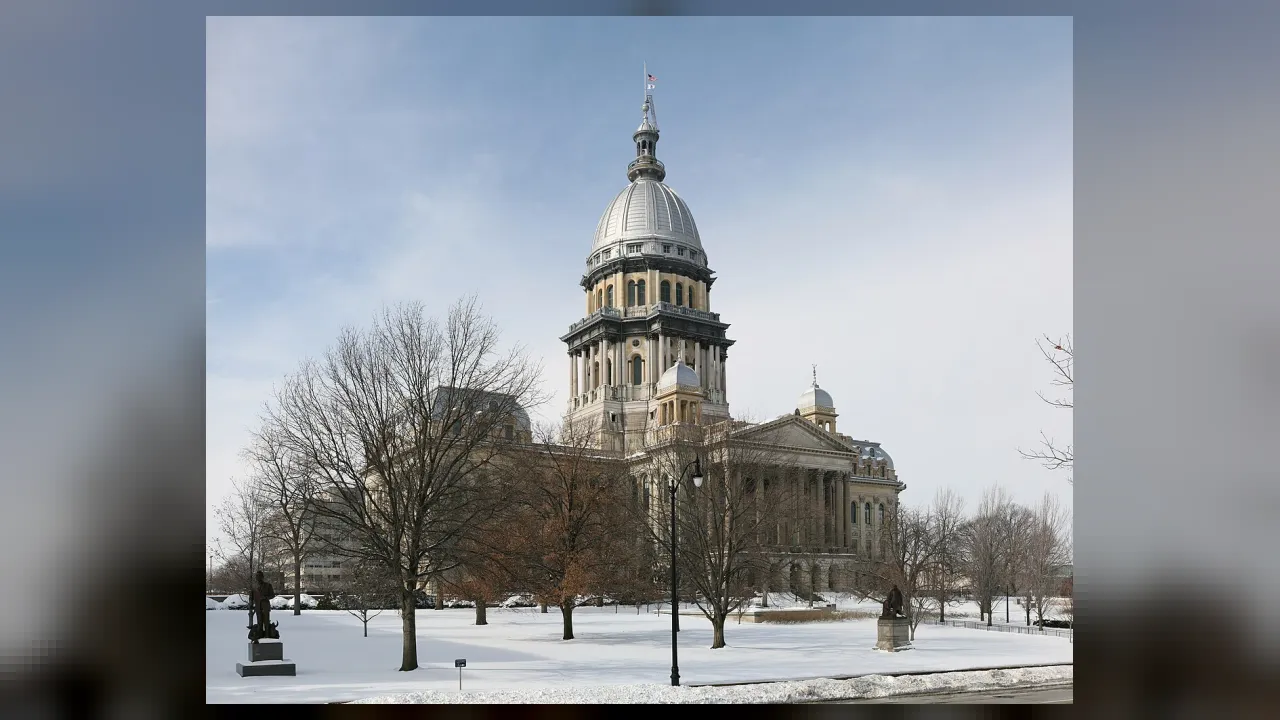
2. What is the capital city of the State of Illinois?
🤯 Mind-Blowing Fact • Grade 2
The giant spinning Ferris wheel was invented for the 1893 World's Fair in Chicago, carrying more than two thousand riders at one time!
✨ Word Sparks (Grade 2 Glossary)
Tap 🔊 to hear
canal
Human-made waterway dug for boats or water
reverse
Turn around and move the opposite way
lakefront
Shoreline land right beside a big lake
🪝
Can engineers really make an entire city river turn around and flow the other way?
1
The River That Flowed Backward!
Lean over a bridge in downtown Chicago and watch boats glide along emerald water! In 1900, clever engineers dug a deep that made the Chicago River direction—keeping Lake Michigan drinking water clean and linking the Great Lakes to the Mississippi River.
2
Twenty-First State and Tall Grass
Illinois joined the Union as the twenty-first state on December 3, 1818. Early travelers marveled at tallgrass prairies where swaying grasses grew higher than a person on horseback!
3
Lincoln's Springfield Neighborhood
In the capital city of Springfield, young lawmaker Abraham Lincoln helped bring the state capital there and later led America through the Civil War.
1. Which Great Lake touches northeastern Illinois at the city of Chicago?
2. What fun amusement ride was first built for the 1893 World's Fair in Chicago?
🤯 Mind-Blowing Fact • Grade 3
Monks Mound at Cahokia Mounds in Illinois has a base covering fourteen acres—even wider at the bottom than the Great Pyramid of Giza in Egypt!
✨ Word Sparks (Grade 3 Glossary)
Tap 🔊 to hear
earthen
Built carefully out of packed soil
architect
Designer who plans safe, sturdy buildings
skeleton
Inner framework holding a tall structure up
🪝
What giant ancient city once stood in Illinois five hundred years before Chicago existed?
1
Ancient Pyramid Mounds at Cahokia
Climb 154 steps to the flat top of Monks Mound in southwestern Illinois and imagine a bustling city of twenty thousand people! Around 1050 to 1200 CE, Mississippian builders raised over a hundred mounds at Cahokia—the largest pre-Columbian Native American city north of Mexico.
2
Waterways Surrounding the Prairie State
Admitted on December 3, 1818, as the twenty-first state, Illinois is nearly wrapped in water: the Mississippi River forms its western border, the Ohio and Wabash rivers border the south and east, and Lake Michigan shines in the northeast.
3
Rebuilding Chicago Toward the Clouds
After the Great Chicago Fire of 1871 destroyed thousands of wooden buildings, tried a bold new idea. In 1885, William Le Baron Jenney used an internal of iron and steel beams to build the ten-story Home Insurance Building—the world's first modern skyscraper!
4
John Deere's Self-Scouring Steel Plow
Sticky Illinois prairie soil clung to old cast-iron plows until blacksmith John Deere crafted a polished steel blade in 1837, unlocking rich Midwest corn and soybean harvests.
1. Why did blacksmith John Deere invent a smooth steel plow in Illinois in 1837?
2. What was Cahokia in southwestern Illinois nearly a thousand years ago?
🤯 Mind-Blowing Fact • Grade 4
Farms around the single town of Morton, Illinois, harvest and pack more than eighty percent of the canned pumpkin used in pies across the world!
✨ Word Sparks (Grade 4 Glossary)
Tap 🔊 to hear
portage
Carrying canoes over land between two waterways
legislature
Elected group that writes and votes laws
converge
Come together from different directions to meet
🪝
How did a low glacial ridge near Chicago connect the Atlantic St. Lawrence Basin with the Gulf of Mexico?
1
The Continental Portage That Built a Metropolis
Long before highways or railroads, Indigenous Illiniwek, Potawatomi, and Miami canoeists showed French explorers Louis Jolliet and Jacques Marquette a geographic secret in 1673: during wet spring weeks, paddlers could cross a tiny marshy ridge just west of Lake Michigan—moving from the Great Lakes watershed into the Des Plaines, Illinois, and Mississippi rivers all the way to the Gulf of Mexico! Completing the Illinois and Michigan Canal in 1848 and reversing the Chicago River in 1900 turned Illinois into the heartland link between two vast water systems.
2
Glacial Till and Prairie Roots
Over hundreds of thousands of years, continental glaciers flattened ninety percent of Illinois and spread mineral-rich rock flour. Deep, fibrous roots of big bluestem grass decayed each autumn, building feet of jet-black topsoil across central Illinois while leaving scenic unglaciated bluffs in northwestern Galena and the southern Shawnee Hills.
3
Abraham Lincoln's Civic Rise
Arriving in Illinois as a young pioneer in 1830, Abraham Lincoln taught himself law, served four terms in the state , argued landmark cases in Springfield, and debated Senator Stephen A. Douglas across seven Illinois towns in 1858 before winning the 1860 presidential election.
4
Rail Crossroads and Scientific Discovery
Where six major freight rail lines still in Chicago, Illinois anchors national grain commerce, physics research at Fermilab and Argonne, and agricultural processing—including over eighty percent of America's canned pumpkin around Morton!
1. Why was the Chicago Portage such a valuable geographic spot for early travelers and later canals?
2. What helped build central Illinois's famous deep, jet-black topsoil over thousands of years?
🤯 Mind-Blowing Fact • Grade 5
Illinois's official state fossil—the 300-million-year-old soft-bodied sea creature called the 'Tully Monster'—has never been discovered anywhere else on Earth outside Illinois!
✨ Word Sparks (Grade 5 Glossary)
Tap 🔊 to hear
mollisol
Deep, nutrient-rich dark grassland prairie soil
ordinance
Foundational law organizing territories into new states
nodule
Rounded mineral lump often preserving ancient fossils
🪝
What links Pennsylvanian-age tropical fossil forests, Northwest Ordinance statehood, structural steel framing, and subatomic physics in the twenty-first state?
1
Mazon Creek Fossils and Glacial Geomorphology
Three hundred million years ago during the Pennsylvanian Period, Illinois straddled Earth's equator as a lush tropical delta. Ironstone along northeastern Illinois's Mazon Creek preserved delicate soft-bodied fossils—including Illinois's bizarre official state fossil, Tullimonstrum gregarium (the 'Tully Monster'), found nowhere else on Earth! Much later, Illinoian and Wisconsinan ice sheets leveled the Central Till Plains, depositing fertile loess and from Lake Michigan southward toward the unglaciated Shawnee Hills and Cairo—where the Ohio and Mississippi rivers meet at just 279 feet above sea level.
2
Cahokia Urbanism to the 1818 Border Shift
Millennia of Woodland and Mississippian civilization peaked around 1100 CE at Cahokia opposite present-day St. Louis, complete with solar-aligned woodhenges and trade networks reaching the Gulf Coast and Lake Superior copper mines. Organized under the Northwest of 1787, Illinois prepared for statehood in 1818 when territorial delegate Nathaniel Pope persuaded Congress to shift the proposed northern border forty-one miles northward—securing fifty-one miles of Lake Michigan shoreline (and future Chicago!) before admission on December 3, 1818.
3
Constitutional Eloquence in the Land of Lincoln
From New Salem's log-cabin general store to Springfield's Old State Capitol, Abraham Lincoln honed the constitutional reasoning expressed in his 1858 'House Divided' speech and Lincoln-Douglas Debates, propelling him to the White House to preserve the Union and issue the Emancipation Proclamation.
4
Skyscraper Engineering and Reversing a Watershed
Following the 1871 fire, Chicago School architects paired load-bearing steel skeletons with Elisha Otis's safety elevators to launch vertical urbanism—later crowned by Fazlur Rahman Khan's bundled-tube engineering on the 1,450-foot Willis (formerly Sears) Tower. In 1900, the 28-mile Chicago Sanitary and Ship Canal breached the subcontinental divide, permanently reversing the Chicago River away from Lake Michigan.
5
Atomic Milestones and National Logistics
From Enrico Fermi's first self-sustaining nuclear chain reaction at the University of Chicago in 1942 to particle physics at Fermilab and continent-spanning rail, air, and agricultural trade, Illinois remains an engine of American innovation.