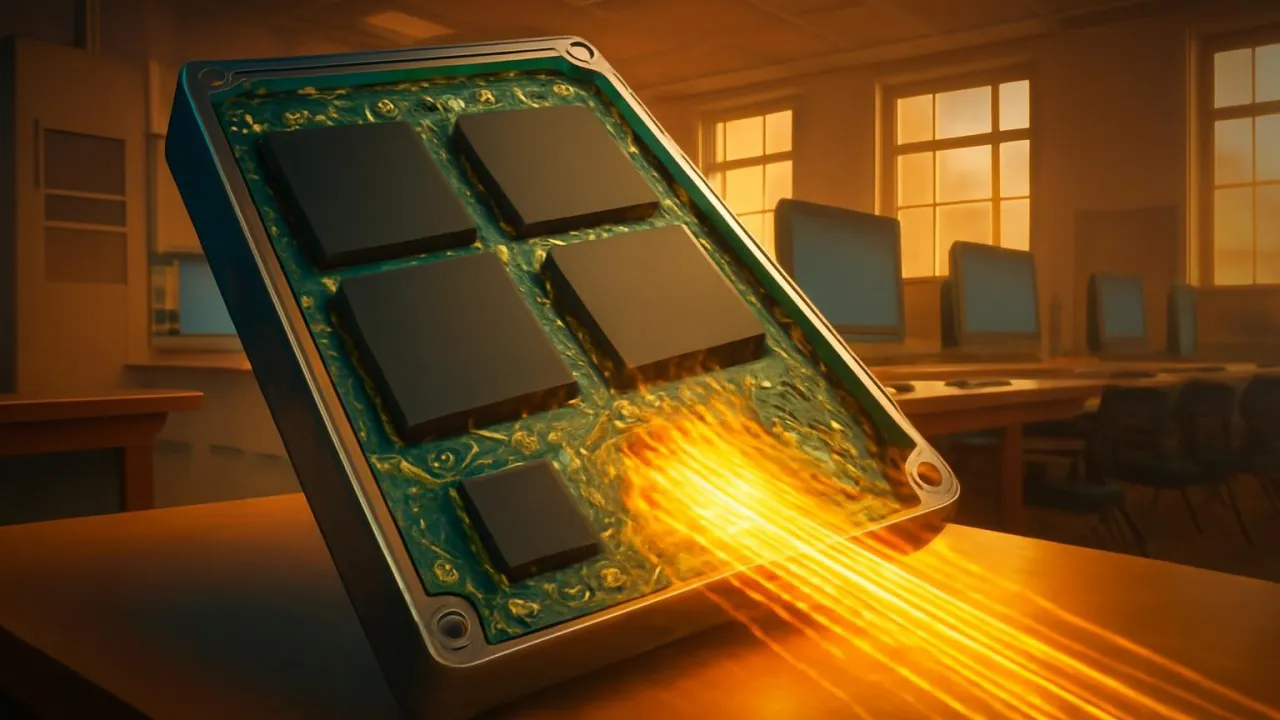
1. What makes SSDs different from old hard drives?
2. Why are SSDs good for laptops?
🤯 Mind-Blowing Fact • Grade 3
SSDs can read data up to 100 times faster than old hard drives!
✨ Word Sparks (Grade 3 Glossary)
Tap 🔊 to hear
microchip
Tiny part that stores information
vibrate
To shake quickly back and forth
durable
Hard to break or damage
🪝
Imagine opening a huge photo album and seeing every picture appear instantly—how does your computer do that?
1
The Speedy Secret Inside
SSDs store information using instead of moving disks. These microchips use electric charges to remember your files, making everything load in a blink. Because there are no spinning parts, SSDs are silent and much faster than old hard drives. This makes them perfect for video games, photos, and important schoolwork.
2
How SSDs Store Data
Each in an SSD holds data using tiny electric signals. When you save a file, the SSD arranges it in special cells, which can be read or written almost instantly. This technology is called solid-state because it uses solid microchips, not moving parts. That is why SSDs do not or make noise.
3
From Invention to Everywhere
The first SSDs were invented by Fujio Masuoka in Japan in the 1980s. At first, they were rare and expensive, used only in space or supercomputers. Today, SSDs are in laptops, tablets, and even video game consoles, helping millions of people every day.
4
Why SSDs Changed the World
SSDs let computers start up in seconds and find files almost instantly. Their durability means they last longer, even if dropped or bumped. They use less energy, which helps save battery life. Thanks to SSDs, our digital world is faster, quieter, and more reliable.
A modern SSD can hold over 2 trillion photos and still fit in your hand!
✨ Word Sparks (Grade 4 Glossary)
Tap 🔊 to hear
NAND flash
Special chips that store computer data
mechanical
Made of moving parts
electronic waste
Old gadgets thrown away
🪝
What would happen if your computer could find any file in the blink of an eye, every time?
1
A New Era in Digital Storage
Solid-state drives, or SSDs, use microchips and electric charges to store data, unlike traditional hard drives that rely on spinning magnetic disks. This breakthrough, pioneered by Fujio Masuoka in the 1980s, marked the beginning of a new era in computer storage technology. SSDs can access and save information almost instantly, making them much faster than older storage devices. Their silent operation and quick response have transformed how we use computers and tablets.
2
How SSDs Store and Retrieve Data
Inside an SSD, data is stored in millions of tiny cells called memory. Each cell holds an electric charge, representing a bit of information, which can be read or changed by sending precise electrical signals. Because there are no moving parts, SSDs do not suffer from wear or vibration, making them more durable and energy-efficient. This technology allows files to be retrieved in milliseconds, even after thousands of uses.
3
From Space Missions to Everyday Life
Early SSDs were very expensive and mainly used in space missions, military equipment, and supercomputers. As technology improved, SSDs became smaller, more affordable, and much more common. Today, they are found in laptops, smartphones, and gaming consoles all over the world, helping people work, play, and create at lightning speed.
4
The Global Impact of SSDs
SSDs have changed the way we store and share information, making digital life faster and more reliable. Their durability means fewer devices are thrown away, which helps reduce . Because they use less power, SSDs also help save energy and extend battery life in portable devices. Thanks to SSDs, our world is more connected, efficient, and ready for the future.
Some SSDs can transfer a full HD movie in less than one second!
✨ Word Sparks (Grade 5 Glossary)
Tap 🔊 to hear
NAND flash memory
Special chips that store lots of data fast
controller
Tiny computer that manages data flow
endurance
How long something keeps working well
🪝
What if every digital photo, video, and document you’ve ever created could be found in a split second—how does your computer pull off this amazing trick?
1
From Spinning Disks to Solid-State Speed
Before SSDs, computers stored data on hard disk drives (HDDs), which use spinning magnetic platters and a moving read/write head. This mechanical process limited speed, created noise, and made drives vulnerable to shock and wear. The invention of the solid-state drive in the 1980s by Fujio Masuoka at Toshiba marked a revolutionary leap. SSDs use semiconductor memory chips—specifically, —to store data as electric charges, eliminating moving parts entirely and enabling much faster access to information.
2
How SSDs Store and Access Data
Within an SSD, millions or even billions of transistors form memory cells, each capable of holding an electric charge representing binary data. These cells are organized into pages and blocks, and sophisticated manage how data is written, erased, and retrieved. Because data can be accessed electronically rather than mechanically, SSDs achieve read speeds exceeding 3,000 megabytes per second in modern models. This architecture also allows for parallel data processing, further boosting performance.
3
Engineering Advantages and Challenges
SSDs offer significant advantages over HDDs: they are silent, resistant to vibration, and consume less power, making them ideal for laptops and mobile devices. Their lack of moving parts greatly reduces the risk of mechanical failure and data loss from drops or shocks. However, SSDs face engineering challenges, such as limited write cycles for each memory cell and the need for advanced error correction algorithms to maintain data integrity over time. Manufacturers continuously innovate to increase and reliability.
4
Historical Evolution and Global Impact
Initially, SSDs were extremely expensive and used mainly in aerospace, military, and scientific applications where speed and durability were critical. As manufacturing costs dropped and storage densities increased, SSDs became accessible for consumer electronics, transforming personal computing, gaming, and even cloud data centers. Today, SSDs power everything from smartphones to supercomputers, enabling faster boot times, rapid file transfers, and new possibilities in artificial intelligence and big data analysis.
5
The Future of Digital Storage
Modern SSDs can store up to 100 terabytes in a device no larger than a paperback book, and new technologies like 3D NAND stacking continue to push capacity even higher. As society generates more digital information every year, SSDs help reduce electronic waste by lasting longer and consuming less energy than traditional drives. Their speed and reliability are essential for scientific research, medical imaging, and global communication networks. The SSD’s silent, lightning-fast technology is shaping the future of how humanity creates, shares, and preserves knowledge.