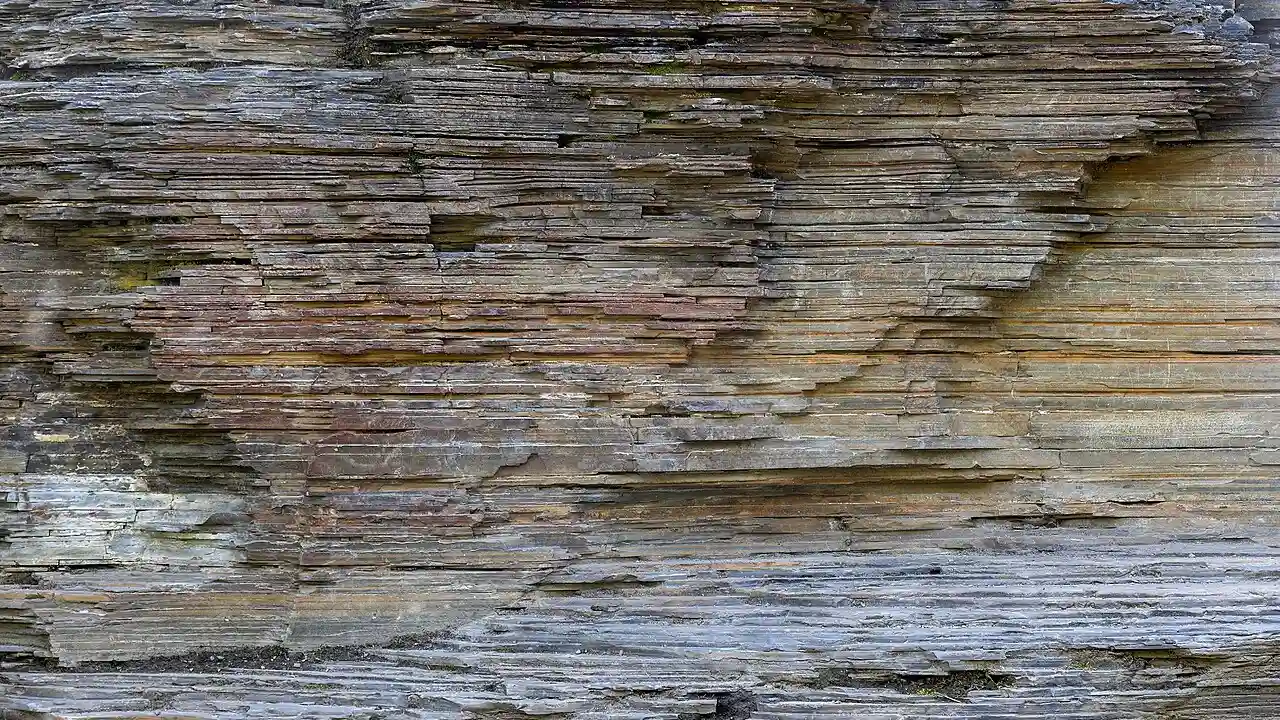
2. Where did the fine mud that became shale settle long ago?
🤯 Mind-Blowing Fact • Grade 2
Canada's famous Burgess Shale preserved 508-million-year-old sea creatures so delicately that scientists can still see their soft eyes and stomachs!
✨ Word Sparks (Grade 2 Glossary)
Tap 🔊 to hear
silt
Fine sediment smaller than sand, bigger than clay
mudflat
Flat muddy shore uncovered at low tide
plankton
Tiny drifting organisms living in water
🪝
Why can you open layers of shale almost like pages in a storybook?
1
Only Still Water Need Apply
Stir a spoonful of sand and clay into a jar of water. Heavy sand drops right away, while tiny clay specks float for hours! In nature, rivers drop sand near shore, carrying microscopic clay far out into quiet bays and deep lakes where it settles into shale.
2
Flat Flakes Stacked Neat
Microscopic clay particles are shaped like tiny flat pancakes. When heavy layers press down from above, all those little flakes lie flat in the same direction, letting shale split into paper-thin plates.
3
Colors Tell a Story
Red shale formed in oxygen-rich , green or gray shale formed underwater, and dark black shale holds ancient plant and bits!
1. Why does shale split easily into thin, flat layers?
2. What makes dark black shale look so dark?
🤯 Mind-Blowing Fact • Grade 3
Every fossil of feathered dinosaurs discovered in northeastern China's Liaoning Province was preserved between paper-thin layers of ancient lake shale!
✨ Word Sparks (Grade 3 Glossary)
Tap 🔊 to hear
fissility
Ability of rock to split into thin flat layers
trilobite
Extinct shelled ocean arthropod preserved in ancient shale
mudstone
Fine-grained mud rock that breaks in blocks, not sheets
🪝
How did Earth's quietest, softest mud become the planet's number-one fossil vault?
1
Invisible Grains, Giant Abundance
Touch a fresh chip of shale: unlike gritty sandstone, it feels silky-smooth. Its clay and fine silt particles are smaller than four-thousandths of a millimeter—far too small to see without an electron microscope! Because weathering breaks feldspars and micas into clay everywhere on land, shale makes up roughly seventy percent of all sedimentary rock in Earth's crust.
2
The Secret of Fissility
Fresh ocean mud starts out as eighty percent water with clay flakes tumbled like a house of cards. As burial squeezes out the water, flat clay minerals rotate horizontally, giving shale a property called —the ability to split into thin, parallel sheets. Non-layered mudrock that breaks in blocky chunks is called instead.
3
Preserving Feathers and Trilobites
Because ultra-fine mud seals out oxygen and bacteria without crushing delicate shapes, shale captures fossil ferns, insect wings, feathered dinosaurs, and Virginia's state fossil relatives like Devonian brachiopods and .
4
Bricks, Tile, and Underground Seals
Crushed shale is fired in kilns to make sturdy red building bricks, terracotta flowerpots, and cement, while underground shale layers form watertight caps over aquifers.
2. Why does shale preserve delicate fossils like insect wings and feathers much better than coarse sandstone?
🤯 Mind-Blowing Fact • Grade 4
Water moves through dense shale so slowly that groundwater trapped inside some deep shale layers has stayed isolated for tens of millions of years!
✨ Word Sparks (Grade 4 Glossary)
Tap 🔊 to hear
aquitard
Dense rock layer that blocks or slows groundwater flow
artesian
Pressurized groundwater trapped beneath a watertight rock layer
bedding plane
Flat boundary separating one sedimentary layer from another
🪝
Why can water sit inside shale pores without ever flowing through it?
1
An Aquitard That Stops Water in Its Tracks
Compare a sandstone bed and a shale bed underground, and a surprising puzzle appears. Shale actually holds microscopic pore spaces between clay flakes, yet water barely moves through it—sometimes less than an inch per thousand years! Because the pore throats are nanometers wide, water molecules cling tightly to electrically charged clay surfaces. Hydrogeologists call shale an or confining layer, trapping pressurized water inside sandstone aquifers beneath it.
2
Crumbling Slopes in the Appalachians
Across Virginia's Valley and Ridge province, thick Ordovician Martinsburg Shale and Devonian Brallier Shale crop out along highway roadcuts and creek banks. Scoring only 2 to 3 on the Mohs scale, shale breaks down rapidly under freeze-thaw cycles into chippy slopes and clay-rich soils, so civil engineers carefully terrace steep shale roadcuts to prevent landslides.
3
Color Chemistry as an Oxygen Meter
Geologists read shale's color like an ancient oxygen gauge. Ferric iron (Fe3+) paints floodplain shales brick-red; ferrous iron (Fe2+) tints low-oxygen marine shales olive-green; and unoxidized organic matter plus tiny pyrite crystals turn stagnant deep-basin shales jet-black.
4
Next Stop in the Rock Cycle: Slate!
When tectonic plates collide and squeeze buried shale under rising heat and pressure, soft clay minerals recrystallize into tough mica, transforming crumbly shale into hard, ringing metamorphic slate.
1. Why does shale act as a watertight confining layer (aquitard) underground?
2. What metamorphic rock forms when heat and mountain-building pressure squeeze shale?
🤯 Mind-Blowing Fact • Grade 5
Clay-bearing mudstones and shales drilled by NASA's Curiosity rover at Yellowknife Bay gave humanity the strongest proof that Gale Crater on Mars once held a calm, drinkable freshwater lake!
✨ Word Sparks (Grade 5 Glossary)
Tap 🔊 to hear
phyllosilicate
Sheet-structured silicate mineral family including clays and micas
anoxic
Containing little or no dissolved oxygen in water
Lagerstätte
Sedimentary deposit with extraordinarily preserved soft-bodied fossils
🪝
How do microscopic clay flakes smaller than bacteria govern everything from mountain landslides to planetary lake beds on Mars?
1
Phyllosilicate Mineralogy and Compaction Physics
Place a sliver of shale beneath a scanning electron microscope, and you enter a labyrinth of stacked sheet-silicate minerals—kaolinite, illite, smectite, and chlorite—intermixed with silt-sized quartz grains under 62.5 micrometers across. Freshly deposited marine mud behaves as an electrostatic flocculated soup holding up to 80 percent water. Under progressive burial to two or three kilometers depth, overburden expels pore water, collapses the clay fabric by more than half its original thickness, and aligns platy perpendicular to vertical stress to impart classic fissility.
2
Lagerstätten: Windows Into Soft-Bodied Evolution
Without fine-grained shales, humanity would know almost nothing about soft-bodied animal evolution! Extraordinary fossil deposits called Konservat-Lagerstätten—including British Columbia's Cambrian Burgess Shale, Germany's Hunsrück beds, and Wyoming's Eocene Green River Shale—preserved non-mineralized nervous systems, compound eyes, fish scales, and palm fronds in exquisite carbonaceous films and pyrite replacements.
3
Anoxic Basins, Kerogen, and Trace Metals
In stratified marine basins such as the Late Devonian Appalachian Basin (Chattanooga and Marcellus shales), oxygen-starved bottom waters prevented scavengers from consuming sunken plankton, locking up organic kerogen alongside trace molybdenum and uranium that geochemists use to reconstruct ancient ocean oxygenation events.
4
Geotechnical Swelling Clays and Seal Integrity
Smectite-rich shales absorb water between crystal sheets and expand forcefully, challenging tunnel and highway foundations, yet that same self-sealing ultralow permeability makes deep shales premier caprocks for underground carbon-dioxide sequestration.
5
Ancient Mudrocks of Gale Crater, Mars
At Yellowknife Bay on Mars, NASA's Curiosity rover drilled into 3.5-billion-year-old Sheepbed mudstones and shales containing smectite clays—conclusive mineralogical proof of a calm, neutral-pH freshwater lake that could once have supported microbial life!