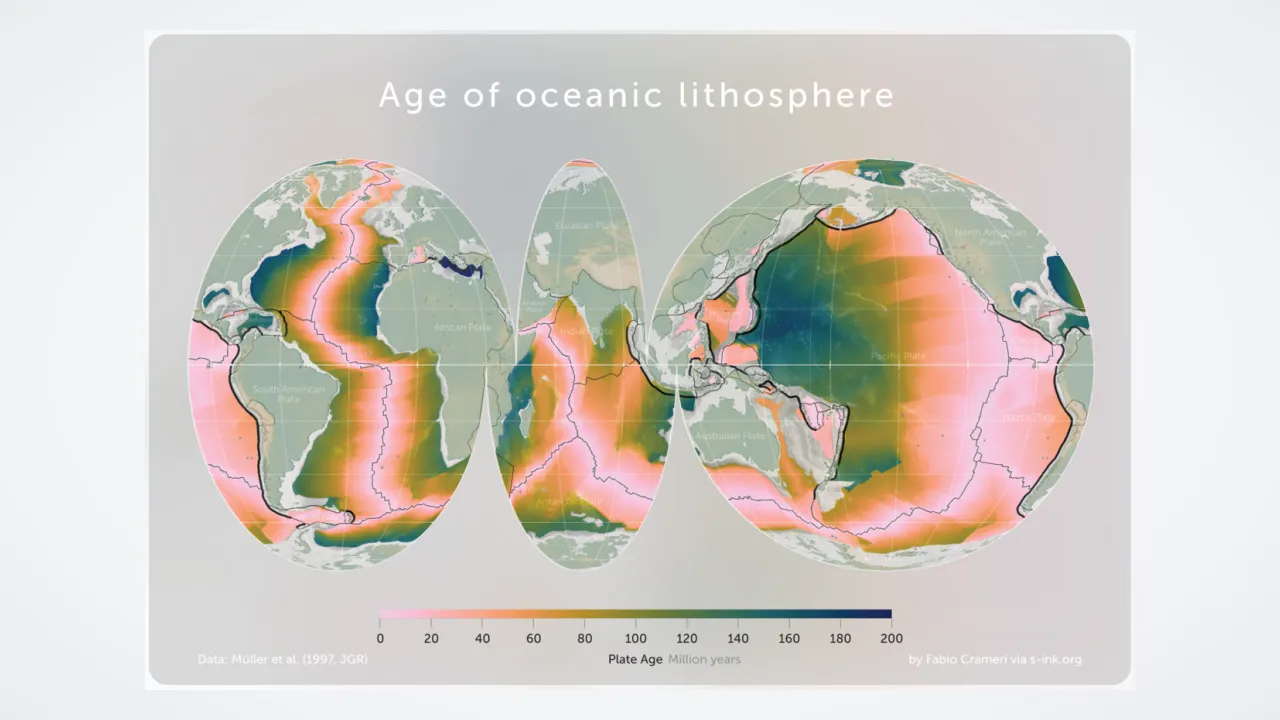
1. Where is the very newest rock found on a spreading ocean floor?
2. What happens to the Atlantic Ocean each year because of seafloor spreading?
🤯 Mind-Blowing Fact • Grade 2
Tiny iron grains frozen inside seafloor lava act like millions of miniature compass needles locked in stone!
✨ Word Sparks (Grade 2 Glossary)
Tap 🔊 to hear
magnetic
Able to pull iron and point like compasses.
crust
Earth's thin, rocky outer layer under land and sea.
compass
A tool with a needle pointing toward north.
🪝
How did invisible magnetic stripes on the bottom of the sea prove that continents really move?
1
Twin Escalators Under the Sea
Picture two flat escalators starting back-to-back and gliding away from each other. In 1960, geologist Harry Hess suggested the ocean floor works the exact same way! Hot rock rises at a mid-ocean ridge, hardens, and glides outward on both sides.
2
Young Near the Center, Old Near Land
Because fresh lava always hardens along the middle seam, the youngest rocks sit right at the ridge. As you travel closer to the continents on either side, the seafloor rocks get older and older.
3
Tiny Compass Needles in Rock
Seafloor lava holds tiny bits of iron that point toward Earth's pole while cooling. Matching stripes of these magnetic rocks on both sides of the ridge proved seafloor spreading was real!
1. As you travel away from a mid-ocean ridge toward a continent, what happens to the age of seafloor rock?
2. Who proposed the big idea of seafloor spreading in the early 1960s?
🤯 Mind-Blowing Fact • Grade 3
Mirror-image magnetic 'zebra stripes' on the ocean floor work like a giant rocky tape recorder playing back millions of years of Earth's history!
✨ Word Sparks (Grade 3 Glossary)
Tap 🔊 to hear
magnetometer
An instrument that measures magnetic fields in rock.
symmetrical
Having matching mirror-image halves on both sides.
sediment
Tiny bits of mud, sand, and shells settling.
🪝
Why did scientists laugh at the idea of drifting continents until they towed magnets behind research ships?
1
Solving Wegener's Puzzle
Back in 1912, Alfred Wegener noticed South America and Africa fit together like puzzle pieces, yet he could not explain how giant continents plowed through solid ocean rock. Fifty years later, Harry Hess and Robert Dietz realized continents don't plow through the seafloor—they ride along as the seafloor itself spreads!
2
Earth's Flipping Magnetic Field
Every few hundred thousand years, Earth's magnetic field mysteriously flips, making a compass needle point south instead of north! When iron-rich basalt lava cools along a mid-ocean ridge, its magnetic minerals lock in whichever direction Earth's field points that day.
3
Zebra Stripes on the Ocean Floor
When ships towed sensitive across ridges, they found normal and reversed magnetic bands forming exact mirror-image 'zebra stripes' on both sides of the rift!
4
Deep-Sea Drilling Confirms It
Soon after, the research ship Glomar Challenger drilled rock cores across the Atlantic, proving thickness and rock age steadily increase with distance from the ridge.
1. Why do magnetic stripes on one side of a mid-ocean ridge match the stripes on the other side?
2. What happens to the layer of mud and sediment on the seafloor as you move farther from the ridge?
🤯 Mind-Blowing Fact • Grade 4
During World War II, Navy captain and geologist Harry Hess kept his ship's echo-sounder switched on day and night across the Pacific, gathering the clues that inspired seafloor spreading!
✨ Word Sparks (Grade 4 Glossary)
Tap 🔊 to hear
paleomagnetism
Ancient magnetic field directions preserved inside rocks.
magnetite
Naturally magnetic iron mineral found inside basalt.
polarity
Direction in which north and south poles point.
🪝
How did World War II sonar maps and Cold War magnetic sensors team up to spark Earth science's biggest revolution?
1
From Continental Drift to Plate Tectonics
For decades after Alfred Wegener proposed continental drift, geologists remained skeptical because no known force could shove granite continents across solid basalt seafloors. While commanding a Navy transport ship in the Pacific during World War II, geologist Harry Hess left his sonar running and discovered flat-topped underwater volcanoes at increasing depths. By 1962, Hess proposed a bold mechanism that Robert Dietz named 'seafloor spreading': new oceanic crust forms at mid-ocean ridges, moves laterally like twin conveyor belts, and sinks back into deep trenches.
2
Vine, Matthews, Morley, and Paleomagnetism
In 1963, British scientists Fred Vine and Drummond Matthews—and independently Canadian geophysicist Lawrence Morley—realized how to test Hess's idea. Basaltic magma contains crystals (`Fe3O4`). As lava cools below a temperature threshold, those crystals align with Earth's magnetic field. Because Earth's magnetic poles periodically reverse , a spreading ridge should record alternating bands of normal and reversed magnetism identically on both flanks.
3
Symmetric Anomalies and Sediment Cores
Surveys across the Reykjanes Ridge south of Iceland confirmed razor-sharp, symmetrical magnetic stripes! Even better, in 1968 the drilling vessel Glomar Challenger recovered basalt cores across the South Atlantic, proving crust near the ridge was brand-new while crust near South America and Africa was roughly 140 million years old.
4
Measuring Spreading Rates Today
By dividing a magnetic stripe's distance from the ridge by its known radiometric age, Virginia Earth science students can calculate exact spreading rates—from 2.5 centimeters per year in the Atlantic to 15 centimeters per year in the eastern Pacific!
1. Which iron-rich mineral inside cooling basalt lava locks in the direction of Earth's magnetic field?
2. How can scientists calculate how fast a seafloor has been spreading?
🤯 Mind-Blowing Fact • Grade 5
Above 580 degrees Celsius—magnetite's Curie point—atoms jiggle too fast to hold magnetism, meaning every stripe on the ocean floor locked in its compass direction the exact moment lava cooled past 580 °C!
✨ Word Sparks (Grade 5 Glossary)
Tap 🔊 to hear
Curie temperature
Heat point below which cooling minerals lock magnetism.
isochron
Map line connecting seafloor rocks of equal age.
geomagnetic reversal
Complete flip of Earth's north and south magnetic poles.
🪝
Why does cooling basalt lose its magnetic memory above 580 degrees Celsius—and how did that physics unlock the history of every ocean basin?
1
Thermoremanent Magnetization and the Curie Point
When basaltic magma erupts along a mid-ocean ridge at roughly 1,200 degrees Celsius, thermal agitation keeps atoms inside its iron-titanium oxide minerals—principally magnetite—jiggling too violently to hold a magnetic alignment. Once seawater chills the solidifying rock below magnetite's of 580 degrees Celsius, atomic magnetic domains lock parallel to Earth's ambient geomagnetic field. Known as thermoremanent magnetization, this physical threshold turns freshly accreted oceanic crust into a permanent archive of planetary magnetism.
2
The Vine-Matthews-Morley Breakthrough
In the early 1960s, marine magnetometers towed across the northeastern Pacific and the Reykjanes Ridge detected baffling zebra-like bands where magnetic intensity swung slightly higher and lower than average. Independently in 1963, Lawrence Morley and the team of Fred Vine and Drummond Matthews connected two revolutionary discoveries: Harry Hess's seafloor-spreading hypothesis and radiometric timelines of geomagnetic polarity reversals on land. Rocks cooled during 'normal' epochs reinforced today's field (positive anomalies), while rocks cooled during 'reversed' epochs partially canceled it (negative anomalies).
3
Isochrons and the Glomar Challenger Proof
Because spreading splits each magnetized strip down the ridge axis, twin bands of identical age—called —migrate symmetrically outward. In 1968, Leg 3 of the Deep Sea Drilling Project aboard the Glomar Challenger clinched the case: fossil plankton directly atop basalt basement rocks across the Mid-Atlantic Ridge grew linearly older with distance, matching magnetic predictions to within a few percent.
4
What Drives the Conveyor: Ridge Push vs. Slab Pull
Early models pictured rising mantle convection plumes actively forcing plates apart. Modern geodynamics shows upwelling beneath most ridges is passive: distant 'slab pull' at subduction trenches and gravitational 'ridge push' down elevated ridge flanks pull plates apart, drawing asthenosphere upward to melt by decompression.
5
Rewinding the Global Map
By matching oceanic backwards like rewinding a filmstrip, geophysicists reconstruct exact positions of continents over the past 180 million years—closing the Atlantic right back into Pangaea!