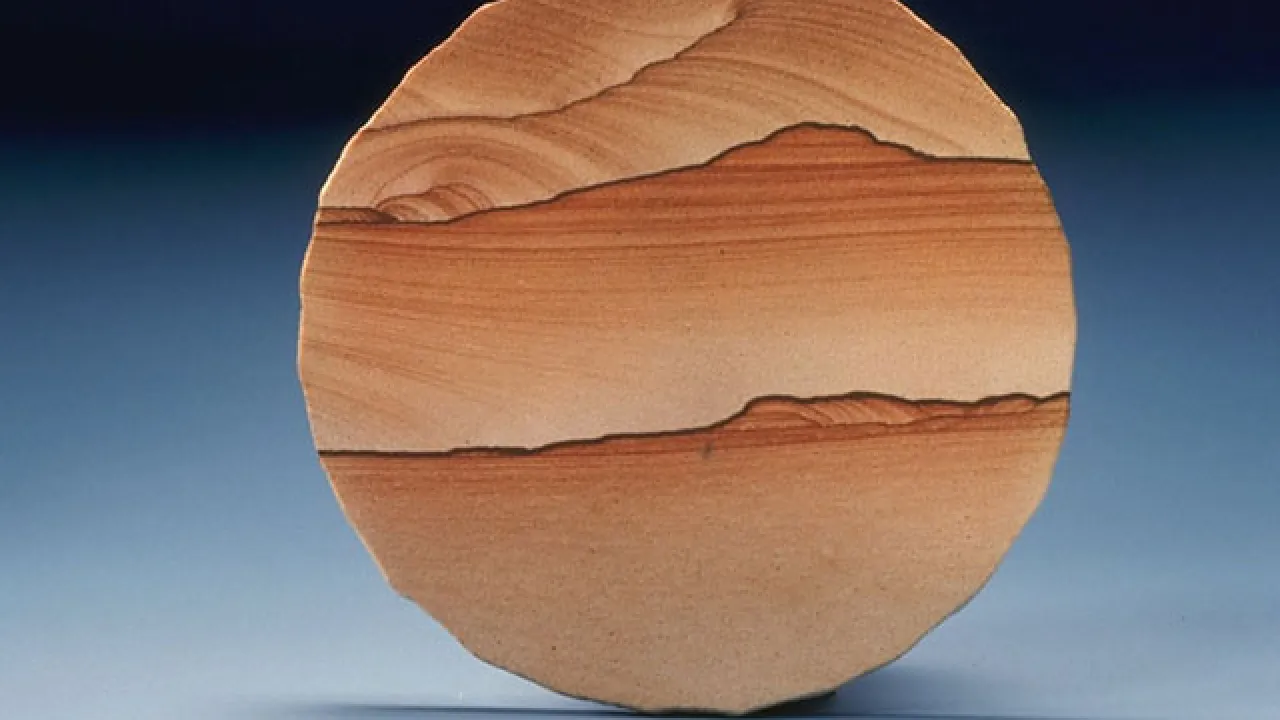
1. Why does sandstone feel rough and gritty when you touch it?
2. Where did the loose sand in sandstone often pile up long ago?
🤯 Mind-Blowing Fact • Grade 2
Arches National Park in Utah has more than 2,000 natural bridges and windows carved by wind and rain out of red sandstone!
✨ Word Sparks (Grade 2 Glossary)
Tap 🔊 to hear
cement
Natural mineral glue holding rock grains together
iron oxide
Rust-colored mineral giving sandstone red and orange shades
ripple mark
Wavy ridge left in sand by wind or water
🪝
How can loose beach sand that slips right through your fingers turn into a 1,000-foot cliff?
1
Squeezed and Cemented
Imagine building a sandcastle at the beach—one wave knocks it flat! To make real sandstone, Earth buries sand layers deep underground. Groundwater trickles through tiny spaces, leaving mineral like quartz, calcite, or iron that glues the grains tight.
2
Painted in Sunset Colors
Why are cliffs in Utah and Arizona painted red, orange, pink, and gold? Tiny coatings of —the very same mineral as rust—stain the mineral in glowing desert colors!
3
Frozen Ripples and Footprints
Sometimes gentle waves left or a dinosaur stepped across damp river sand before new layers covered it up, saving those tracks in stone.
1. What turns loose, buried sand into solid sandstone?
2. What gives southwestern sandstone cliffs their bright red and orange colors?
🤯 Mind-Blowing Fact • Grade 3
Tilted cross-beds in Utah's 2,000-foot-thick Navajo Sandstone prove that North America once held a sand-dune desert larger than the Sahara!
✨ Word Sparks (Grade 3 Glossary)
Tap 🔊 to hear
clastic
Made of broken rock and mineral fragments
cross-bedding
Tilted rock layers formed by moving dunes or currents
aquifer
Porous underground rock layer storing fresh groundwater
🪝
How can geologists tell whether a sandstone cliff used to be a windy desert or a rushing river?
1
Tough Quartz Survivors
Peer at sandstone through a magnifier and you will spot rounded, glassy grains between one-sixteenth of a millimeter and two millimeters wide. Most are quartz, a tough mineral that survives tumbling down rivers for thousands of years after softer minerals crumble into clay.
2
Reading Cross-Bedding Clues
Look at Zion National Park's towering Navajo Sandstone, and you will see tilted layers sweeping across the cliff at steep angles. Geologists call this pattern . As ancient wind blew sand up one side of a giant dune and spilled it down the steeper leeward slope, the rock recorded the exact wind direction!
3
Underground Water Sponges
Even after mineral cement glues sand grains together, tiny open pores remain between the round spheres. Rainwater seeps through these connected pores, turning underground sandstone beds into giant freshwater that supply towns and farms.
4
Historic Brownstones
In the 1800s, reddish-brown Triassic sandstone was quarried across eastern states—including northern Virginia—to build famous city rowhouses called brownstones.
1. What can tilted cross-bedding layers inside sandstone tell a geologist?
2. Why do underground sandstone layers make excellent freshwater aquifers?
🤯 Mind-Blowing Fact • Grade 4
George Washington personally chose Virginia's pale Aquia Creek sandstone in the 1790s to build the walls of the White House and the original U.S. Capitol!
✨ Word Sparks (Grade 4 Glossary)
Tap 🔊 to hear
arkose
Pinkish sandstone rich in feldspar from nearby granite
sorting
How uniform in size a rock's grains are
arenite
Clean, sand-sized clastic sedimentary rock with little mud
🪝
Why do long, ruler-straight sandstone ridges form the backbone of Virginia's Appalachian valleys?
1
Grain Sorting and Mineral Maturity
Geologists read a piece of clastic sandstone like a travel diary! Angular sand grains mixed with pink feldspar—called —show that granite mountains eroded nearby and buried quickly. By contrast, pure white quartz made of smoothly rounded, identically sized quartz grains proves that ocean waves and rivers washed, sorted, and tumbled that sand for millions of years.
2
Cement Strength Shapes Whole Mountains
Two sandstones made of identical quartz sand (Mohs hardness 7) can behave very differently depending on their cement. Calcite-cemented sandstone crumbles slowly in humid rain, whereas silica-cemented orthoquartzite binds grains with pure quartz cement, creating armor-like rock. Across Virginia's Valley and Ridge province, upturned beds of Silurian Tuscarora Sandstone resist erosion so stubbornly that they hold up Massanutten Mountain and Seneca Rocks while neighboring limestones and shales wear down into deep valleys.
3
Virginia's Historic Aquia Creek Quarries
In Virginia's Coastal Plain along Stafford County, Cretaceous river deltas left pale, cross-bedded Aquia Creek sandstone. Early builders barged blocks up the Potomac River to construct the U.S. Capitol pillars, Mount Vernon steps, and the White House.
4
Glassmaking and Clean Filtration
Ultra-pure quartz sandstones—such as the Oriskany Sandstone in the Appalachians—are quarried and melted to manufacture crystal-clear optical glass, solar panels, and water-treatment sand filters.
1. What does a sandstone made of well-rounded, uniform, nearly 100% pure quartz grains reveal?
2. Why does Virginia's Tuscarora Sandstone form tall ridges like Massanutten Mountain?
🤯 Mind-Blowing Fact • Grade 5
NASA's Curiosity rover photographed cross-bedded sandstone cliffs on Mars whose dune ripples match desert sandstones in Utah almost millimeter for millimeter!
✨ Word Sparks (Grade 5 Glossary)
Tap 🔊 to hear
diagenesis
Physical and chemical changes turning buried sediment into rock
graywacke
Dark, muddy sandstone deposited by underwater sediment avalanches
aeolian
Transported, shaped, and deposited by blowing wind
🪝
How did layered sandstones inside Gale Crater prove to NASA rovers that ancient Mars once held flowing rivers and windswept dunes?
1
Wentworth Scale and Diagenesis
On the Wentworth grain-size scale, sandstone encompasses clastic rocks whose framework grains measure strictly between 0.0625 and 2.0 millimeters in diameter. Turning loose sediment into coherent bedrock requires : burial beneath kilometers of overburden reduces initial porosity from roughly 40 percent down to 15 or 25 percent, while warm pore fluids precipitate authigenic quartz overgrowths, sparry calcite, or hematite rims that lock clasts together.
2
Quartz Arenite, Arkose, and Lithic Graywacke
Sedimentary petrologists plot sandstones on a ternary diagram of Quartz, Feldspar, and Lithic rock fragments to reconstruct plate-tectonic settings. Passive continental margins produce ultra-mature quartz arenites; fault-bounded rift valleys like eastern North America's Triassic Culpeper Basin yield feldspar-rich red arkoses; and submarine turbidity currents rushing down deep ocean trenches dump muddy, poorly sorted displaying graded bedding.
3
Fluid Reservoirs and Darcy's Law
With interconnected pore throats tens of microns wide, clean sandstones exhibit high hydraulic conductivity governed by Darcy's Law. Major continental sandstone aquifers—such as North America's High Plains Ogallala system, Australia's Great Artesian Basin, and the Cambrian-Ordovician St. Peter Sandstone—store trillions of gallons of filtered drinking water, while deeply buried porous sandstones provide premier geological formations for geothermal energy circulation and permanent carbon-dioxide storage.
4
Aeolian Versus Fluvial Sedimentary Structures
Meter-scale trough cross-beds with frosted, wind-pitted grains and steep 34-degree avalanche foresets distinguish desert ergs like the Jurassic-Cretaceous Colorado Plateau formations from lower-angle river point-bar deposits containing sparkling muscovite flakes, asymmetric current ripples, mud-crack casts, and basal pebble lags.
5
Martian Sandstones at Mount Sharp
Using high-resolution hand-lens cameras on Mars, NASA's Curiosity and Perseverance rovers documented cross-bedded basaltic sandstones in Gale and Jezero craters—complete with water-laid delta foresets, diagenetic iron-oxide concretions, and wind-sculpted Stimson Formation dunes—proving identical physical sedimentology shapes rocky worlds across the solar system!