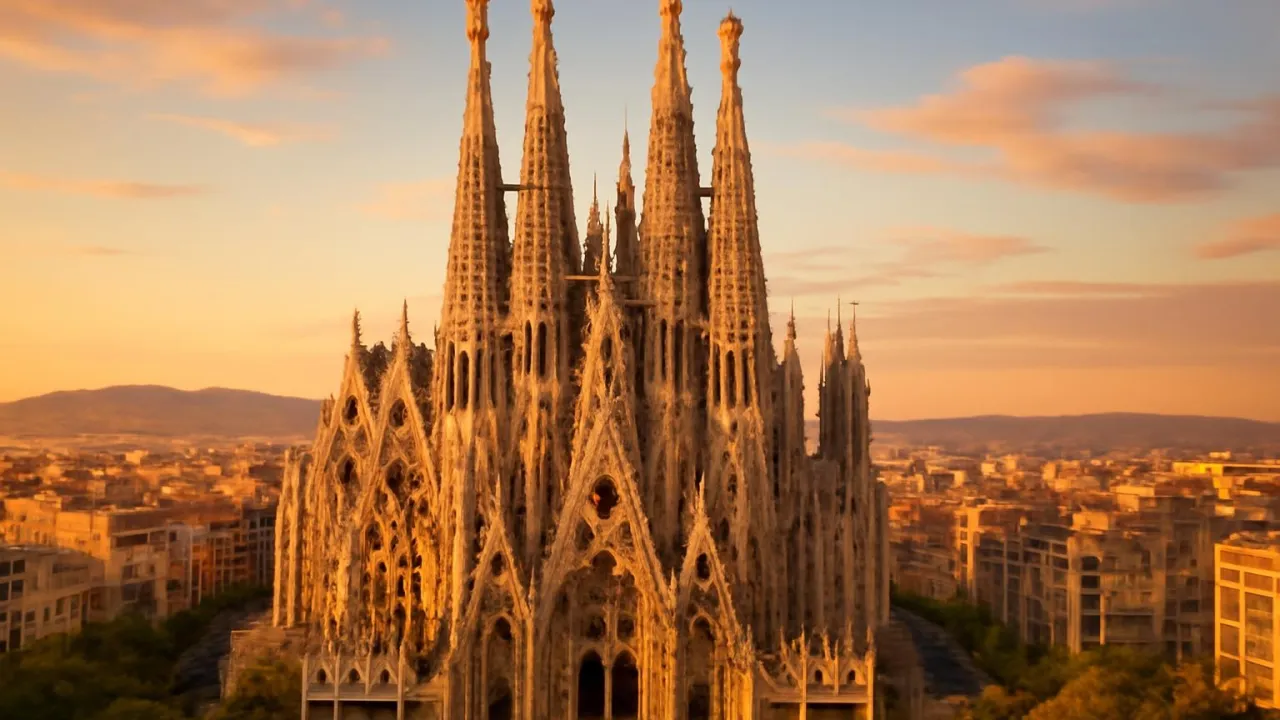
1. What do the towers of Sagrada Familia look like?
2. Who visits Sagrada Familia?
🤯 Mind-Blowing Fact • Grade 2
When finished, Sagrada Familia will have 18 towers—one for each apostle, evangelist, Mary, and Jesus!
✨ Word Sparks (Grade 2 Glossary)
Tap 🔊 to hear
cathedral
A very big church
construction
Building something new
rainbow
Colors made by light
🪝
Have you ever seen a building that looks like a fairy tale?
1
A Forest Made of Stone
Sagrada Familia’s towers reach up like tall trees, shining in the sunlight. The church’s walls twist and curve, making it look magical. Colorful stained glass windows fill the inside with .
2
A Building That Keeps Growing
People started building Sagrada Familia in 1882, and it is still not finished. Builders use special tools and designs to make the church strong and beautiful. Every year, new pieces are added to the tall spires.
3
A Place for Everyone to Visit
Visitors from all around the world come to see Sagrada Familia. They walk inside and look up at the bright windows and high ceilings. The church is a special place for people to wonder and dream.
2. How many towers will Sagrada Familia have when finished?
🤯 Mind-Blowing Fact • Grade 3
Sagrada Familia’s tallest tower will be 566 feet—taller than most skyscrapers in Barcelona!
✨ Word Sparks (Grade 3 Glossary)
Tap 🔊 to hear
prototype
A test model for building
arch
A curved shape that holds weight
monument
A famous building or statue
🪝
Can you imagine building something so tall it almost touches the clouds?
1
Nature’s Shapes in Stone
Sagrada Familia’s towers rise like a forest of stone, inspired by trees and plants. The famous architect Antoni Gaudí wanted the church to feel like walking through nature. Curved columns inside look like tree trunks holding up leafy branches. Colorful stained glass windows fill the space with glowing light.
2
Building for Over a Century
Construction began in 1882, and Sagrada Familia is still being built today. Workers use both old tools and modern machines to shape the stone. Gaudí designed special and columns to support the heavy roof. Each new spire added brings the church closer to completion.
3
A Monument for the World
Millions of people visit Sagrada Familia every year from all over the globe. The church is a UNESCO World Heritage site because of its unique architecture. Visitors marvel at the vibrant windows and twisting shapes. The building is a symbol of creativity and hope.
4
How Does It Stand So Tall?
Gaudí used strong and branching columns to hold up the tall towers. The design spreads the weight, so the stone does not crack or fall. Builders test each new part with models called . Careful planning keeps the church safe as it grows higher.
1. What inspired Sagrada Familia’s shapes and columns?
2. Why do builders use prototypes?
🤯 Mind-Blowing Fact • Grade 4
Gaudí used gravity and hanging chains to design the perfect arches for Sagrada Familia.
✨ Word Sparks (Grade 4 Glossary)
Tap 🔊 to hear
catenary arch
A curve made by a hanging chain
facade
The front or outside of a building
perseverance
Never giving up, even when it’s hard
🪝
What secrets hide in a church where stone grows like a living forest?
1
A Living Dream in Stone and Light
The Sagrada Familia’s towers spiral upward, inspired by the shapes of trees, flowers, and seashells found in nature. Antoni Gaudí, its visionary architect, believed that architecture should imitate the natural world, so he filled the church with twisting columns and colorful stained glass that mimics sunlight through leaves. Each spire and tells a story from the life of Jesus, using sculptures and symbols. When sunlight pours through the windows, the interior glows with brilliant blues, reds, and golds.
2
Engineering Wonders: Arches, Columns, and Balance
Gaudí’s design uses special branching columns and to distribute the weight of the massive stone structure. These engineering choices make the church stable, even as it grows taller each year. Builders use both traditional hand tools and advanced computer models to guide their work. The ongoing construction is a careful balance between Gaudí’s original plans and modern building techniques.
3
History Still in the Making
Construction began in 1882, and even after more than 140 years, Sagrada Familia is not finished. Wars, funding problems, and changing technology have all slowed its progress. Yet, each generation of builders adds new details, keeping Gaudí’s dream alive. When completed, it will have 18 unique spires, each representing important figures from Christian history.
4
A Symbol for Barcelona and the World
Sagrada Familia is more than a church—it is a symbol of creativity, faith, and for people everywhere. As a UNESCO World Heritage site, it attracts millions of visitors who marvel at its beauty and engineering. The church’s blend of art, science, and faith inspires architects and dreamers around the globe. Its unfinished state reminds us that great works sometimes take many lifetimes to complete.
1. How did Gaudí design strong arches for Sagrada Familia?
2. What does Sagrada Familia symbolize for many people?
🤯 Mind-Blowing Fact • Grade 5
Sagrada Familia’s tallest spire will surpass 566 feet, making it the world’s tallest church—by design, just shorter than Barcelona’s Montjuïc hill, honoring nature.
✨ Word Sparks (Grade 5 Glossary)
Tap 🔊 to hear
biomimicry
Design that copies shapes from nature
hyperboloid
A curved shape found in strong towers
acoustics
How sound moves in a space
🪝
If you could step inside a cathedral where mathematics, sunlight, and stone all dance together, what would you discover?
1
Nature’s Geometry: Gaudí’s Vision Realized
Antoni Gaudí envisioned Sagrada Familia as a living cathedral where every structural element echoes forms found in nature. The soaring spires, twisting columns, and shell-like vaults are all based on mathematical shapes such as , paraboloids, and helicoids. Gaudí believed that these geometric forms, which occur naturally in plants and crystals, would create a harmonious and stable structure. His use of —design inspired by living things—makes the church feel like a stone forest alive with movement and light.
2
Engineering the Impossible: Strength Through Innovation
Sagrada Familia’s immense weight is supported by a network of branching columns and catenary arches, distributing forces with mathematical precision. Gaudí pioneered the use of gravity models, hanging chains upside down to reveal the optimal curve for each arch. Modern builders use computer-aided design (CAD) to interpret Gaudí’s original plaster models and adapt them for today’s materials and safety standards. The tallest central tower, dedicated to Jesus, will reach 566 feet (172.5 meters), making it the tallest church structure in the world upon completion.
3
A Timeline Across Centuries
Construction of Sagrada Familia began in 1882, and it has continued for over 140 years, interrupted by wars, funding shortages, and changes in technology. Gaudí devoted the last 15 years of his life exclusively to the project, leaving behind detailed models and drawings. After his death in 1926, architects and artisans have worked to interpret and realize his complex vision. Each generation adds new techniques, from stone carving by hand to 3D printing of intricate details.
4
A Cultural and Spiritual Beacon
Sagrada Familia is not only a masterpiece of architecture but also a symbol of Barcelona’s spirit and resilience. It is a UNESCO World Heritage site, drawing over 4 million visitors annually from every continent. The church’s facades narrate the story of Christianity through sculptures, mosaics, and symbolic forms. Its unfinished state is a reminder that human creativity is an ongoing process, inviting people to reflect on faith, perseverance, and the power of imagination.
5
Light, Color, and Acoustics: The Science of Awe
Gaudí designed the interior to be flooded with natural light, using stained glass windows positioned to create shifting patterns of color throughout the day. The are carefully engineered, with vaults and columns dispersing sound for music and prayer. The interplay of sunlight, color, and sound transforms the space into a sensory experience that inspires awe and contemplation. Sagrada Familia demonstrates how science, mathematics, and art can combine to create a landmark that touches both the mind and the heart.