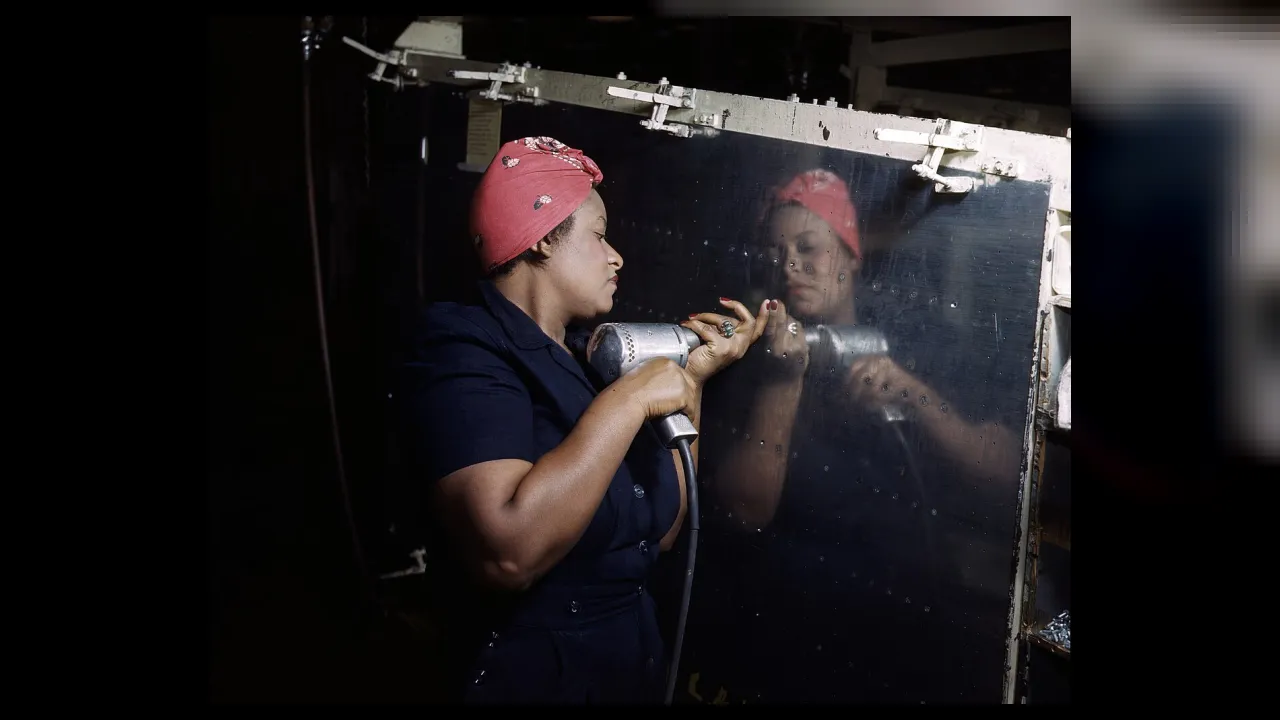
📜 Key MilestoneOver 6 million women entered the workforce alongside 20 million Victory Gardens
⚡ Historical SparkTransformed civilian factories and ordinary neighborhoods into an unstoppable industrial and civic team
🤯 Mind-Blowing Fact • Grade 1
Families planted twenty million backyard and schoolyard Victory Gardens, growing nearly half of all the fresh vegetables eaten in America during World War II!
✨ Word Sparks (Grade 1 Glossary)
Tap 🔊 to hear
rivet
Metal pin holding airplane plates tightly together
home front
Everyday citizens helping from back at home
recycle
Turn old scrap metal into new tools
🪝
Who wore a polka-dot bandana and built giant ships and airplanes during World War II?
1
We Can Do It!
Rat-a-tat-tat! Sparks fly as women fasten metal plates onto airplane wings with tools. Posters of strong 'Rosie the Riveter' cheered them on!
2
Growing Victory Gardens
Millions of men were away serving as soldiers and sailors. Back home, kids planted backyard 'Victory Gardens' full of carrots, beans, and tomatoes.
3
Saving Tin and Rubber
Children pulled wagons down streets collecting old keys, tin cans, and rubber tires. Every neighbor pitched in to help win the war!
2. Why did families plant 'Victory Gardens' in their yards during World War II?
🤯 Mind-Blowing Fact • Grade 2
Toy factories paused making metal wagons and bicycles during World War II so every pound of steel could be used for ships, bridges, and jeeps!
✨ Word Sparks (Grade 2 Glossary)
Tap 🔊 to hear
ration
Share scarce food or fuel in fair amounts
shipyard
Waterfront factory where big ships are built
welder
Worker who joins metal using intense heat
🪝
How did car factories suddenly start building airplanes—and how did schoolchildren help?
1
Stepping Into Shipyards and Factories
Hear the hiss of welding torches and the steady hammer of rivet guns inside a huge aircraft hangar! When sixteen million Americans served in uniform during World War II, over six million women stepped into factories, , and railroads.
2
Ration Books at the Grocery Store
Because troops needed sugar, rubber tires, shoes, and gasoline, every family received little stamp booklets called books. Even if you had extra coins, you needed ration stamps to buy butter or gas so supplies were shared fairly!
3
Kids on the Home Front
Schoolchildren saved foil wrappers, bacon grease, and scrap iron in neighborhood drives, and bought ten-cent savings stamps to help fund ships and planes.
1. What were World War II 'ration books' used for?
2. About how many women entered the workforce for the first time during World War II?
🤯 Mind-Blowing Fact • Grade 3
Shipyard crews including thousands of women welders set a world record in November 1942 by assembling the 441-foot Liberty ship SS Robert E. Peary in just four days and fifteen hours!
✨ Word Sparks (Grade 3 Glossary)
Tap 🔊 to hear
arsenal
Large supply center making tools for defense
aerodynamics
Science of how air moves around planes
war bond
Citizen loan certificate helping fund national defense
🪝
How did real-life 'Rosies' build an entire cargo ship in less than a week?
1
Turning Auto Plants Into Airplane Factories
Picture an enormous Michigan factory rolling a brand-new four-engine B-24 bomber out the doors every single hour! After December 1941, American companies stopped making passenger cars, toasters, and typewriters, retooling assembly lines into what President Roosevelt called the ' of Democracy.'
2
Real-Life Rosies Across America
Inspired by J. Howard Miller's famous 'We Can Do It!' poster, real-life Rosies welded Liberty ships, inspected artillery shells, and wired radar sets. At Virginia's Norfolk Naval Shipyard and Newport News Shipbuilding, thousands of women—both Black and white—helped construct aircraft carriers and Navy vessels.
3
Women Mathematicians and Pilots
Home-front talent went beyond riveting! At Langley Memorial Aeronautical Laboratory in Hampton, Virginia, brilliant women mathematicians—including Dorothy Vaughan and her colleagues—calculated wind-tunnel to make Allied planes faster and safer.
4
Changing Ideas About Work Forever
Combined with Victory Gardens, , and scrap drives, home-front teamwork produced nearly three hundred thousand aircraft. Women proved they could master any technical trade, reshaping workplaces for future generations.
1. What famous slogan appeared above Rosie's flexed arm on J. Howard Miller's 1943 factory poster?
2. Where in Virginia did women mathematicians like Dorothy Vaughan test airplane designs during World War II?
🤯 Mind-Blowing Fact • Grade 4
At Ford's massive Willow Run plant in Michigan, thousands of Rosie the Riveters helped assemble 1.2 million parts per bomber so efficiently that a finished B-24 Liberator rolled off the line every sixty-three minutes!
✨ Word Sparks (Grade 4 Glossary)
Tap 🔊 to hear
retool
Equip factory machines to build new products
civilian
Citizen who is not in military uniform
precision
Exact careful measurement without tiny mistakes
🪝
How did everyday citizens, shipwelders, and Virginia mathematicians help turn the tide of World War II?
1
Total Mobilization on the Home Front
Imagine walking through downtown Norfolk or Detroit in 1943 as three eight-hour factory shifts hum nonstop day and night! Fighting a two-ocean war across Europe and the Pacific required unprecedented industrial mobilization. The War Production Board converted manufacturing so swiftly that U.S. shipyards and aircraft plants soon outproduced all Axis nations combined.
2
Six Million New Women Workers
Between 1940 and 1945, the female share of the U.S. workforce jumped from twenty-seven percent to thirty-seven percent—nearly nineteen million working women in all. Known collectively as 'Rosie the Riveter' after a hit 1942 song and Norman Rockwell and J. Howard Miller artworks, women mastered arc welding, crane operation, riveting, and optics.
3
Opening Doors for Minority Workers
After labor leader A. Philip Randolph urged equal hiring in defense plants, President Roosevelt signed Executive Order 8802 in June 1941 barring discrimination in defense industries. Hundreds of thousands of African American women transitioned from low-paid farm or domestic work into skilled shipyard jobs at Hampton Roads, Baltimore, and California, as well as scientific computing roles at NACA Langley in Virginia.
4
Shared Sacrifice in Every Kitchen
Meanwhile, eighty-five million Americans purchased $185 billion in War Bonds, Office of Price Administration ration coupons conserved rubber, gasoline, coffee, and meat, and twenty million Victory Gardens harvested eight million tons of produce annually—proving civic unity was America's greatest strength.
1. What did President Roosevelt's Executive Order 8802 accomplish in June 1941?
2. Roughly how many airplanes did American home-front workers build during World War II?
🤯 Mind-Blowing Fact • Grade 5
More than 1,070 civilian female pilots in the WASP (Women Airforce Service Pilots) logged sixty million miles flying every type of U.S. military aircraft—including giant B-29 bombers—from factory runways to departure airbases!
✨ Word Sparks (Grade 5 Glossary)
Tap 🔊 to hear
inflation
Rapid rise in everyday store prices
procurement
Obtaining supplies equipment and materials at scale
glycerin
Useful liquid chemical made from saved fats
🪝
How did World War II home-front mobilization permanently end the Great Depression and transform women's economic and civic status?
1
Forging the 'Arsenal of Democracy'
Following the attack on Pearl Harbor on December 7, 1941, the United States executed the fastest industrial transformation in modern history. Coordinated by the War Production Board, civilian factories halted automobile and appliance lines to produce 296,000 aircraft, 86,000 tanks, 2,710 Liberty cargo ships, and millions of tons of medical and communications gear—erasing lingering Great Depression unemployment within months.
2
Behind the Icon of Rosie the Riveter
With over sixteen million Americans serving in the Armed Forces, defense contractors recruited women—including married women and mothers—on an unprecedented scale. Female employment surged past nineteen million, while another 350,000 women volunteered directly in military branches such as the WACs, Navy WAVES, Coast Guard SPARs, Army and Navy Nurse Corps, and civilian Women Airforce Service Pilots (WASPs) who ferried combat planes from factories to bases.
3
Hampton Roads and Scientific Computing
Virginia's Hampton Roads region became one of the busiest home-front hubs on Earth: Norfolk Naval Shipyard employed over 42,000 workers, and Newport News Shipbuilding launched fleet carriers in record time. Across the harbor in Hampton, the National Advisory Committee for Aeronautics (NACA) hired college-educated women—including the West Area Computers led later by Dorothy Vaughan—following Executive Order 8802's mandate for fair defense employment.
4
Conservation Economics and War Finance
To prevent runaway while factories focused on defense, the Office of Price Administration capped consumer prices and distributed ration books for tires, fuel oil, sugar, meat, and canned goods. Citizens recycled millions of tons of tin, copper, paper, and cooking fats (used to make ), while purchasing $185.7 billion in War Bonds.
5
Long-Term Shifts in American Society
Although many defense plants laid off female riveters when veterans returned in 1945, millions of women re-entered expanding postwar clerical, teaching, healthcare, and technical careers—passing confidence and equal-pay aspirations directly to their daughters in the late twentieth century.