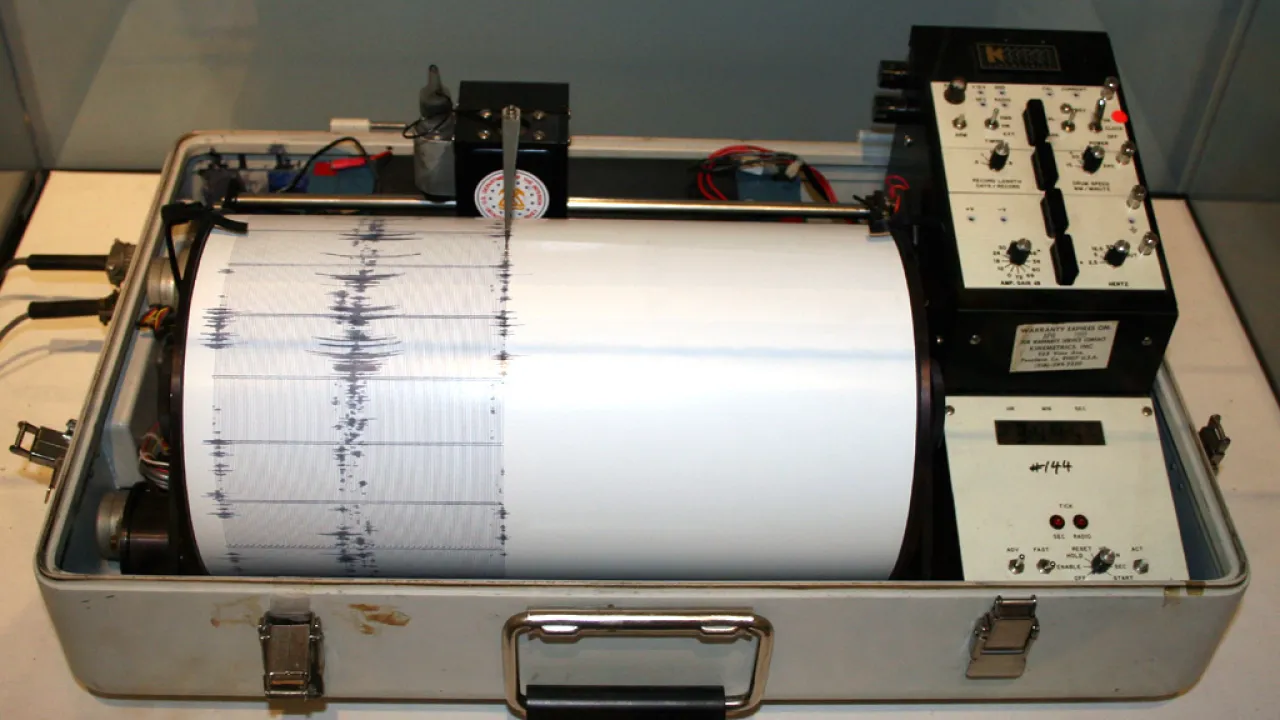
1. What special machine draws wiggly lines to record ground shaking?
2. Which magnitude number shows a much stronger earthquake?
🤯 Mind-Blowing Fact • Grade 2
One single magnitude 6 earthquake releases about 1,000 times more energy than a magnitude 4 earthquake—just two whole numbers lower!
✨ Word Sparks (Grade 2 Glossary)
Tap 🔊 to hear
Richter scale
Famous 1935 number scale for measuring earthquake waves.
energy
Power released when stuck rocks suddenly snap free.
wave
A ripple of motion traveling through solid rock.
🪝
Why is a magnitude 5 earthquake WAY more than just 'one little bit' stronger than a magnitude 4?
1
Charles Richter's Clever Idea
Back in 1935, California scientist Charles Richter wanted an easy way to compare small tremors with huge earthquakes. He created the using numbers based on the tallest wiggles recorded on a seismograph!
2
Jumping by Tens and Thirty-Twos
Here is the coolest surprise: earthquake numbers do not step up evenly like inches on a ruler. Going from magnitude 4 to magnitude 5 means the ground shakes 10 times higher—and releases about 32 times more !
3
Upgrading to Moment Magnitude
Later, scientists noticed the topped out on giant ocean-wide earthquakes. So they invented the Moment Magnitude scale, which measures the true size of the rock slip for every quake today!
1. How much taller are the seismograph wave wiggles in a magnitude 5 quake compared to a magnitude 4?
2. About how much more energy does each whole-number step up release?
🤯 Mind-Blowing Fact • Grade 3
The largest earthquake ever recorded by modern instruments—the 1960 Valdivia earthquake in Chile—reached an astonishing Moment Magnitude of 9.5!
✨ Word Sparks (Grade 3 Glossary)
Tap 🔊 to hear
amplitude
Height of a seismic wave peak from center.
epicenter
Surface point directly above where an earthquake starts.
Moment Magnitude
Modern earthquake scale based on total fault slip.
🪝
Why did news reporters stop using the Richter scale for giant earthquakes—and what replaced it?
1
How the 1935 Richter Scale Worked
When Charles Richter and Beno Gutenberg worked in Pasadena in 1935, they designed the Richter scale specifically for Southern California earthquakes using one particular brass seismograph! By measuring the biggest wave and adjusting for distance, they gave each quake a clear number.
2
The 'Maxing Out' Problem
Richter's method worked wonderfully for small and medium quakes. However, during gigantic earthquakes where faults rupture for hundreds of kilometers, short Richter waves 'saturate'—maxing out near 8 even when one mega-quake is ten times bigger than another!
3
Enter Moment Magnitude (`Mw`)
In 1979, seismologists Hiroo Kanamori and Thomas Hanks introduced the scale (`Mw`). It calculates energy from three physical facts: rock stiffness, how far the fault slipped, and total ruptured fault area.
4
Magnitude vs. Intensity
Remember: an earthquake has only ONE magnitude (energy at the source), whereas shaking 'intensity' (Mercalli scale) feels strongest near the and fades farther away!
1. Why did scientists replace the original Richter scale with the Moment Magnitude scale for reporting major earthquakes?
2. How does earthquake 'magnitude' differ from shaking 'intensity'?
🤯 Mind-Blowing Fact • Grade 4
Because ancient East Coast bedrock transmits vibrations like a solid bell, Virginia's magnitude 5.8 earthquake in 2011 was felt by more people in North America than any West Coast quake in history!
✨ Word Sparks (Grade 4 Glossary)
Tap 🔊 to hear
logarithmic
Number scale where each step multiplies by ten.
Mercalli scale
Roman-numeral scale rating felt shaking and building effects.
focus (hypocenter)
Exact underground spot where fault rock first ruptures.
🪝
Can an earthquake have a NEGATIVE magnitude like -2.0—and how did Virginia's 2011 earthquake get felt all the way in Canada?
1
Power of a Logarithmic Scale
Imagine trying to plot the weight of an ant and the weight of Mount Everest on one paper chart! Earthquakes span an equally enormous range, which is why Charles Richter built a base-10 scale in 1935. Each whole-number increase (+1.0) represents a 10-fold jump in recorded wave amplitude and roughly 31.6 times (`10^1.5`) more radiated seismic energy. Because logarithms have no ceiling or floor, ultra-sensitive borehole sensors actually record tiny rock-crack tremors down to magnitude -2.0—about the energy of dropping a brick off a table!
2
Three Ingredients of Moment Magnitude (`Mw`)
Today, the U.S. Geological Survey reports all significant earthquakes using the Moment Magnitude scale (`Mw`), calibrated so its numbers match Richter values for mid-sized quakes without ever maxing out on giant ruptures. Seismologists compute 'seismic moment' by multiplying rock rigidity (`μ`) × fault rupture area (`A`) × average slip distance (`D`) using long-period broadband seismic waves.
3
Magnitude vs. Modified Mercalli Intensity
Virginia students got a firsthand seismology lesson on August 23, 2011, when a `Mw 5.8` earthquake struck Mineral, Virginia! Why did a moderate `5.8` quake rattle landmarks in Washington, D.C., and get felt by one-third of the U.S. population from Georgia to Canada? East Coast crust is older, colder, and less fractured than California's crust, allowing seismic waves to ring clearly over vast distances!
4
Why Magnitude 10 Doesn't Happen on Earth
Because magnitude depends on fault length, Earth simply has no single continuous fault long enough to generate a tectonic magnitude 10 earthquake!
1. What three physical measurements do seismologists multiply together to find an earthquake's seismic moment?
2. Why was the 2011 Mineral, Virginia (`Mw 5.8`) earthquake felt across ten times more area than a similar-magnitude California quake?
🤯 Mind-Blowing Fact • Grade 5
Because two whole steps on the Moment Magnitude scale equal exactly 1,000 times more energy, a four-step jump from `Mw 5.0` to `Mw 9.0` multiplies released earthquake energy by a staggering ONE MILLION times!
✨ Word Sparks (Grade 5 Glossary)
Tap 🔊 to hear
saturation
When short-wave scales max out during giant earthquakes.
seismic moment
Physical torque value combining rock stiffness, area, and slip.
shear modulus
Measure of how stiffly solid rock resists bending.
🪝
Why did the famous 1960 Chile earthquake register only ~8.5 on classical Richter waves yet jump to 9.5 on the Moment Magnitude scale?
1
Local Magnitude (`ML`) and Spectral Saturation
When Charles Richter and Beno Gutenberg formulated Local Magnitude (`ML`) at Caltech in 1935, they defined `ML = 0` using the maximum trace amplitude (in micrometers) recorded 100 kilometers from an epicenter on a Wood-Anderson torsion seismometer—an instrument most sensitive to high-frequency waves oscillating with ~0.8-second periods. Later body-wave (`mb`) and surface-wave (`Ms`, 20-second period) scales extended coverage worldwide. Yet during great subduction ruptures lasting several minutes across 500 to 1,000 kilometers of fault plane, 1-second and 20-second seismic wavelengths are far shorter than the fault itself! Consequently, `ML` saturates near ~7.0 and `Ms` saturates near ~8.3, severely underestimating giant earthquakes.
2
Kanamori, Hanks, and Seismic Moment (`M0`)
To eliminate completely, Hiroo Kanamori (1977) and Thomas Hanks (1979) anchored a new scale to static fault mechanics via : `M0 = μAD`, where `μ` is crustal (~30 gigapascals), `A` is ruptured fault area, and `D` is average slip. Converting `M0` (in newton-meters) through the logarithmic formula `Mw = (2/3) log10(M0) - 9.1` aligns `Mw` seamlessly with `ML` between magnitudes 3 and 7 while capturing ultra-long-period waves (hundreds of seconds) radiated by megathrusts—revealing 1960 Chile as `Mw 9.5` and 1964 Alaska as `Mw 9.2`!
3
Calculating Energy Multipliers
Notice the `(2/3)` coefficient inside the Moment Magnitude equation: inverting it shows `M0` (and radiated elastic energy) scales as `10^(1.5 × ΔMw)`. Thus, a +1.0 jump multiplies energy by `10^1.5 ≈ 31.62`, a +2.0 jump multiplies energy by exactly `10^3 = 1,000`, and a `Mw 9.0` quake unleashes *one million times* the energy of a `Mw 5.0` quake!
4
Fault-Length Ceilings on Tectonic Magnitude
Why hasn't humanity ever recorded a tectonic `Mw 10.0`? Generating `10^24` newton-meters of moment would require continuous simultaneous rupture of a fault over 10,000 kilometers long with tens of meters of slip—longer than any unbroken trench on Earth.
5
Real-Time Centroid Moment Tensors
Within minutes of any major tremor globally, automated broadband networks invert whole-Earth waveforms to publish both `Mw` and a 'beachball' focal mechanism showing exact 3D fault orientation—guiding tsunami centers and emergency responders worldwide.