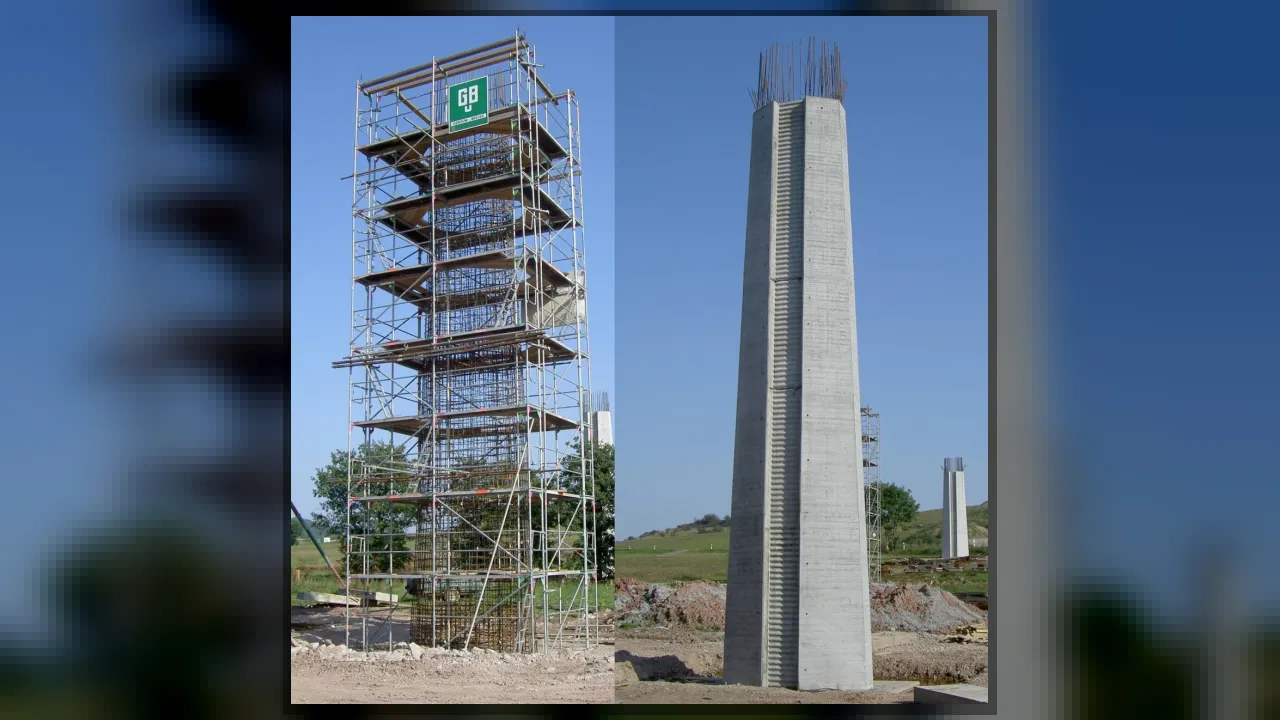
Some skyscrapers made with reinforced concrete are over 100 stories tall!
✨ Word Sparks (Grade 2 Glossary)
Tap 🔊 to hear
reinforced
Made stronger with something inside
skeleton
The hard parts inside a body
load
How much weight something holds
🪝
Have you ever wondered how bridges hold up so many cars?
1
Mixing for Strength
Builders pour wet concrete over metal bars, and then it dries hard. The metal bars inside are called steel, and they help the concrete stay strong. This special mix is used to build things that need to last. It is much stronger than plain concrete alone.
2
Building Tall and Wide
concrete is used for bridges, tall buildings, and even playgrounds. The steel bars inside act like , giving the concrete extra power. This helps buildings stand up to strong winds and heavy . People can walk, drive, and play safely on it.
3
Hidden Power
You can’t see the steel bars, but they are working hard. They stop cracks from spreading and keep the concrete from breaking. That’s why concrete is used all over the world. It helps us build amazing things every day.
The world’s longest reinforced concrete bridge stretches over 34 kilometers in China!
✨ Word Sparks (Grade 3 Glossary)
Tap 🔊 to hear
rebar
Steel bars inside concrete
composite
Made from two or more materials
blueprint
A drawing that shows how to build
🪝
Imagine you could see inside a giant bridge—what would you find hidden there?
1
A Secret Inside the Stone
When concrete is poured, workers place steel rods or mesh inside the wet mix. These steel pieces are called , and they give the concrete extra strength. Once the concrete dries, it becomes hard like stone, but the steel inside keeps it from cracking. This combination is called reinforced concrete.
2
Why Not Just Concrete?
Concrete is strong when you push on it, but it can crack if you pull or bend it. Steel is great at handling bending and stretching, so putting steel inside concrete helps both materials work together. This teamwork is called construction. It lets us build much bigger and safer structures.
3
Building Wonders
Reinforced concrete is used to build skyscrapers, long bridges, tunnels, and even stadiums. The steel bars hidden inside help these buildings stand up to heavy loads, strong winds, and even earthquakes. Engineers use to plan where every steel bar should go. This careful design keeps people safe.
4
A World-Changing Idea
Joseph Monier, a French gardener, first used reinforced concrete for flower pots in the 1860s. Soon, engineers realized it could change how cities were built. Today, almost every city in the world uses reinforced concrete for roads, homes, and schools. It truly changed the way we build.
2. Who first used reinforced concrete for flower pots?
🤯 Mind-Blowing Fact • Grade 4
Some reinforced concrete dams are so strong they can hold back millions of tons of water for decades!
✨ Word Sparks (Grade 4 Glossary)
Tap 🔊 to hear
compression
Pushing or squishing force
tension
Pulling or stretching force
reinforcement
Making something stronger with support
🪝
What if you could design a building that stands for a hundred years—how would you make it so strong?
1
A Powerful Partnership
Reinforced concrete combines two materials—concrete and steel—to create something much stronger than either alone. Concrete is excellent at withstanding , which means it resists being squished or pushed together. Steel, on the other hand, is very good at handling , which means it resists being stretched or pulled apart. By placing steel bars, called rebar, inside wet concrete, engineers create a composite material that can handle both forces. This partnership allows us to build structures that are tall, wide, and long-lasting.
2
Engineering the Invisible
Before concrete hardens, workers carefully arrange steel rods or mesh in a pattern designed by engineers. The steel must be placed exactly where the concrete will face the most , such as the bottom of a bridge or the middle of a floor. When the concrete dries, it locks the steel in place, making the whole structure much stronger. This process is called , and it’s a key part of modern construction.
3
Changing Cities and Skylines
The invention of reinforced concrete in the 19th century made it possible to build skyscrapers, massive dams, tunnels, and even earthquake-resistant buildings. Cities around the world use reinforced concrete for roads, schools, and hospitals because it lasts a long time and can be shaped into almost any form. The flexibility and strength of this material have transformed how people live and work in urban environments.
4
A Lasting Legacy
French inventors like Joseph Monier and François Coignet were among the first to patent reinforced concrete methods. Their ideas spread quickly, and soon, engineers everywhere were using this technology to solve big building challenges. Today, reinforced concrete is found in nearly every country, supporting the world’s tallest towers and longest bridges. Its invention truly changed the course of architecture and engineering.
1. Why is steel placed inside concrete structures?
2. Who helped invent and patent reinforced concrete?
🤯 Mind-Blowing Fact • Grade 5
Some reinforced concrete bridges are designed to last more than 120 years—even through earthquakes and floods!
✨ Word Sparks (Grade 5 Glossary)
Tap 🔊 to hear
compressive strength
How much squishing force something can take
prestressed
Steel is stretched before concrete hardens
corrosion
When metal gets weak from rust
🪝
Imagine the clang of metal and the splash of wet cement—what secrets hide inside a city’s tallest tower?
1
The Science of Strength: Concrete Meets Steel
Picture a team where one member is strong at squishing and the other is a champion at stretching. That’s how reinforced concrete works—concrete handles the heavy squishing, called compression, while steel rods, known as rebar, take care of pulling and bending, or tension. When engineers combine these two, they create a material that can support thousands of tons and reach incredible heights. This teamwork is why reinforced concrete is used in everything from bridges to skyscrapers.
2
Engineering the Invisible Framework
Before any concrete is poured, workers weave a skeleton of ribbed steel rebar into the shape of the future building or bridge. These ribs help the steel grip tightly to the concrete once it hardens, so the two materials move as one. Engineers carefully calculate where to place each rod, making sure it’s strongest where tension will pull the hardest, like the bottom of a beam or the middle of a floor. This invisible framework is what keeps giant structures safe even during earthquakes.
3
From 19th Century Innovation to Global Standard
In the 1850s, François Coignet and Joseph Monier experimented with adding iron and steel to concrete, first for garden tubs and beams. Their inventions quickly spread, and soon reinforced concrete became the backbone of modern cities. By the early 1900s, engineers were using it to build domes, tunnels, and bridges that had never been possible before. Today, reinforced concrete supports schools, hospitals, highways, and the tallest towers on earth.
4
Transforming Skylines and Resisting Nature
The beauty of reinforced concrete is its flexibility—it can be shaped into twisting towers, sweeping arches, or sturdy dams. Engineers use and post-tensioned concrete methods, stretching the steel before or after the concrete sets, to make buildings even stronger. These techniques help structures survive powerful earthquakes and heavy storms, protecting people and property all around the world.
5
A Material for the Future
Reinforced concrete is still evolving, with new types of rebar that resist rust and smart sensors that monitor cracks and stress. Some bridges built today can last over a century, thanks to these advances. As cities grow and change, reinforced concrete will keep shaping our world, making it safer and more amazing for generations to come.