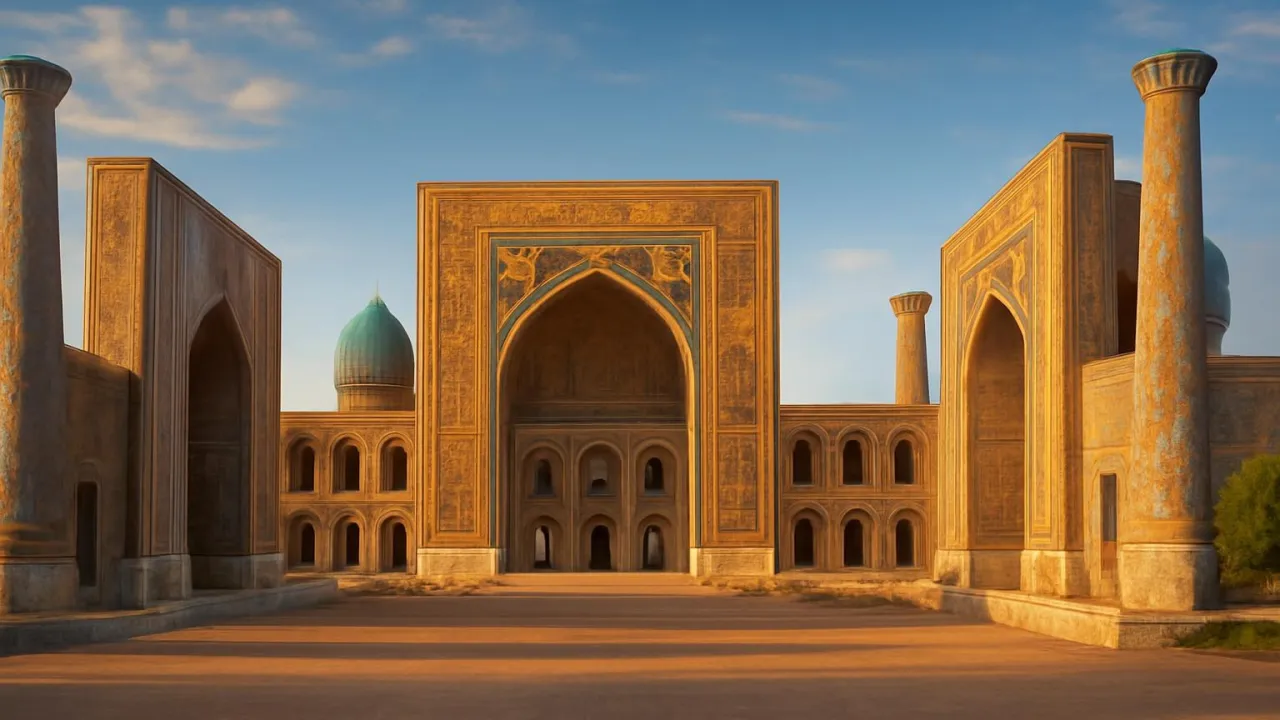
2. How many big buildings stand around the square?
🤯 Mind-Blowing Fact • Grade 2
The Registan’s largest arch is taller than a school bus standing up!
✨ Word Sparks (Grade 2 Glossary)
Tap 🔊 to hear
madrasah
A special school for learning
minaret
A tall tower on a building
pattern
A design that repeats again and again
🪝
Can you imagine standing where traders and kings once met?
1
A Sparkling Meeting Place
The Registan is a bright, open square in Samarkand. Its walls are covered with blue and gold tiles. People from many lands once gathered here to trade and talk. Today, visitors come to see its beauty.
2
Three Amazing Buildings
Three tall , or schools, stand around the square. Each building has a giant arched doorway and towers called . The on the walls look like stars and flowers. Builders used special tiles to make the colors shine.
3
A Place Full of Life
The Registan once echoed with music, voices, and laughter. Today, you might hear birds singing above the blue roofs. People take photos and explore the arches. It is a place where history feels alive.
2. What shapes can you see on the Registan’s walls?
🤯 Mind-Blowing Fact • Grade 3
Some Registan tiles were made with real gold powder mixed into the glaze!
✨ Word Sparks (Grade 3 Glossary)
Tap 🔊 to hear
geometric
Made of shapes like triangles and stars
mosaic
A picture made from many small pieces
vibrate
To shake or move back and forth quickly
🪝
What would it feel like to stand where ancient voices once echoed?
1
A Center for the Silk Road
Long ago, the Registan was the lively heart of Samarkand. Merchants, scholars, and travelers met here to share stories and goods. The square’s name means 'sandy place' in Persian. Its grand design welcomed people from across Asia.
2
Majestic Madrasahs and Towers
Three huge madrasahs surround the square, each with tall minarets and wide arches. Builders used glazed tiles to create blue, gold, and turquoise patterns. The arches are shaped for strength and beauty. These buildings taught math, science, and poetry.
3
Dazzling Tiles and Patterns
The Registan’s walls sparkle with patterns and calligraphy. Craftsmen used tiles to form stars, flowers, and swirling lines. The tiles reflect sunlight, making the square glow at sunrise and sunset. This style is called Timurid architecture.
4
A Living Monument
Today, the Registan is a UNESCO World Heritage site. Visitors hear music and laughter echoing under the arches. The square’s design helps sound , making it perfect for festivals. The Registan stands as a monument to learning and art.
1. Why do the Registan’s arches help music sound louder?
2. What subjects did students learn at the Registan’s schools?
🤯 Mind-Blowing Fact • Grade 4
The Registan’s largest arch rises over 115 feet (35 meters) above the square!
✨ Word Sparks (Grade 4 Glossary)
Tap 🔊 to hear
acoustics
How sound moves and echoes in a space
faience
Colorful, shiny tiles made from clay
monument
A building made to remember something important
🪝
Can you picture sunlight glinting off a sea of golden tiles as voices echo beneath ancient arches?
1
The Heart of Timurid Samarkand
For centuries, the Registan was the bustling center of Samarkand, a city at the crossroads of the Silk Road. Merchants, poets, and travelers from many lands gathered here to trade, learn, and celebrate. The word 'Registan' means 'sandy place,' but its square dazzles with color and life. Its importance made Samarkand famous across Asia and beyond.
2
Engineering Marvels: Madrasahs and Minarets
Three grand madrasahs—Ulugh Beg, Sher-Dor, and Tilya-Kori—frame the square with soaring arches and slender minarets. Builders used baked bricks and special glazed tiles to create intricate geometric and floral patterns. The arches are not just beautiful; their curved design distributes weight, making the structures stable and strong. Minarets once called students to lessons and announced important events.
3
Artistry in Every Tile
The Registan’s walls shimmer with blue, turquoise, and gold mosaics, crafted by skilled artisans. Craftsmen used techniques like 'mosaic ' to set each tiny tile in place, forming calligraphy and swirling designs. Some tiles were glazed with gold powder, reflecting sunlight in dazzling patterns. These decorations are a hallmark of Timurid architecture, blending art and science.
4
A Monument to Learning and Culture
As a UNESCO World Heritage site, the Registan is protected for future generations to explore and enjoy. Its open square was designed for gatherings, with that amplify music and voices during festivals. The Registan’s influence can be seen in buildings across Central Asia. Today, it stands as a to the power of learning, creativity, and cultural exchange.
1. How do the Registan’s arches help the buildings stay strong?
2. What makes the Registan’s tiles shine in the sunlight?
🤯 Mind-Blowing Fact • Grade 5
The Registan’s Ulugh Beg Madrasah was once led by a famous astronomer who built one of the world’s largest observatories!
✨ Word Sparks (Grade 5 Glossary)
Tap 🔊 to hear
tessellation
A pattern made by fitting shapes together with no gaps
restoration
Fixing or rebuilding something to make it strong again
observatory
A special building for studying the stars and planets
🪝
What secrets of math, science, and art are hidden in the shimmering blue and gold of the Registan’s ancient walls?
1
A Crossroads of Civilization
Imagine stepping into the Registan’s vast plaza as the morning sun strikes its golden domes and blue mosaics. For over six centuries, this square was the vibrant heart of Samarkand, a city famed along the Silk Road for its trade, scholarship, and culture. The Registan’s name means 'sandy place,' but its surface is paved with stone and surrounded by three monumental madrasahs. Here, merchants, scientists, and poets from Persia, India, China, and Europe once gathered, making it a true crossroads of civilization.
2
Architectural Brilliance: Arches, Domes, and Minarets
The Registan’s three madrasahs—Ulugh Beg (1417–1420), Sher-Dor (1619–1636), and Tilya-Kori (1646–1660)—showcase the engineering genius of the Timurid era. Builders used baked bricks, glazed tiles, and wooden beams to construct arches over 115 feet (35 meters) high. The pointed arches and ribbed domes distribute weight efficiently, preventing collapse even during earthquakes. Slender minarets, some leaning due to centuries of settling, once served as both watchtowers and platforms for the call to prayer.
3
Mathematics and Geometry in Design
Every surface of the Registan is covered with intricate geometric patterns, calligraphy, and floral mosaics. Artisans used advanced mathematical principles—like symmetry, , and proportion—to plan and execute these designs. The use of 'mosaic faience' allowed for precise fitting of thousands of colored tiles, some containing real gold or lapis lazuli powder. These patterns not only dazzled the eye but also symbolized the universe’s order and the pursuit of knowledge.
4
Acoustics, Festivals, and Cultural Legacy
The Registan’s open square was engineered with acoustics in mind, allowing music and voices to resonate clearly during public gatherings and festivals. The madrasahs served as centers for mathematics, astronomy, and poetry, attracting scholars from across the Islamic world. Today, the Registan is a UNESCO World Heritage site, hosting concerts and celebrations that echo its ancient purpose. Its influence can be seen in architectural styles from Iran to India and beyond.
5
Preservation and Global Significance
Centuries of earthquakes, erosion, and war threatened the Registan’s survival, but careful has preserved its splendor for future generations. Modern engineers use laser scanning and non-invasive techniques to study and protect its delicate tiles and structures. As a symbol of cultural exchange and scientific achievement, the Registan inspires architects, artists, and students worldwide. Its story reminds us how art, science, and history connect people across time and place.