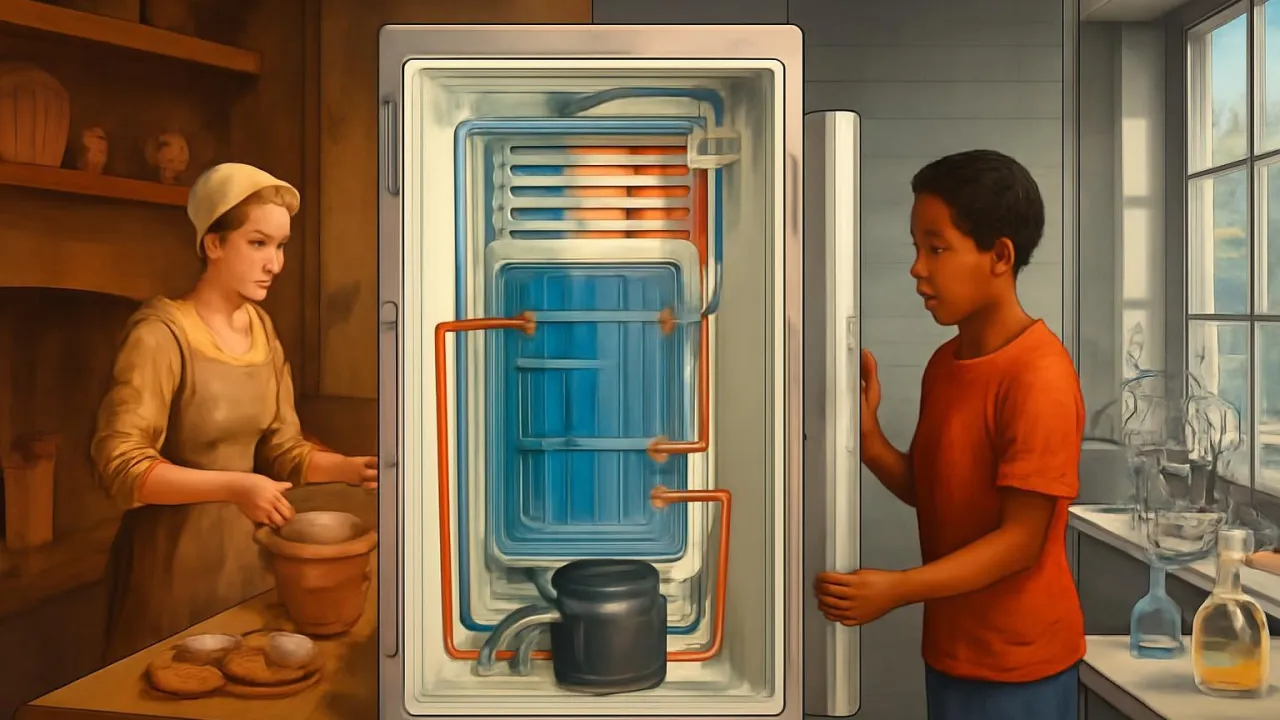
Have you ever heard the gentle hum from your fridge?
1
The Chilly Helper
When you open the fridge, cool air swirls around your food. The shelves hold milk, fruit, and leftovers, all kept fresh and safe. Families use fridges every day, so food does not quickly.
2
How Does It Get Cold?
A refrigerator uses a special pipe filled with cold to chill the inside. This gas moves in a loop, taking heat away from food and sending it outside. The door tight, so the cold air stays trapped inside.
3
A Big Change for Homes
Before fridges, people used ice boxes or cellars to keep things cool. The refrigerator made it easier to store food for days or even weeks. Now, almost every home in the world has one.
Modern refrigerators can keep food safe for up to a week or more!
✨ Word Sparks (Grade 3 Glossary)
Tap 🔊 to hear
refrigerant
A special liquid that gets cold
compressor
A machine that pushes the gas
evaporate
To turn from liquid into gas
🪝
What if you could trap winter inside a box all year?
1
The Magic of Cold Storage
A refrigerator feels like a box of chilly air, humming quietly in the kitchen. When you open the door, you might notice a rush of coolness and neatly stacked food. This invention lets families store milk, vegetables, and leftovers for days without spoiling. People everywhere rely on refrigerators to keep their food safe and tasty.
2
The Science Inside
Refrigerators use a process called mechanical refrigeration, which depends on the principle of heat transfer. A special fluid called flows through coils, changing from a liquid to a gas and back. As the refrigerant , it absorbs heat from inside the fridge, making the air cold. The and condenser then push the heat outside, keeping the inside cool.
3
From Ice Boxes to Modern Marvels
Before electric fridges, people used ice boxes filled with big blocks of ice. These early boxes slowed down spoilage but needed new ice often. In 1834, Jacob Perkins built the first working refrigerator using vapor compression. Over time, refrigerators became safer, more efficient, and common in homes around the world.
4
A World-Changing Invention
Refrigerators help prevent foodborne illness by slowing bacteria growth. They make it possible to store fresh food, medicine, and even scientific samples for longer periods. Today, refrigerators come in many sizes and even have smart features. This invention truly changed how people live and eat.
2. Why did people need to replace ice in ice boxes often?
🤯 Mind-Blowing Fact • Grade 4
Refrigerators use the same science as air conditioners and even some spacecraft cooling systems!
✨ Word Sparks (Grade 4 Glossary)
Tap 🔊 to hear
thermodynamics
The science of heat and energy
insulation
Material that keeps cold air inside
perishable
Food that spoils quickly
🪝
Imagine a world where keeping food fresh was a daily struggle—what changed everything?
1
Refrigerators: The Science of Staying Cool
When you open a refrigerator, you’re not just seeing shelves of food—you’re witnessing the power of at work. This invention uses a sealed system filled with refrigerant, which absorbs heat from inside and releases it outside. The compressor squeezes the refrigerant, causing it to heat up, then the condenser cools it down so it can absorb more heat. This cycle repeats, keeping the inside cold and food safe.
2
From Ancient Ice to Modern Machines
Long before electric refrigerators, people stored food in cellars, ice houses, or wooden ice boxes packed with natural ice. In 1834, Jacob Perkins built the first vapor-compression refrigerator, using mechanical parts to move heat. By the early 1900s, electric fridges appeared in homes, making food storage safer and much more convenient.
3
How Refrigerators Changed the World
The refrigerator revolutionized kitchens by making it possible to store foods for days or weeks. This helped reduce food waste and protected families from illnesses caused by spoiled food. Refrigeration also made it possible to transport fresh produce and medicine across long distances, changing how people eat and stay healthy.
4
Engineering for the Future
Today’s refrigerators use advanced , energy-saving compressors, and even smart sensors to keep food fresh. Engineers continue to improve designs to use less electricity and safer refrigerants that don’t harm the environment. The refrigerator’s story is one of science, invention, and global impact.
1. What is the main job of the compressor in a fridge?
2. Why did refrigerators help reduce food waste?
🤯 Mind-Blowing Fact • Grade 5
The largest walk-in refrigerators can keep entire warehouses of food at below-freezing temperatures for months!
✨ Word Sparks (Grade 5 Glossary)
Tap 🔊 to hear
condenser
Coils that release heat outside the fridge
expansion valve
A part that cools refrigerant quickly
magnetic refrigeration
Cooling using magnets, not gases
🪝
What scientific secrets allow a refrigerator to fight time and keep your food safe?
1
Refrigeration: Harnessing Thermodynamics for Everyday Life
When you hear the gentle hum of a refrigerator, you’re witnessing the marvel of thermodynamics in action. Mechanical refrigerators use a closed-loop system where a refrigerant circulates through coils, absorbing heat from the inside and releasing it outside. The compressor increases the refrigerant’s pressure, causing it to heat up as it moves through the coils at the back. As the refrigerant cools and condenses, it flows through an , rapidly dropping in pressure and temperature, which allows it to absorb more heat inside the fridge.
2
From Ice Harvesting to Modern Engineering
Before mechanical refrigeration, people relied on ice harvested from lakes and rivers, storing it in insulated ice houses or wooden ice boxes. The first vapor-compression refrigerator, patented by Jacob Perkins in 1834, used ether as a refrigerant and a hand-cranked compressor. By the 1920s, safer electric refrigerators using Freon became common in households, revolutionizing food storage and safety. Today, environmental concerns have led engineers to develop new refrigerants with lower global warming potential.
3
Global Impact: Freshness, Health, and Innovation
Refrigerators have transformed societies by making it possible to store perishable foods, vaccines, and medicines for days or weeks. This has reduced foodborne illnesses and food waste, while also enabling long-distance transportation of fresh produce. In developing countries, solar-powered refrigerators are helping remote communities store life-saving vaccines and nutritious food. The refrigerator is a key player in global health and nutrition.
4
Engineering Challenges and Energy Efficiency
Modern refrigerators use polyurethane foam insulation, variable-speed compressors, and digital sensors to maintain precise temperatures and save energy. Engineers face challenges like reducing electricity use and finding refrigerants that do not harm the ozone layer or contribute to climate change. Some advanced models use inverter technology, which adjusts compressor speed to match cooling needs and further reduces energy consumption.
5
The Future of Refrigeration
Scientists are exploring , which uses materials that heat up and cool down in magnetic fields, eliminating harmful gases entirely. Refrigerators are also becoming smarter, with Wi-Fi connectivity, internal cameras, and automatic temperature controls. As technology advances, the refrigerator continues to evolve, keeping our food safe, our planet cleaner, and our lives more convenient.