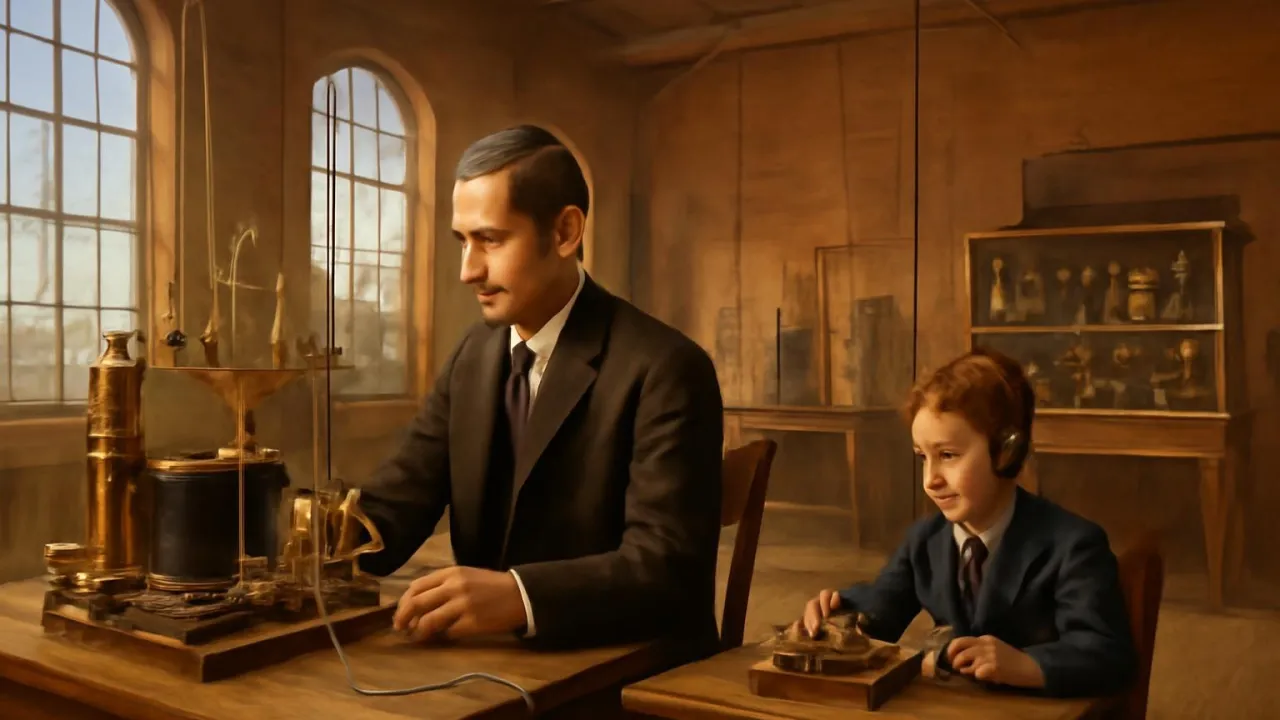
The first radio SOS call saved over 700 people on the Titanic!
✨ Word Sparks (Grade 2 Glossary)
Tap 🔊 to hear
waves
Invisible energy moving through air
Morse code
Dots and dashes for letters
wireless
No wires needed to send signals
🪝
What if you could send a message without any wires at all?
1
Waves in the Air
People used to send messages with wires, but radio telegraphy used . These waves traveled through the air, carrying beeps from place to place. The beeps made a special code called . Each beep and pause meant a letter or word.
2
Tall Antennas
Tall antennas helped send the far away, even across the sea. People listened with special machines and wrote down the messages. This made it possible to talk to people in other countries quickly.
3
A Life-Saving Idea
Radio telegraphy was very important for ships and trains. If there was trouble, they could send a message for help. Many lives were saved because of fast messages.
Marconi’s first wireless message crossed the Atlantic Ocean in 1901!
✨ Word Sparks (Grade 3 Glossary)
Tap 🔊 to hear
vibration
Fast shaking that carries sound or energy
receiver
A machine that catches signals
prototype
A first test version of an invention
🪝
Imagine hearing a secret message in beeps from across the ocean—how did it get there?
1
The Magic of Wireless Beeps
Before radio telegraphy, messages traveled slowly along wires. Marconi’s invention sent coded beeps, called Morse code, through invisible radio waves. These waves vibrated through the air, carrying information across great distances. Suddenly, messages could leap over mountains and seas.
2
How Did It Work?
A spark-gap transmitter created electric sparks that made radio waves. The waves traveled from a tall antenna, spreading out in all directions. A antenna picked up the waves and turned them back into beeps. Operators listened and wrote down the code to read the message.
3
Changing the World
Radio telegraphy made it possible to send news and warnings quickly. Ships in trouble could call for help, and rescue teams would hear the SOS. People could share weather reports and important news faster than ever before. The world became more connected and safe.
4
A Code for Everyone
Morse code used short and long beeps called dots and dashes. Each letter had its own pattern, so anyone could learn to send messages. Even today, Morse code is used in emergencies when other systems fail.
1. What did Marconi’s invention send through the air?
2. Why was Morse code important for radio telegraphy?
🤯 Mind-Blowing Fact • Grade 4
Marconi’s radio telegraphy helped rescue Titanic survivors by sending a wireless SOS across the Atlantic.
✨ Word Sparks (Grade 4 Glossary)
Tap 🔊 to hear
electromagnetic
Energy that travels as invisible waves
transmitter
A device that sends out signals
resonance
When vibrations match and grow stronger
🪝
What if you could send a message across the ocean in just seconds, using invisible waves?
1
A New Age of Communication
Before radio telegraphy, sending messages over long distances required miles of wires or slow ships. In the late 1800s, Guglielmo Marconi discovered how to send Morse code messages using waves, which travel invisibly through the air. His spark-gap produced rapid electrical discharges that created these waves. This breakthrough meant people could communicate instantly, even across oceans and mountains.
2
How Radio Telegraphy Works
A uses electric current to create vibrations called radio waves, which travel outward from a tall antenna. These waves carry coded signals, such as the dots and dashes of Morse code, to distant receivers. When the waves reach another antenna, a receiver turns them back into sounds that operators can decode. This process allowed messages to travel thousands of miles without any physical connection.
3
Transforming Safety and News
Radio telegraphy became a vital tool for ships, trains, and even armies. Ships in distress could send an SOS signal, which rescuers would hear and respond to quickly. News agencies used radio to share information about weather, disasters, and world events in real time. This invention made the world feel smaller and safer for everyone.
4
A Lasting Legacy
Marconi’s invention won him the Nobel Prize and inspired many other breakthroughs. Radio telegraphy led to the development of voice radio, television, and even the wireless internet we use today. Its impact can still be felt whenever we use wireless technology to connect with people far away.
2. Which invention did radio telegraphy help inspire?
🤯 Mind-Blowing Fact • Grade 5
The first transatlantic radio message in 1901 traveled over 2,000 miles from England to Canada—without a single wire!
✨ Word Sparks (Grade 5 Glossary)
Tap 🔊 to hear
electromagnetic waves
Invisible energy that travels at light speed
frequency
How often waves repeat in a second
amplitude modulation
Changing wave height to send sounds
🪝
Close your eyes and imagine a stormy night at sea—how could a ship send a silent call for help across the world?
1
From Wires to Wireless: A Communication Revolution
In the late 19th century, the world relied on telegraph wires stretched across continents and oceans to send messages. Guglielmo Marconi’s groundbreaking work in radio telegraphy replaced these wires with , making it possible to transmit Morse code signals wirelessly. His experiments began in Italy and quickly expanded, leading to the first successful transatlantic wireless message in 1901. This invention marked the dawn of global wireless communication, forever changing how people shared news, warnings, and discoveries.
2
Engineering the Invisible: How Radio Telegraphy Works
Radio telegraphy uses a spark-gap transmitter to generate bursts of electric current, which create . These waves are broadcast from a tall antenna, radiating outward at the speed of light. A distant receiver antenna detects the waves, converting them back into audible clicks or beeps representing Morse code. The principle relies on resonance and tuning, ensuring the transmitter and receiver are set to the same for clear signal transmission over hundreds or even thousands of kilometers.
3
Quantitative Impact: Distances and Life-Saving Reach
Marconi’s early radio stations could transmit signals over 2,000 miles, a feat previously thought impossible. During the Titanic disaster in 1912, the ship’s radio operator sent an SOS signal that was received over 500 miles away, helping rescue more than 700 survivors. Radio telegraphy became essential for maritime safety, military coordination, and rapid news distribution, shrinking the world and saving countless lives.
4
From Morse to Modern Wireless
The success of radio telegraphy inspired further innovations, including (AM) for voice radio and, eventually, television and digital wireless communication. The basic principles of electromagnetic wave transmission still power today’s Wi-Fi, Bluetooth, and satellite signals. Marconi’s invention not only transformed how we communicate but also laid the foundation for the interconnected world we live in now.
5
A Legacy That Echoes On
Radio telegraphy received the Nobel Prize in Physics in 1909, recognizing its profound scientific and societal impact. The invention demonstrated the power of invisible forces——to unite people across continents. Even today, Morse code is taught to radio operators as a backup for emergencies, and the concept of wireless signaling continues to evolve with every new technology. Marconi’s vision of a world connected without wires remains one of humanity’s greatest engineering achievements.