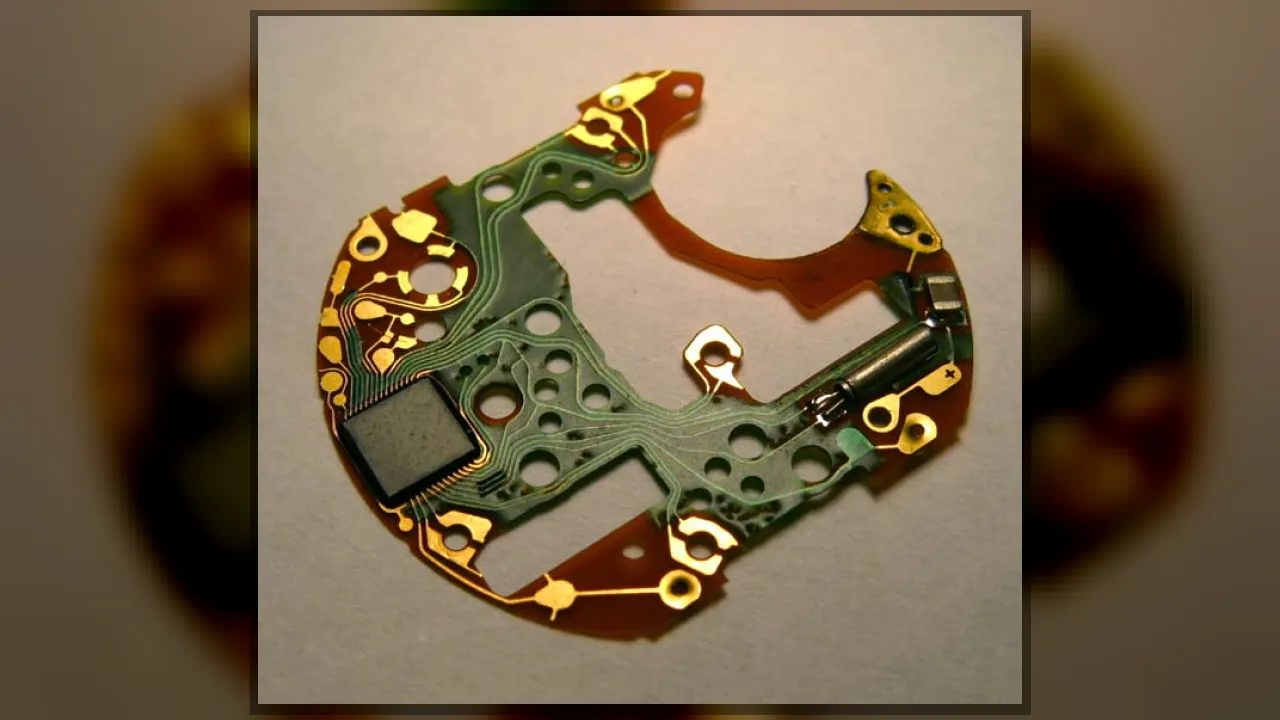
1. What makes the tiny quartz crystal inside a wristwatch wiggle?
2. What counts the crystal's fast wiggles to move the second hand once per second?
🤯 Mind-Blowing Fact • Grade 2
The very first Seiko quartz wristwatch in 1969 had a solid gold case and cost as much as a brand-new family sedan!
✨ Word Sparks (Grade 2 Glossary)
Tap 🔊 to hear
tuning fork
Two-pronged tool vibrating at one exact pitch
crystal
Solid mineral with neatly ordered atoms
pulse
A short, regular burst of electricity
🪝
Why is the crystal inside a wristwatch carved into the exact shape of a miniature musical tuning fork?
1
A Silent Song on Your Arm
Tap a metal in music class, and its two prongs hum at one steady pitch! Hidden inside almost every modern watch sits a tuning fork thinner than an eyelash, humming silently day and night.
2
Christmas Day Surprise in Tokyo
Early clocks filled tall metal cabinets in laboratories. After ten years of shrinking parts, engineers at Seiko in Japan unveiled the Astron on Christmas Day in 1969—the world's first quartz watch you could wear!
3
Counting to 32,768
Electricity from a button battery makes the prongs flex 32,768 times per second. A microchip counts those beats and sends one crisp electric each second to a tiny motor or digital screen.
1. How big were the earliest quartz clocks before engineers shrank them onto a wrist?
2. In what city was the world's first commercial quartz wristwatch unveiled in December 1969?
🤯 Mind-Blowing Fact • Grade 3
32,768 oscillations per second sits just above the 20,000-cycle limit of human hearing—otherwise you would hear your wristwatch whistling a high-pitched squeal!
✨ Word Sparks (Grade 3 Glossary)
Tap 🔊 to hear
piezoelectric
Making electricity when squeezed, or flexing with voltage
binary
Counting or dividing using powers of two
stepping motor
Tiny motor turning in exact click-like steps
🪝
Why did watchmakers pick the strange-looking number 32,768 instead of a round number like 10,000?
1
Squeeze a Crystal, Make a Spark!
In 1880, French brothers Jacques and Pierre Curie discovered a wild trick in nature: squeeze a quartz crystal and it makes a tiny spark of electricity—or zap it with electricity and the crystal flexes! Scientists call this piezoelectricity.
2
The Race to Shrink a Giant
Bell Labs built the first room-sized quartz clock in 1927, and soon Swiss and Japanese teams raced to fit one onto a wrist. Led by Tsuneya Nakamura, Seiko solved the power puzzle with a tiny and launched the Astron watch in 1969.
3
The Secret of Dividing by Two
Laser-trimmed into a four-millimeter tuning fork, the watch crystal vibrates 32,768 times per second. Why that exact number? Start with 32,768 and divide by 2 fifteen times in a row—16,384... 8,192... all the way down—and you land on 1! Simple flip-flop circuits do that halving effortlessly.
4
Precision for Everyone
Soon five-dollar watches kept better time than luxury mechanical watches costing thousands, putting dependable schedules on billions of wrists.
1. Why is 32,768 vibrations per second such a handy number for a tiny watch microchip?
2. Why can't your ears hear the quartz tuning fork vibrating 32,768 times a second?
🤯 Mind-Blowing Fact • Grade 4
Watchmakers call the 1970s 'The Quartz Revolution' because affordable electronic watches dropped errors from minutes per month down to just fifteen seconds per month overnight!
✨ Word Sparks (Grade 4 Glossary)
Tap 🔊 to hear
hertz
Unit measuring one cycle per second
synthetic
Lab-grown with pure structure matching nature
analog
Showing time with rotating hands on dial
🪝
How can you tell at a glance whether a watch uses coiled mechanical springs or a vibrating quartz crystal?
1
Watch the Second Hand Move
Glance closely at two watches side by side! A traditional spring-wound watch sweeps its second hand forward in five to eight tiny flutters each second, whereas a quartz watch marches in crisp, decisive one-second hops—tick... pause... tick!
2
Curie Physics Meets Microelectronics
That signature one-second beat began in 1880 when brothers Pierre and Jacques Curie discovered piezoelectricity in silicon-dioxide quartz crystals. In 1927, Warren Marrison and J.W. Horton at Bell Telephone Laboratories built the first vacuum-tube quartz clock, accurate enough to reveal tiny wobbles in Earth's rotation! Shrinking that cabinet into a 30-millimeter watch case took four decades until Seiko's Tsuneya Nakamura and his team in Suwa, Japan, introduced the Astron 35SQ on December 25, 1969, just months ahead of Switzerland's Beta 21 consortium.
3
Inside the Sealed Capsule
Inside a vacuum-sealed metal cylinder barely larger than a grain of rice sits a quartz crystal laser-trimmed into a tuning fork. Voltage from a silver-oxide cell flexes the prongs; as they spring back, they generate a tiny voltage that feeds a CMOS oscillator circuit locked at 32,768 . Fifteen binary divider stages step that frequency down to 1 hertz, driving either a liquid-crystal display or a Lavet-type magnetic stepping motor.
4
Beyond Wrists Into Every Computer
Because quartz drifts less than half a second per day, the exact same miniature crystal oscillators now pace almost every smartphone, microwave timer, car computer, and game console on Earth.
1. How does a quartz watch's second hand usually move compared to a traditional mechanical watch?
2. Why is the tiny quartz tuning fork sealed inside an airless vacuum capsule?
🤯 Mind-Blowing Fact • Grade 5
A quartz watch is actually slightly more accurate when worn on your wrist than sitting cold in a drawer, because engineers cut the crystal angle specifically for human skin warmth around 28 degrees Celsius!
✨ Word Sparks (Grade 5 Glossary)
Tap 🔊 to hear
photolithography
Etching microscopic shapes using patterned ultraviolet light
autoclave
High-pressure heated vessel for growing pure crystals
ultrasonic
Vibrating at frequencies above human hearing range
🪝
How did engineers tune a four-millimeter sliver of lab-grown silicon dioxide so body warmth on your wrist makes it most accurate?
1
Precision Carved From Rock Crystal
For three centuries, horologists battled gravity, friction, and mainspring torque to coax accuracy from balance wheels oscillating at three to five hertz. Raising an oscillator's frequency thousands-fold while slashing friction nearly to zero transformed timekeeping forever—replacing steel hairsprings with the atomic lattice of crystalline silicon dioxide ($SiO_2$).
2
From Bell Labs Racks to Project 59A
Following Jacques and Pierre Curie's 1880 discovery of the direct and converse piezoelectric effects, Bell Labs engineers Warren Marrison and J.W. Horton constructed the first room-sized quartz crystal clock in 1927. Determined to miniaturize quartz timekeeping for the 1964 Tokyo Olympics and beyond, Seiko's Suwa Seikosha division launched 'Project 59A' under Tsuneya Nakamura. Overcoming battery drain with a hand-soldered hybrid CMOS divider and an ultra-efficient open-stator Lavet stepping motor, Seiko debuted the 18-karat-gold Astron 35SQ in December 1969, while Switzerland's Centre Electronique Horloger unveiled its Beta 21 movement months later.
3
Photolithography, $2^{15}$ Hz, and Thermal Tuning
Modern watch crystals begin inside high-pressure hydrothermal that grow flawless synthetic quartz bars. Wafer saws slice the mineral at a precise crystallographic angle so its parabolic 'turnover temperature' sits right around 25 to 28 degrees Celsius—the exact warmth of a watch worn on human skin! etches microscopic tuning forks plated with gold electrodes, and pulsed laser beams vaporize nanograms of gold from the prong tips until resonance hits exactly 32,768 hertz ($2^{15}$ Hz).
4
Cascading Flip-Flops and Micro-Power Design
Choosing $2^{15}$ hertz keeps vibrations safely (>20 kHz) while minimizing capacitive power draw, allowing fifteen sequential T-type flip-flop transistors to halve the signal down to a 1-hertz square wave on less than one microampere of current. High-precision thermocompensated (TCXO) movements sample wrist temperature digitally and trim divider pulses to achieve accuracy within five seconds per year!
5
Heartbeat of the Digital Age
Seiko chose to open its core quartz patents to the world, catalyzing mass production of billions of 32.768 kHz real-time clock modules that today keep time inside computers, satellites, medical pacemakers, and smartphones.