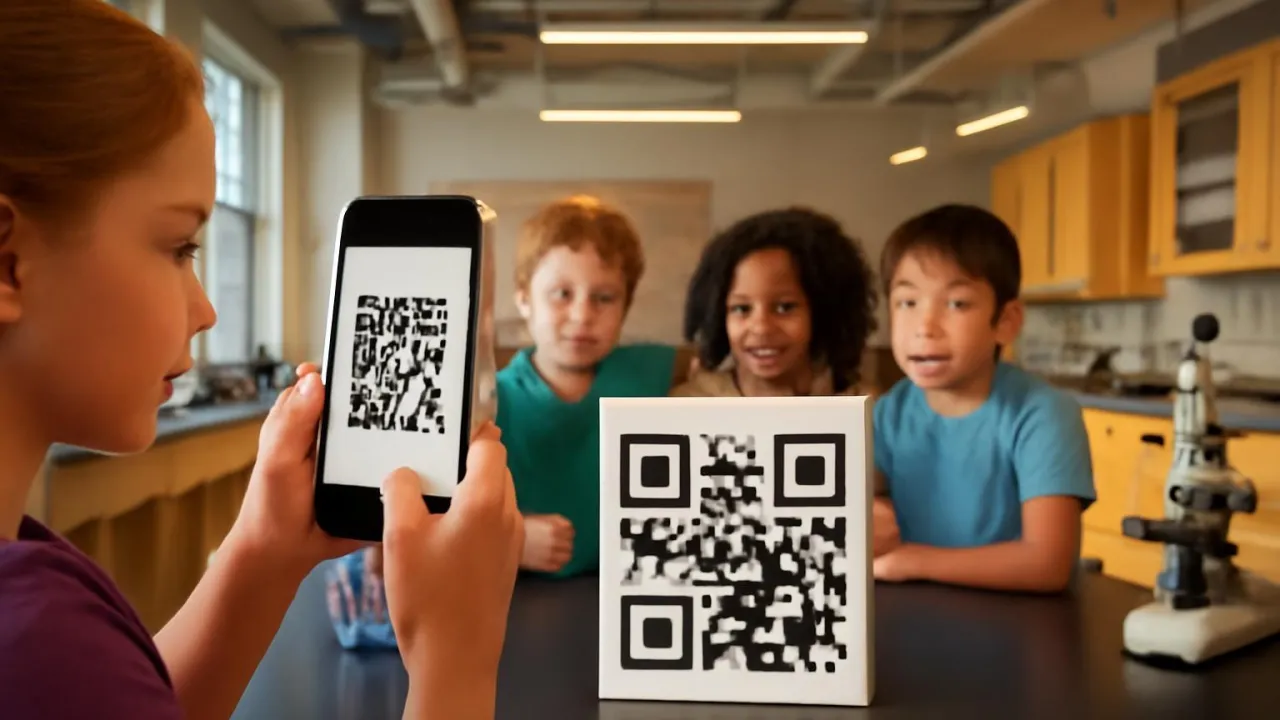
QR stands for 'Quick Response' because it gives answers so fast!
✨ Word Sparks (Grade 2 Glossary)
Tap 🔊 to hear
pattern
A design made by shapes or lines
information
Facts or details you can learn
website
A place you visit on the internet
🪝
Have you ever seen a square that unlocks a secret with a phone?
1
A Code Full of Squares
QR codes are made of tiny black and white squares. Each is special and stores inside. You might see them on posters, snacks, or even your library card.
2
How Does It Work?
When you use a phone camera to scan the code, it reads the quickly. The phone can open a , show a video, or share a message in just seconds.
3
Why Do People Use Them?
QR codes help people get fast and easily. They are used in stores, at museums, and even on homework sheets. Next time you see one, try scanning it!
QR codes can still work even if up to 30% of the pattern is damaged!
✨ Word Sparks (Grade 3 Glossary)
Tap 🔊 to hear
pattern
A design made by repeating shapes
machine vision
When computers 'see' and understand images
decode
To figure out a hidden message
🪝
What if a tiny square could instantly open a secret message for you?
1
A Clever Code of Squares
QR codes are made up of many black and white squares arranged in a special . Each pattern is unique and stores digital information, like a website link or a secret message. These codes are printed on posters, packages, and even museum signs. Invented in Japan, QR codes help people connect the real world to digital spaces.
2
How Scanning Works
When a camera scans a QR code, it reads the of squares very quickly. The camera uses special software to the information hidden inside. This process is called ',' and it happens in a split second. That's why QR codes are called 'Quick Response' codes.
3
Why QR Codes Are Special
QR codes are different from barcodes because they can hold much more data. They can store words, numbers, and even website links in their square . Because they are fast and easy to use, people use them for tickets, payments, and even treasure hunts.
4
A World of Uses
From shopping to learning, QR codes make life easier for people everywhere. You can find them in classrooms, on food labels, and at bus stops. Their design helps them work even if part of the code is smudged or covered. Next time you see a QR code, try scanning it to unlock its secret!
The largest QR code ever made was over 159 square meters—bigger than a tennis court!
✨ Word Sparks (Grade 4 Glossary)
Tap 🔊 to hear
binary encoding
A way to store information using 1s and 0s
error correction
Fixing mistakes to keep things working
position marker
A special square that helps scanners find the code
🪝
Imagine if a single square on a sign could instantly send you a message—how does it work?
1
The Puzzle of Patterns
A QR code looks like a jumble of black and white squares, but each square is carefully arranged to form a unique pattern. This pattern encodes digital information, such as website addresses, contact details, or text messages, using a system called '.' Invented by Masahiro Hara in Japan in 1994, QR codes were designed to help track car parts efficiently.
2
How QR Codes Store and Share Data
Each QR code pattern is read by a camera or scanner using machine vision technology. The scanner detects the in the corners and then decodes the data based on the arrangement of the small squares. QR codes can store over 4,000 characters, making them much more powerful than traditional barcodes.
3
The Science of Error Correction
One reason QR codes are so reliable is their built-in . This means that even if a part of the code is smudged or damaged, the scanner can still read the information by using special mathematical formulas. This feature allows QR codes to work in many different environments, from busy stores to outdoor signs.
4
Global Impact and Everyday Use
Today, QR codes connect people to information instantly across the globe. They are used for mobile payments, contactless tickets, museum guides, and even to share Wi-Fi passwords. The invention of the QR code has made accessing digital information faster and more convenient for millions of people worldwide.
A single QR code can store up to 7,089 numbers or 4,296 letters—much more than a barcode!
✨ Word Sparks (Grade 5 Glossary)
Tap 🔊 to hear
matrix barcode
A code made of squares in a grid
Reed-Solomon
Special math that fixes missing code pieces
algorithm
A set of steps a computer follows to solve a problem
🪝
What if a tiny pattern of squares could instantly connect you to the world—how did engineers make it possible?
1
Cracking the Code: The Birth of QR
Step into a bustling Japanese car factory in 1994, where engineer Masahiro Hara faced a challenge: tracking thousands of parts with regular barcodes was too slow and limited. Inspired by the game of 'Go,' with its black and white stones, Hara designed the QR (Quick Response) code—a two-dimensional that could store far more information than traditional barcodes. By arranging black and white modules in a square grid, the QR code could encode text, numbers, and even binary data in a compact, scannable form.
2
How QR Codes Encode and Protect Data
Each QR code uses a system called binary encoding, where the presence or absence of a black square represents a 1 or 0. The code includes three large position markers in the corners, which help scanners instantly locate and orient the code. Error correction is built in using mathematics, allowing the code to be read even if up to 30% is damaged or obscured. This robust design makes QR codes reliable in almost any environment.
3
Machine Vision: The Science Behind the Scan
When a smartphone or scanner reads a QR code, it uses machine vision to detect the position markers and analyze the grid. The software then decodes the binary data, instantly translating it into a website link, contact information, or digital file. This process happens in milliseconds, making QR codes incredibly fast and efficient for sharing information.
4
From Factories to Phones: The Global Spread
Originally created for tracking auto parts, QR codes exploded in popularity worldwide as smartphones became common. Today, they are used for mobile payments, digital tickets, health records, advertising, and even interactive museum exhibits. During the COVID-19 pandemic, QR codes became essential for contactless menus, check-ins, and information sharing, demonstrating their adaptability and global impact.
5
The Future of QR Technology
QR codes continue to evolve, with new versions able to store images, videos, and encrypted data. Some QR codes now include colors or logos, making them both functional and visually appealing. As the world becomes more connected, QR codes remain a key bridge between physical objects and digital information, shaping how people access, share, and experience knowledge across the globe.